Engineered once, deployable many times.
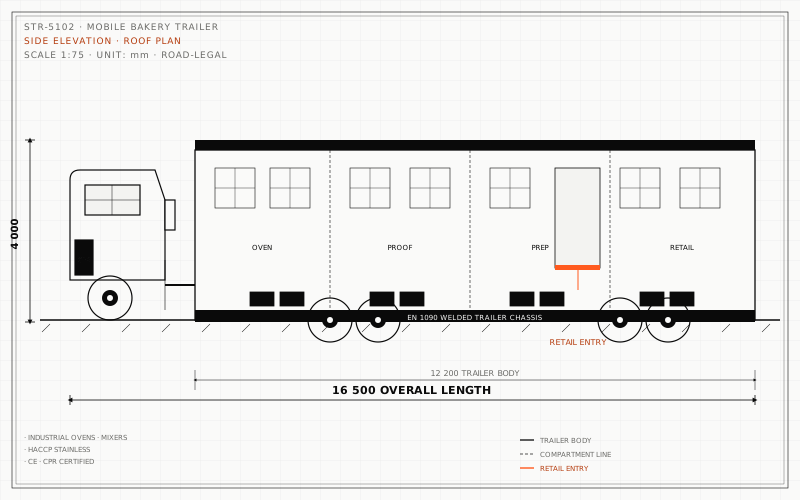
A mobile bakery trailer is a road-deployable bread and pastry production unit configured with industrial baking equipment — mixer, dough divider, proofing chamber, oven, cooling rack and packing infrastructure — in a single integrated trailer. structmod mobile bakery trailers serve military catering operations needing field bakery capability beyond garrison support, humanitarian feeding programmes producing fresh bread for refugee or displaced populations, mining and oil & gas camp catering producing daily fresh bread for resident workforces, and disaster response teams establishing food production capability where commercial bakery infrastructure is destroyed.
Standard configurations produce 500-1,500 loaves per shift depending on equipment specification and team size. Production workflow follows: ingredient receiving and storage zone (refrigerated for yeast and fats, dry for flour and sugar), industrial dough mixer (typical 50-150 kg dough capacity per cycle), dough divider and shaping equipment, proofing chamber with temperature and humidity control (typical 28-32°C, 75-85% relative humidity), oven (deck oven or rotary oven sized to throughput), cooling rack zone, packing line, and finished goods storage. Centralised mechanical bay houses gas supply, water heating, ventilation extract and refrigeration. Operator workspace and supporting facilities (washroom, cleaning equipment store) round out the trailer fit-out.
structmod mobile bakery trailers serve catering programmes where bread production must follow the operational programme — military theatre catering producing fresh bread for deployed troops, humanitarian feeding programmes (UN World Food Programme bakery operations in protracted refugee situations), mining campaign catering producing fresh bread daily for camp residents, and event catering producing artisan bread at festivals and large public events. Lead time is 10-12 weeks from contract signature. Compliance covers ISO 22000 food safety, NFPA 96 ventilation, IEC 60364-1 commercial electrical.
Secuencia de despliegue típica
- Hora 0 — el remolque llega en el vehículo tractor, se posiciona y calza
- Hora 0–1 — gatos estabilizadores desplegados, nivelación verificada
- Hora 1–2 — paredes hidráulicas o extensiones desplegadas donde aplique
- Hora 2–3 — conexiones de servicios (electricidad, agua, aguas residuales)
- Hora 3–4 — prueba funcional según protocolo FAT
- Hora 4 — entrega operacional con formación de usuarios
Spec sheet — STR-2115
| Longitud total | 15.5 m · 50.9 ft |
|---|---|
| Anchura (transporte) | 2,55 m |
| Anchura (desplegado) | 7.50 m |
| Altura (transporte) | 3,00 m |
| Superficie (desplegado) | 116.3 m² |
| Peso en seco | 9.5 t |
| Chasis | Acero laminado en caliente EN 10025 S355JR · EN 1090 EXC-2 |
| Calidad de soldadura | EN ISO 3834-3 |
| Envolvente | Panel sándwich, núcleo PIR 80 mm · λ ≈ 0,023 W/(m·K) |
| Resistencia al fuego | EI-30 · ensayado según EN 13501-2 |
| Suelo | Contrachapado marino sobre EPDM · clasificación antideslizante R-10 |
| Instalación eléctrica | 230 V / 50 Hz · TN-S · conforme IEC 60364 |
| Climatización | Bomba de calor inverter split · MERV-8 |
| Rango de operación | −25 °C a +50 °C ambiente |
| Clasificación de viento | Diseñado para viento básico de 130 km/h (EN 1991-1-4) |
| Transporte | Huella ISO 668 · apto para placa CSC (variantes contenedor) |
| Tiempo de montaje | 2 horas · equipo de 2 personas |
Full drawings, calculation notes, DoP, O&M manual and FAT report included with every unit. Specs indicative — configurable to project requirements.