Engineered once, deployable many times.
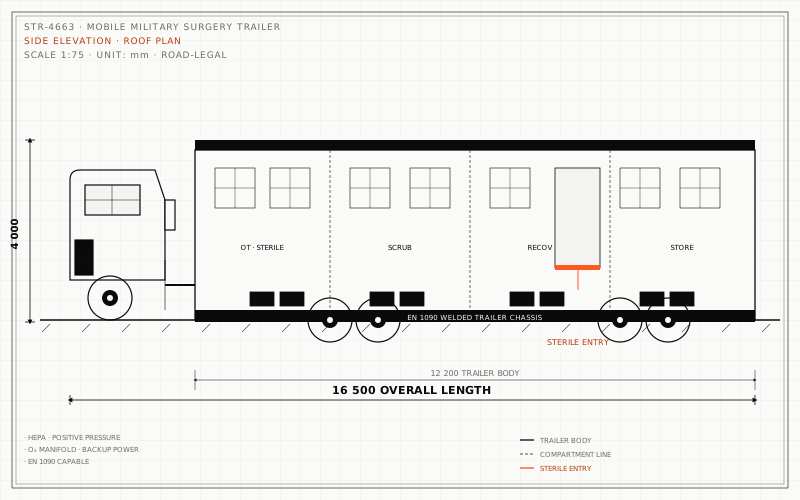
A mobile military surgery trailer is a road-deployable forward surgical facility engineered for damage-control surgery in expeditionary military operations. structmod mobile military surgery trailers deliver NATO Role 2 forward surgical capability — sized to stabilise battlefield casualties before evacuation to higher-echelon care, with the rugged engineering and operational mobility that forward surgical teams (FSTs) and shock trauma platoons require. The trailer-based configuration deploys with the supported formation and positions for damage-control surgery within the 'golden hour' that trauma outcomes depend on.
Standard configurations include the operating theatre (typical 20-25 m² with HEPA H13 ventilation approaching ISO 14644 class 7), anaesthesia workstation with gas scavenging, scrub sink bay at the theatre entrance, clean preparation zone, dirty instrument return, 2-4 bed recovery and patient holding ward, and supporting clinical spaces (medication preparation, sterile stock, biomedical engineering bench). Medical gas reticulation per ISO 9170 with cylinder-bank backup; medical electrical per IEC 60364-7-710 Group 2 with isolated power and UPS; optional ballistic envelope per STANAG 4569 Level III/IV for operations under small-arms threat.
structmod mobile military surgery trailers serve forward surgical teams operating ahead of Role 3 combat support hospitals, shock trauma platoons supporting maneuver units, expeditionary medical forces providing pre-hospital damage control surgery, and humanitarian-military operations where surgical capability must move with the operational picture. Lead time is 12-14 weeks from contract signature for stock configurations, 14-18 weeks for configurations with extended holding, ICU integration, or ballistic envelope. NATO STANAG 2560 medical evaluation criteria, AMedP-9.1 modular medical support principles, and STANAG 2345 MEDEVAC interface compatibility guide the design. Clinical commissioning includes microbiological air sampling and surgical workflow validation before first clinical use.
Secuencia de despliegue típica
- Hora 0 — el remolque llega en el vehículo tractor, se posiciona y calza
- Hora 0–1 — gatos estabilizadores desplegados, nivelación verificada
- Hora 1–2 — paredes hidráulicas o extensiones desplegadas donde aplique
- Hora 2–3 — conexiones de servicios (electricidad, agua, aguas residuales)
- Hora 3–4 — prueba funcional según protocolo FAT
- Hora 4 — entrega operacional con formación de usuarios
Spec sheet — STR-3182
| Longitud total | 14.2 m · 46.6 ft |
|---|---|
| Anchura (transporte) | 2,99 m |
| Anchura (desplegado) | 2,99 m |
| Altura (transporte) | 2,90 m |
| Superficie (desplegado) | 42.5 m² |
| Peso en seco | 14.2 t |
| Chasis | Acero laminado en caliente EN 10025 S355JR · EN 1090 EXC-2 |
| Calidad de soldadura | EN ISO 3834-3 |
| Envolvente | Panel sándwich, núcleo PIR 80 mm · λ ≈ 0,023 W/(m·K) |
| Resistencia al fuego | EI-30 · ensayado según EN 13501-2 |
| Suelo | Contrachapado marino sobre EPDM · clasificación antideslizante R-10 |
| Instalación eléctrica | 120/240 V · 60 Hz (especificación EE.UU.) · conforme IEC 60364 |
| Climatización | Unidad compacta de cubierta · MERV-13 |
| Rango de operación | −25 °C a +50 °C ambiente |
| Clasificación de viento | Diseñado para viento básico de 150 km/h (EN 1991-1-4) |
| Transporte | Huella ISO 668 · apto para placa CSC (variantes contenedor) |
| Tiempo de montaje | 4 horas · equipo de 2 personas |
Full drawings, calculation notes, DoP, O&M manual and FAT report included with every unit. Specs indicative — configurable to project requirements.