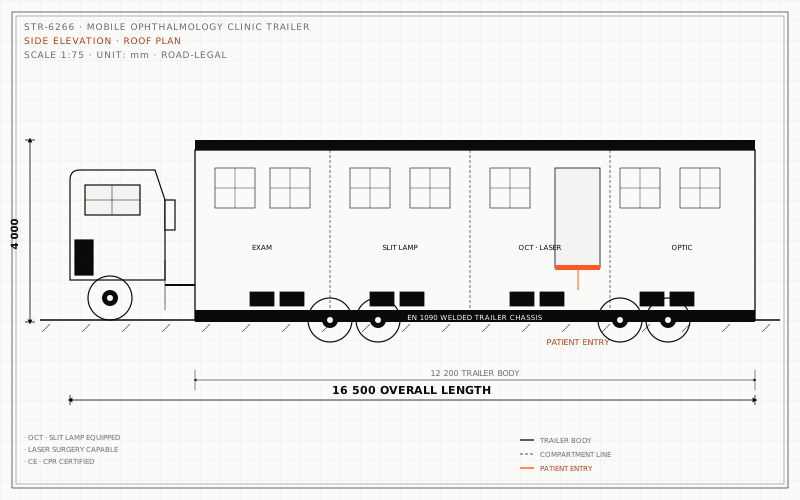
Engineered once, deployable many times.
A mobile ophthalmology clinic trailer brings comprehensive eye care to populations underserved by fixed ophthalmology infrastructure — rural communities with long travel distances to eye clinics, school vision screening programmes, workforce vision health programmes, ageing-population cataract screening, and humanitarian missions addressing preventable blindness in refugee or conflict-affected populations. structmod mobile ophthalmology clinic trailers integrate examination lane, refraction workflow, fundus imaging, slit-lamp biomicroscopy and minor surgical capability into a single road-deployable unit serving 40-80 patients per clinical day.
The standard clinical workflow supports full ophthalmology examination: patient arrival and history taking, visual acuity assessment (distance and near), refraction (subjective and objective with autorefraction), intraocular pressure measurement (tonometry), slit-lamp examination of anterior segment, fundus examination with direct and indirect ophthalmoscopy or fundus camera imaging, and any indicated additional testing (visual fields, OCT where specified). Minor procedures — foreign body removal, chalazion incision, simple eyelid lesion removal — are supported in a treatment bay with appropriate sterilisation and sharps handling. Patient flow through the trailer keeps dilated patients in a subdued-lighting recovery area before discharge.
structmod mobile ophthalmology clinic trailers serve national eye health programmes (cataract screening and surgical referral pathways, trachoma elimination, diabetic retinopathy screening), NGO vision health projects (Orbis, Sightsavers, CBM-supported programmes), corporate occupational vision programmes, and private ophthalmology practices extending outreach. Lead time is 10-12 weeks from contract signature. Specialty equipment integration (OCT, corneal topography, specular microscopy) adds 2-4 weeks to the base timeline depending on equipment complexity.
Secuencia de despliegue típica
- Hora 0 — el remolque llega en el vehículo tractor, se posiciona y calza
- Hora 0–1 — gatos estabilizadores desplegados, nivelación verificada
- Hora 1–2 — paredes hidráulicas o extensiones desplegadas donde aplique
- Hora 2–3 — conexiones de servicios (electricidad, agua, aguas residuales)
- Hora 3–4 — prueba funcional según protocolo FAT
- Hora 4 — entrega operacional con formación de usuarios
Spec sheet — STR-3563
| Longitud total | 12.3 m · 40.4 ft |
|---|---|
| Anchura (transporte) | 2,99 m |
| Anchura (desplegado) | 2,99 m |
| Altura (transporte) | 3.20 m |
| Superficie (desplegado) | 36.8 m² |
| Peso en seco | 17.3 t |
| Chasis | Acero laminado en caliente EN 10025 S355JR · EN 1090 EXC-2 |
| Calidad de soldadura | EN ISO 3834-3 |
| Envolvente | Panel sándwich, núcleo PIR 80 mm · λ ≈ 0,023 W/(m·K) |
| Resistencia al fuego | EI-30 · ensayado según EN 13501-2 |
| Suelo | Contrachapado marino sobre EPDM · clasificación antideslizante R-10 |
| Instalación eléctrica | 120/240 V · 60 Hz (especificación EE.UU.) · conforme IEC 60364 |
| Climatización | Unidad compacta de cubierta · MERV-13 |
| Rango de operación | −25 °C a +50 °C ambiente |
| Clasificación de viento | Diseñado para viento básico de 150 km/h (EN 1991-1-4) |
| Transporte | Huella ISO 668 · apto para placa CSC (variantes contenedor) |
| Tiempo de montaje | 5 horas · equipo de 2 personas |
Full drawings, calculation notes, DoP, O&M manual and FAT report included with every unit. Specs indicative — configurable to project requirements.