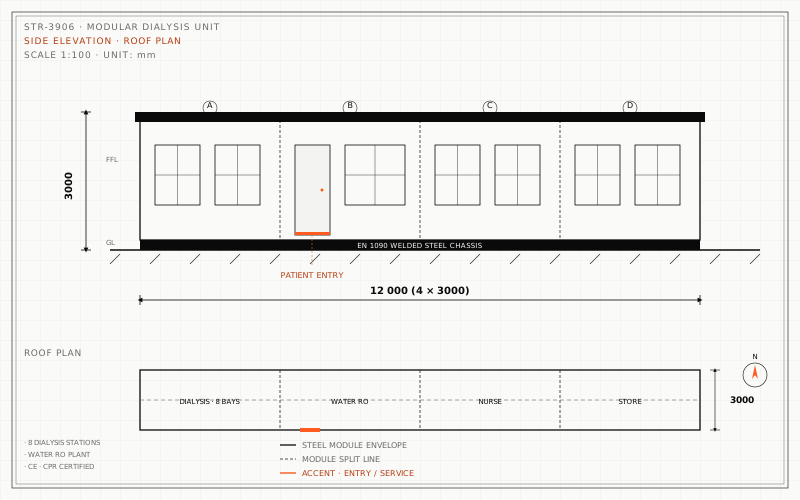
Engineered once, deployable many times.
A modular dialysis unit is a permanent renal care wing built from prefabricated modules with the water treatment plant, central concentrate distribution, dialysis chair stations, nursing infrastructure and supporting clinical workflow already integrated. structmod modular dialysis units deliver renal care capacity in 8, 12 or 24 dialysis station configurations — sized to the catchment population's chronic kidney disease prevalence and the local dialysis programme model. Construction timeline is 12-16 weeks turnkey for a 24-station unit, compared to 12-18 months for a conventionally-built dialysis centre, critical when patient demand outpaces existing fixed-site capacity.
The water treatment plant is the heart of the dialysis unit and the most engineered component. structmod modular dialysis units integrate full reverse osmosis water treatment in a dedicated water plant module: pre-filtration, water softening, RO permeation (typically dual-pass for clinical reliability), post-RO UV treatment, and ring-main delivery loop to each dialysis station. Water quality monitoring and surveillance follow AAMI/ISO 23500 (water for haemodialysis) and EN 13959 (water for dialysis applications): conductivity, chlorine and chloramine, total organic carbon, microbiological count and endotoxin sampling per the standards' frequency. Central bicarbonate and acid concentrate distribution feeds each station through dedicated concentrate loops.
structmod modular dialysis units serve national renal programmes building rural dialysis access, hospital renal services expanding outpatient haemodialysis capacity, private dialysis chains opening new centres, and humanitarian programmes serving refugee populations with established renal failure. Lead time is 12-16 weeks from contract signature for stock configurations, 14-20 weeks for customised programmes. Clinical commissioning includes water quality validation, machine-specific testing and infection control verification before first treatment.
Secuencia de despliegue típica
- Día 1 — cimentación del emplazamiento verificada, gatos de tornillo o zapatas corridas colocados
- Días 2–3 — módulos elevados a posición con grúa móvil
- Días 3–4 — conexiones entre módulos y sellado de envolvente
- Días 4–5 — conexiones MEP, pruebas húmedas
- Días 5–6 — acabados interiores, instalación de accesorios y equipos
- Día 7 — puesta en marcha, informe FAT, formación y entrega
Spec sheet — STR-2160
| Longitud total | 12.0 m · 39.4 ft |
|---|---|
| Anchura (transporte) | 2,99 m |
| Anchura (desplegado) | 2,99 m |
| Altura (transporte) | 2.70 m |
| Superficie (desplegado) | 35.9 m² |
| Peso en seco | 9.0 t |
| Chasis | Acero laminado en caliente EN 10025 S355JR · EN 1090 EXC-2 |
| Calidad de soldadura | EN ISO 3834-3 |
| Envolvente | Panel sándwich, núcleo PIR 80 mm · λ ≈ 0,023 W/(m·K) |
| Resistencia al fuego | EI-30 · ensayado según EN 13501-2 |
| Suelo | Contrachapado marino sobre EPDM · clasificación antideslizante R-10 |
| Instalación eléctrica | 230 V / 50 Hz · TN-S · conforme IEC 60364 |
| Climatización | Bomba de calor inverter split · MERV-8 |
| Rango de operación | −25 °C a +50 °C ambiente |
| Clasificación de viento | Diseñado para viento básico de 130 km/h (EN 1991-1-4) |
| Diseño sísmico | Según EN 1998-1 (Eurocódigo 8) · clase de ductilidad DCM |
| Transporte | Huella ISO 668 · apto para placa CSC (variantes contenedor) |
| Tiempo de montaje | 2 horas · equipo de 2 personas |
Full drawings, calculation notes, DoP, O&M manual and FAT report included with every unit. Specs indicative — configurable to project requirements.