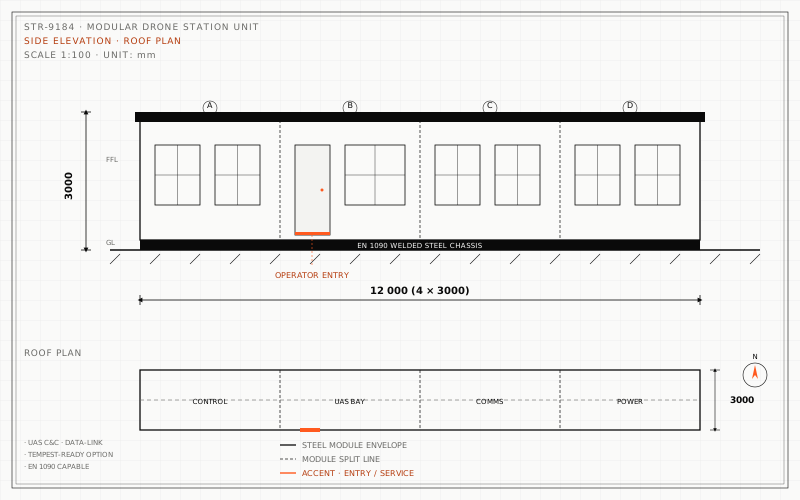
Engineered once, deployable many times.
A modular drone station is a deployable unmanned aircraft system (UAS) operations base built from prefabricated modules with the ground control station, maintenance and storage bays, mission planning workspace, and launch/recovery infrastructure required for sustained drone operations. structmod modular drone stations serve military intelligence, surveillance and reconnaissance (ISR) units, border security forces operating long-range surveillance UAS, commercial drone services (mapping, inspection, agriculture), and emergency response teams using UAS for situational awareness. The modular construction approach allows the drone station to deploy with the operating unit and redeploy as missions change.
Standard configurations organise the station around the UAS operations workflow: ground control station (GCS) module with operator workstations, mission planning displays, video downlink processing, and command-and-control radios; maintenance bay sized to the operating UAS family with workshop infrastructure, parts storage, and battery charging or fuel storage; mission planning room for pre-flight briefings, route planning, target deconfliction, and post-flight intelligence exploitation; aircrew rest area for sustained operations; secure data processing space for downlinked intelligence products. Launch/recovery infrastructure varies by UAS type — runway access for fixed-wing, vertical takeoff zones for rotary-wing or VTOL platforms, catapult mounting for catapult-launched systems.
structmod modular drone stations serve defence ISR units operating Class I-III UAS, border security forces running long-endurance surveillance, commercial drone service operators establishing field bases, and academic/research institutions running UAS research programmes. Lead time is 10-14 weeks from contract signature for stock configurations, 12-16 weeks for configurations including specialty mission planning capability or classified data handling. Compliance includes IEC 60364-1 commercial electrical (military electrical for defence configurations), aviation infrastructure standards per destination country, and EMI/EMC protection for sensitive command-and-control electronics.
Secuencia de despliegue típica
- Día 1 — cimentación del emplazamiento verificada, gatos de tornillo o zapatas corridas colocados
- Días 2–3 — módulos elevados a posición con grúa móvil
- Días 3–4 — conexiones entre módulos y sellado de envolvente
- Días 4–5 — conexiones MEP, pruebas húmedas
- Días 5–6 — acabados interiores, instalación de accesorios y equipos
- Día 7 — puesta en marcha, informe FAT, formación y entrega
Spec sheet — STR-2645
| Longitud total | 12.5 m · 41.0 ft |
|---|---|
| Anchura (transporte) | 2,99 m |
| Anchura (desplegado) | 2,99 m |
| Altura (transporte) | 3.20 m |
| Superficie (desplegado) | 37.4 m² |
| Peso en seco | 17.5 t |
| Chasis | Acero laminado en caliente EN 10025 S355JR · EN 1090 EXC-2 |
| Calidad de soldadura | EN ISO 3834-3 |
| Envolvente | Panel sándwich, núcleo PIR 80 mm · λ ≈ 0,023 W/(m·K) |
| Resistencia al fuego | EI-30 · ensayado según EN 13501-2 |
| Suelo | Contrachapado marino sobre EPDM · clasificación antideslizante R-10 |
| Instalación eléctrica | 120/240 V · 60 Hz (especificación EE.UU.) · conforme IEC 60364 |
| Climatización | Unidad compacta de cubierta · MERV-13 |
| Rango de operación | −25 °C a +50 °C ambiente |
| Clasificación de viento | Diseñado para viento básico de 150 km/h (EN 1991-1-4) |
| Diseño sísmico | Según EN 1998-1 (Eurocódigo 8) · clase de ductilidad DCM |
| Transporte | Huella ISO 668 · apto para placa CSC (variantes contenedor) |
| Tiempo de montaje | 2 horas · equipo de 2 personas |
Full drawings, calculation notes, DoP, O&M manual and FAT report included with every unit. Specs indicative — configurable to project requirements.