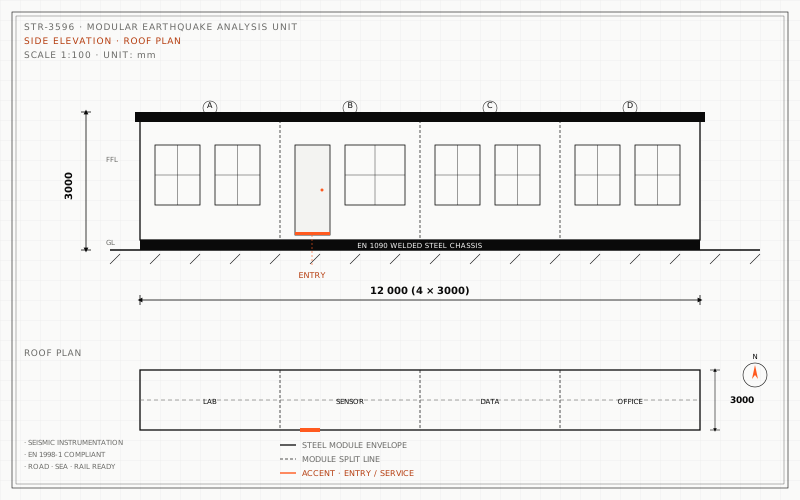
Engineered once, deployable many times.
A modular earthquake analysis unit is a deployable seismic field station built from prefabricated modules with the vibration-isolated foundation, electromagnetic-clean power infrastructure, sensor array and data acquisition workspace required for high-quality seismological monitoring. structmod modular earthquake analysis units serve national earthquake monitoring services (densifying seismograph networks across earthquake-prone regions), university seismology departments (research-quality field stations), aftershock monitoring deployments following major earthquakes, and induced-seismicity monitoring at hydraulic fracturing or geothermal sites.
The vibration-isolated foundation is the most engineered component — the seismograph and accompanying instruments must be decoupled from human activity and ambient vibration to achieve research-quality measurements. structmod modular earthquake analysis units integrate an isolated concrete pier or slab founded on bedrock or stable subsoil, structurally independent from the building floor. Sensor pads accept three-component broadband seismometers, accelerometers (for strong-motion recording during large events), and supplementary instruments (GNSS for crustal deformation, electric and magnetic field sensors where geomagnetic monitoring is included). Clean-power infrastructure delivers electromagnetically-quiet 24V DC for instruments through dedicated battery banks with charge controllers — protecting recordings from grid switching transients.
structmod modular earthquake analysis units serve seismic monitoring programmes worldwide, with particular deployment intensity in earthquake-prone regions: Türkiye (TBDY 2019 seismic monitoring densification following the 2023 Kahramanmaraş earthquakes), the Mediterranean basin, the Caucasus, the Himalayas, the Pacific Ring of Fire, and the East African Rift. Lead time is 10-12 weeks from contract signature. Sensor selection (which broadband seismometer, which strong-motion accelerometer, which timing source) is specified by the operating service against the monitoring programme's frequency band requirements and dynamic range targets. Compliance follows IEC 60364-1 commercial electrical and any operating service technical requirements.
Secuencia de despliegue típica
- Día 1 — cimentación del emplazamiento verificada, gatos de tornillo o zapatas corridas colocados
- Días 2–3 — módulos elevados a posición con grúa móvil
- Días 3–4 — conexiones entre módulos y sellado de envolvente
- Días 4–5 — conexiones MEP, pruebas húmedas
- Días 5–6 — acabados interiores, instalación de accesorios y equipos
- Día 7 — puesta en marcha, informe FAT, formación y entrega
Spec sheet — STR-3274
| Longitud total | 15.4 m · 50.5 ft |
|---|---|
| Anchura (transporte) | 2,99 m |
| Anchura (desplegado) | 2,99 m |
| Altura (transporte) | 3.10 m |
| Superficie (desplegado) | 46.0 m² |
| Peso en seco | 16.4 t |
| Chasis | Acero laminado en caliente EN 10025 S355JR · EN 1090 EXC-2 |
| Calidad de soldadura | EN ISO 3834-3 |
| Envolvente | Panel sándwich, núcleo PIR 80 mm · λ ≈ 0,023 W/(m·K) |
| Resistencia al fuego | EI-30 · ensayado según EN 13501-2 |
| Suelo | Contrachapado marino sobre EPDM · clasificación antideslizante R-10 |
| Instalación eléctrica | 400 V / 50 Hz · trifásico · conforme IEC 60364 |
| Climatización | VRF multi-split · HEPA H13 (médica) |
| Rango de operación | −25 °C a +50 °C ambiente |
| Clasificación de viento | Diseñado para viento básico de 140 km/h (EN 1991-1-4) |
| Diseño sísmico | Según EN 1998-1 (Eurocódigo 8) · clase de ductilidad DCM |
| Transporte | Huella ISO 668 · apto para placa CSC (variantes contenedor) |
| Tiempo de montaje | 2–7 días en obra |
Full drawings, calculation notes, DoP, O&M manual and FAT report included with every unit. Specs indicative — configurable to project requirements.