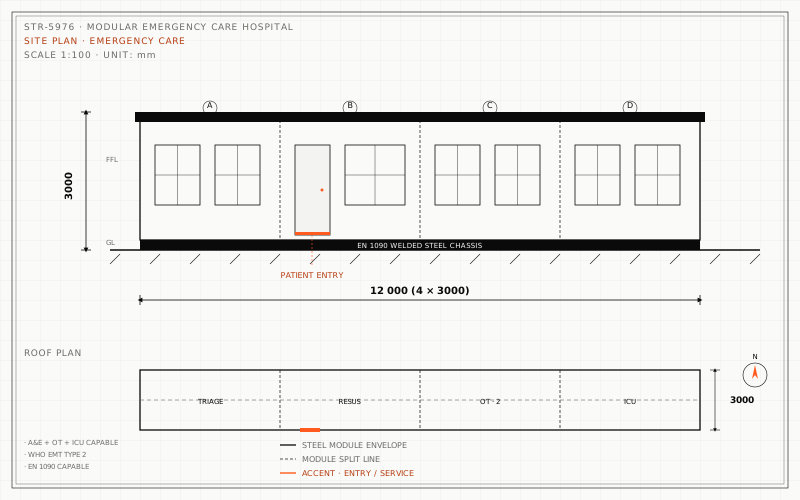
Engineered once, deployable many times.
A modular emergency care hospital is a permanent emergency department wing built from prefabricated modules organised around the standard ED workflow — triage at entry, resuscitation bays for life-threatening presentations, treatment bays for urgent and standard cases, and a short-stay observation area for patients awaiting admission, discharge or transfer. structmod modular emergency care hospitals serve hospitals expanding ED capacity to meet rising patient volumes, replacing aging ED infrastructure during refurbishment, or building new emergency capability at hospitals or stand-alone urgent care centres. The 12-18 week turnkey delivery compresses the conventional 12-24 month ED construction timeline.
Standard configurations include the ambulance entrance with trolley reception, triage cubicles for initial clinical screening, 2-3 resuscitation bays equipped for cardiac arrest, major trauma and airway emergencies (full monitoring, defibrillation, airway management, ventilation, surgical airway capability), 8-16 treatment bays for urgent and standard presentations (examination couches with monitoring, IV access, medication trolleys), a short-stay observation ward (4-12 beds) for patients awaiting decision, supporting clinical spaces (clean and dirty utility, drug room, plaster room, paediatric assessment, mental health assessment cubicle) and ED-specific clinical workflow (POCUS access, x-ray imaging integration, lab sample transport, emergency medication automation).
structmod modular emergency care hospitals deliver to hospitals across Europe, the Gulf and Africa where ED capacity expansion is a priority, to national health programmes building urgent care capability, and to humanitarian agencies establishing emergency referral capacity in extended deployments. Lead time is 14-18 weeks from contract signature for stock configurations, 18-24 weeks for customised configurations including specialty ED capabilities (paediatric ED, mental health crisis service, infectious disease isolation). Clinical commissioning validates emergency workflow, monitoring, life-safety systems and infection control before clinical opening.
Secuencia de despliegue típica
- Día 1 — cimentación del emplazamiento verificada, gatos de tornillo o zapatas corridas colocados
- Días 2–3 — módulos elevados a posición con grúa móvil
- Días 3–4 — conexiones entre módulos y sellado de envolvente
- Días 4–5 — conexiones MEP, pruebas húmedas
- Días 5–6 — acabados interiores, instalación de accesorios y equipos
- Día 7 — puesta en marcha, informe FAT, formación y entrega
Spec sheet — STR-3129
| Longitud total | 12.9 m · 42.3 ft |
|---|---|
| Anchura (transporte) | 2,99 m |
| Anchura (desplegado) | 2,99 m |
| Altura (transporte) | 3,00 m |
| Superficie (desplegado) | 38.6 m² |
| Peso en seco | 15.9 t |
| Chasis | Acero laminado en caliente EN 10025 S355JR · EN 1090 EXC-2 |
| Calidad de soldadura | EN ISO 3834-3 |
| Envolvente | Panel sándwich, núcleo PIR 80 mm · λ ≈ 0,023 W/(m·K) |
| Resistencia al fuego | EI-30 · ensayado según EN 13501-2 |
| Suelo | Contrachapado marino sobre EPDM · clasificación antideslizante R-10 |
| Instalación eléctrica | 230 V / 50 Hz · TN-S · conforme IEC 60364 |
| Climatización | Bomba de calor inverter split · MERV-8 |
| Rango de operación | −25 °C a +50 °C ambiente |
| Clasificación de viento | Diseñado para viento básico de 130 km/h (EN 1991-1-4) |
| Diseño sísmico | Según EN 1998-1 (Eurocódigo 8) · clase de ductilidad DCM |
| Transporte | Huella ISO 668 · apto para placa CSC (variantes contenedor) |
| Tiempo de montaje | 2–7 días en obra |
Full drawings, calculation notes, DoP, O&M manual and FAT report included with every unit. Specs indicative — configurable to project requirements.