Engineered once, deployable many times.
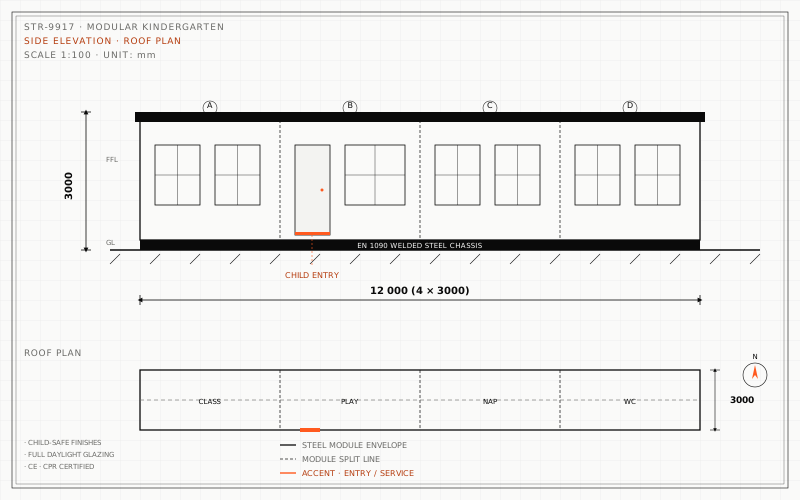
A modular kindergarten is a permanent early-years education facility built from prefabricated modules with the age-appropriate classrooms, play spaces, washrooms, kitchen and outdoor learning interface that nurseries and preschools require. structmod modular kindergartens serve national early-years education programmes (a strategic priority in many countries where kindergarten coverage is being extended), private kindergarten chains opening new locations, employer-sponsored childcare for workforce communities, and humanitarian education programmes serving refugee or displaced young children. The 8-12 week turnkey delivery enables September openings, rapid programme rollout, and post-disaster education continuity.
Standard configurations include age-grouped classrooms (typically 40-60 m² for 15-25 children depending on age group — 0-2 years younger toddlers, 2-3 years older toddlers, 3-5 years preschool), indoor play hall for active play in poor weather, age-appropriate washrooms with low-height fixtures, sleep/quiet area for younger children's nap times, kitchen sized for child meals (full meal preparation or warming-up depending on programme), reception and parent meet-and-greet area, staff room and administrative office, secure outdoor play area interface (the outdoor play equipment itself is supplied separately), and supporting infrastructure. Safety features include low window sills with appropriate restrictors, soft-edge furniture, electrical outlets at adult height with covers, and secure entrance/exit control.
structmod modular kindergartens serve education ministries extending early-years coverage in growing populations and underserved areas, employer-sponsored childcare programmes (a growing sector as employers compete for workforce), refugee education programmes through UNHCR and education NGOs, and post-disaster reconstruction restoring early-years infrastructure. Compliance includes destination-country building code, fire safety and life safety per appropriate national standard, child safety regulations specific to early-years education, kitchen food safety per HACCP/ISO 22000, and accessibility for children with disabilities. Lead time is 8-12 weeks from contract signature for stock configurations, 12-14 weeks for customised configurations.
Secuencia de despliegue típica
- Día 1 — cimentación del emplazamiento verificada, gatos de tornillo o zapatas corridas colocados
- Días 2–3 — módulos elevados a posición con grúa móvil
- Días 3–4 — conexiones entre módulos y sellado de envolvente
- Días 4–5 — conexiones MEP, pruebas húmedas
- Días 5–6 — acabados interiores, instalación de accesorios y equipos
- Día 7 — puesta en marcha, informe FAT, formación y entrega
Spec sheet — STR-2079
| Longitud total | 15.9 m · 52.2 ft |
|---|---|
| Anchura (transporte) | 2,99 m |
| Anchura (desplegado) | 2,99 m |
| Altura (transporte) | 3,00 m |
| Superficie (desplegado) | 47.5 m² |
| Peso en seco | 9.9 t |
| Chasis | Acero laminado en caliente EN 10025 S355JR · EN 1090 EXC-2 |
| Calidad de soldadura | EN ISO 3834-3 |
| Envolvente | Panel sándwich, núcleo PIR 80 mm · λ ≈ 0,023 W/(m·K) |
| Resistencia al fuego | EI-30 · ensayado según EN 13501-2 |
| Suelo | Contrachapado marino sobre EPDM · clasificación antideslizante R-10 |
| Instalación eléctrica | 230 V / 50 Hz · TN-S · conforme IEC 60364 |
| Climatización | Bomba de calor inverter split · MERV-8 |
| Rango de operación | −25 °C a +50 °C ambiente |
| Clasificación de viento | Diseñado para viento básico de 130 km/h (EN 1991-1-4) |
| Diseño sísmico | Según EN 1998-1 (Eurocódigo 8) · clase de ductilidad DCM |
| Transporte | Huella ISO 668 · apto para placa CSC (variantes contenedor) |
| Tiempo de montaje | 2–7 días en obra |
Full drawings, calculation notes, DoP, O&M manual and FAT report included with every unit. Specs indicative — configurable to project requirements.