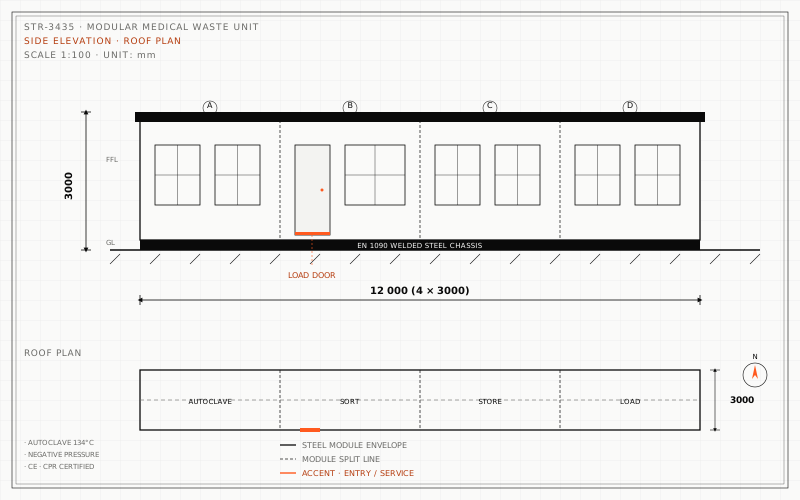
Engineered once, deployable many times.
A modular medical waste unit treats clinical waste at the point of care — sterilising infectious material in an autoclave and reducing volume through shredding before final disposal. structmod modular medical waste units serve hospitals managing their own clinical waste stream rather than relying on external disposal contractors, field hospitals operating in remote locations without established waste infrastructure, and humanitarian programmes treating waste in disaster or conflict settings. The modular unit handles the standard clinical waste streams — sharps, infectious soft waste, anatomical waste, pharmaceutical waste — through a combined autoclaving and shredding process that renders waste safe and reduces disposal volume by 70-80%.
The treatment workflow is engineered around safety and operator protection: clinical waste arrives at the unit in colour-coded bags or sharps bins per the segregation protocol; loading into the autoclave chamber happens through a sealed loading bay protecting the operator from exposure; the autoclave cycle (typically 134°C for 18 minutes or equivalent dwell time) sterilises all infectious material to log-6 reduction of bacterial spore challenges per EN 285 or ISO 17665; treated waste transfers to the integrated shredder reducing it to fragments under 25 mm; the shredded sterile output goes to standard municipal waste stream rather than requiring specialist clinical waste disposal. Operator protection includes PPE workflow, eyewash, emergency shower, and cycle-failure alarms.
structmod modular medical waste units deliver to hospitals seeking to internalise clinical waste management for cost or sovereignty reasons, to military and humanitarian field hospitals where external waste contractor services don't exist, to specialty facilities (research labs, clinical trial sites, burns units) generating high-volume specialist waste streams, and to national health programmes building distributed waste treatment infrastructure. Lead time is 10-12 weeks from contract signature. Compliance includes EN 285 / ISO 17665 autoclave validation, WHO Safe Management of Wastes from Health-Care Activities guidance, and EU Waste Framework Directive (2008/98/EC) for European deployments.
Secuencia de despliegue típica
- Día 1 — cimentación del emplazamiento verificada, gatos de tornillo o zapatas corridas colocados
- Días 2–3 — módulos elevados a posición con grúa móvil
- Días 3–4 — conexiones entre módulos y sellado de envolvente
- Días 4–5 — conexiones MEP, pruebas húmedas
- Días 5–6 — acabados interiores, instalación de accesorios y equipos
- Día 7 — puesta en marcha, informe FAT, formación y entrega
Spec sheet — STR-2606
| Longitud total | 12.6 m · 41.3 ft |
|---|---|
| Anchura (transporte) | 2,99 m |
| Anchura (desplegado) | 2,99 m |
| Altura (transporte) | 2,90 m |
| Superficie (desplegado) | 37.7 m² |
| Peso en seco | 14.6 t |
| Chasis | Acero laminado en caliente EN 10025 S355JR · EN 1090 EXC-2 |
| Calidad de soldadura | EN ISO 3834-3 |
| Envolvente | Panel sándwich, núcleo PIR 80 mm · λ ≈ 0,023 W/(m·K) |
| Resistencia al fuego | EI-30 · ensayado según EN 13501-2 |
| Suelo | Contrachapado marino sobre EPDM · clasificación antideslizante R-10 |
| Instalación eléctrica | 120/240 V · 60 Hz (especificación EE.UU.) · conforme IEC 60364 |
| Climatización | Unidad compacta de cubierta · MERV-13 |
| Rango de operación | −25 °C a +50 °C ambiente |
| Clasificación de viento | Diseñado para viento básico de 150 km/h (EN 1991-1-4) |
| Diseño sísmico | Según EN 1998-1 (Eurocódigo 8) · clase de ductilidad DCM |
| Transporte | Huella ISO 668 · apto para placa CSC (variantes contenedor) |
| Tiempo de montaje | 3 horas · equipo de 2 personas |
Full drawings, calculation notes, DoP, O&M manual and FAT report included with every unit. Specs indicative — configurable to project requirements.