Engineered once, deployable many times.
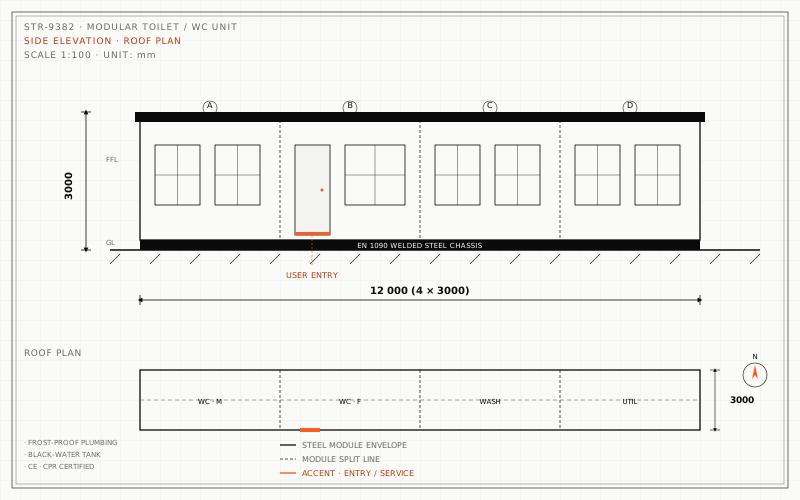
A modular toilet and WC unit is a permanent or relocatable sanitary block assembled from prefabricated modules with the toilet cubicles, urinals, hand-wash basins, plumbing infrastructure and ventilation pre-installed and tested. structmod modular toilet and WC units serve workforce camp ablution requirements (where shower blocks and toilet blocks deploy as separate buildings), event venue sanitary infrastructure, school and educational facility washrooms, public space sanitary provision (parks, transport hubs, tourism sites), and humanitarian deployment sanitary infrastructure. The 6-10 week turnkey delivery is critical when sanitary capacity drives camp or event readiness.
Standard configurations support 4, 8, 12, 16 or 20 plumbing fixtures depending on serving population. Fixture mix typically follows: male side (1 toilet cubicle + 2 urinals + 1 hand-wash basin per 4 users for typical workforce planning), female side (2 toilet cubicles + 1 hand-wash basin per 4 users), accessibility-compliant cubicle (1 per fixture group with appropriate space, grab rails and door width), and family/baby-change cubicle for public-use installations. Plumbing infrastructure follows destination-country plumbing code with appropriate water supply, hot water for hand-washing where specified, drainage to mains sewer or onboard holding tank, ventilation extract from toilet zone (typical 8-12 air changes per hour), and accessible/maintenance access to plumbing infrastructure.
structmod modular toilet and WC units deploy across many use cases — workforce camp standalone toilet blocks (separate from shower blocks where male/female ratios or use patterns require), event venue temporary toilet provision (festivals, sporting events, public assemblies), educational facility additions (school washroom expansion as enrollment grows), public space sanitary provision (parks, beaches, transit interchanges, tourist sites), and humanitarian deployment (refugee camp sanitation per UNHCR/Sphere standards). Lead time is 6-10 weeks from contract signature for stock configurations. EN 1090 EXC-2 structural, IEC 60364-7-701 medical electrical for wet-area installations, plumbing per destination-country code, accessibility per ADA equivalent.
Secuencia de despliegue típica
- Día 1 — cimentación del emplazamiento verificada, gatos de tornillo o zapatas corridas colocados
- Días 2–3 — módulos elevados a posición con grúa móvil
- Días 3–4 — conexiones entre módulos y sellado de envolvente
- Días 4–5 — conexiones MEP, pruebas húmedas
- Días 5–6 — acabados interiores, instalación de accesorios y equipos
- Día 7 — puesta en marcha, informe FAT, formación y entrega
Spec sheet — STR-2214
| Longitud total | 13.4 m · 44.0 ft |
|---|---|
| Anchura (transporte) | 2,99 m |
| Anchura (desplegado) | 2,99 m |
| Altura (transporte) | 2.70 m |
| Superficie (desplegado) | 40.1 m² |
| Peso en seco | 9.4 t |
| Chasis | Acero laminado en caliente EN 10025 S355JR · EN 1090 EXC-2 |
| Calidad de soldadura | EN ISO 3834-3 |
| Envolvente | Panel sándwich, núcleo PIR 80 mm · λ ≈ 0,023 W/(m·K) |
| Resistencia al fuego | EI-30 · ensayado según EN 13501-2 |
| Suelo | Contrachapado marino sobre EPDM · clasificación antideslizante R-10 |
| Instalación eléctrica | 230 V / 50 Hz · TN-S · conforme IEC 60364 |
| Climatización | Bomba de calor inverter split · MERV-8 |
| Rango de operación | −25 °C a +50 °C ambiente |
| Clasificación de viento | Diseñado para viento básico de 130 km/h (EN 1991-1-4) |
| Diseño sísmico | Según EN 1998-1 (Eurocódigo 8) · clase de ductilidad DCM |
| Transporte | Huella ISO 668 · apto para placa CSC (variantes contenedor) |
| Tiempo de montaje | 2–7 días en obra |
Full drawings, calculation notes, DoP, O&M manual and FAT report included with every unit. Specs indicative — configurable to project requirements.