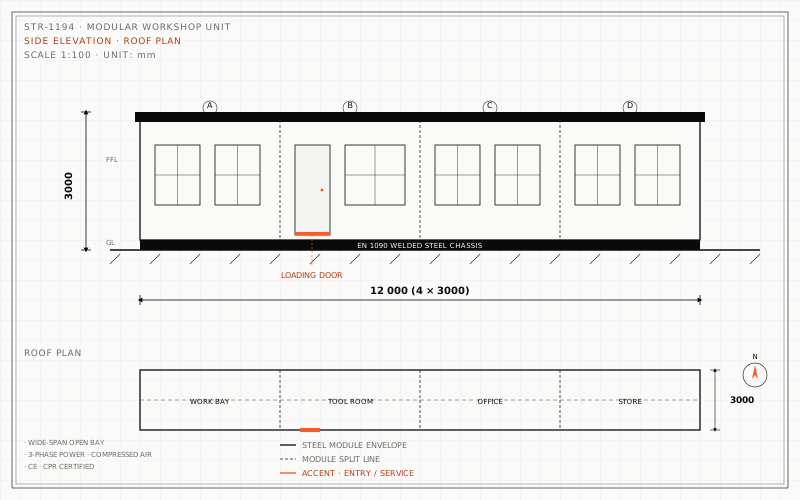
Engineered once, deployable many times.
A modular workshop unit is a heavy-duty industrial facility built from prefabricated modules with the structural capacity, electrical infrastructure, ventilation and equipment provisions required for industrial workshop operations — vehicle and equipment maintenance, metal fabrication and welding, mechanical assembly, electrical assembly, woodworking, or specialised manufacturing. structmod modular workshop units serve mining and oil & gas operators establishing site maintenance facilities, defence forces standing up vehicle workshops at deployed bases, manufacturing companies establishing production lines at new locations, and infrastructure projects (construction, utilities) requiring on-site workshop capability.
Standard configurations include workshop bays sized to the equipment being serviced (typically 6-8 m clear height for large vehicle access, 4-6 m for general workshop use), 3-phase electrical infrastructure sized to workshop equipment load (typical 80-200 kVA per workshop bay), compressed air distribution to multiple service points, exhaust extraction for welding fume and engine emissions per EN 12792 and EN ISO 16110-2, overhead crane support beam where lifting capability is required (typical 2-5 tonne crane capacity), parts and tool storage with appropriate security, office and administration space for workshop management, and lockers/changing facilities for workshop staff. Workshop floor finish is heavy-duty concrete or epoxy resin per equipment access and chemical resistance requirements.
structmod modular workshop units serve operators across mining, oil & gas, defence, manufacturing and infrastructure where workshop capability needs to deploy with the operating site. Lead time is 10-14 weeks from contract signature for stock configurations, 12-16 weeks for configurations with overhead crane integration or specialty equipment provisions. EN 1090 EXC-2 structural steel sized to the workshop loads (including crane loads where fitted), IEC 60364-1 commercial/industrial electrical with appropriate earth fault protection, fire safety per workshop fire-load classification, and ventilation per industrial ventilation standards.
Secuencia de despliegue típica
- Día 1 — cimentación del emplazamiento verificada, gatos de tornillo o zapatas corridas colocados
- Días 2–3 — módulos elevados a posición con grúa móvil
- Días 3–4 — conexiones entre módulos y sellado de envolvente
- Días 4–5 — conexiones MEP, pruebas húmedas
- Días 5–6 — acabados interiores, instalación de accesorios y equipos
- Día 7 — puesta en marcha, informe FAT, formación y entrega
Spec sheet — STR-2187
| Longitud total | 14.7 m · 48.2 ft |
|---|---|
| Anchura (transporte) | 2,99 m |
| Anchura (desplegado) | 2,99 m |
| Altura (transporte) | 3,00 m |
| Superficie (desplegado) | 44.0 m² |
| Peso en seco | 9.7 t |
| Chasis | Acero laminado en caliente EN 10025 S355JR · EN 1090 EXC-2 |
| Calidad de soldadura | EN ISO 3834-3 |
| Envolvente | Panel sándwich, núcleo PIR 80 mm · λ ≈ 0,023 W/(m·K) |
| Resistencia al fuego | EI-30 · ensayado según EN 13501-2 |
| Suelo | Contrachapado marino sobre EPDM · clasificación antideslizante R-10 |
| Instalación eléctrica | 230 V / 50 Hz · TN-S · conforme IEC 60364 |
| Climatización | Bomba de calor inverter split · MERV-8 |
| Rango de operación | −25 °C a +50 °C ambiente |
| Clasificación de viento | Diseñado para viento básico de 130 km/h (EN 1991-1-4) |
| Diseño sísmico | Según EN 1998-1 (Eurocódigo 8) · clase de ductilidad DCM |
| Transporte | Huella ISO 668 · apto para placa CSC (variantes contenedor) |
| Tiempo de montaje | 4 horas · equipo de 2 personas |
Full drawings, calculation notes, DoP, O&M manual and FAT report included with every unit. Specs indicative — configurable to project requirements.