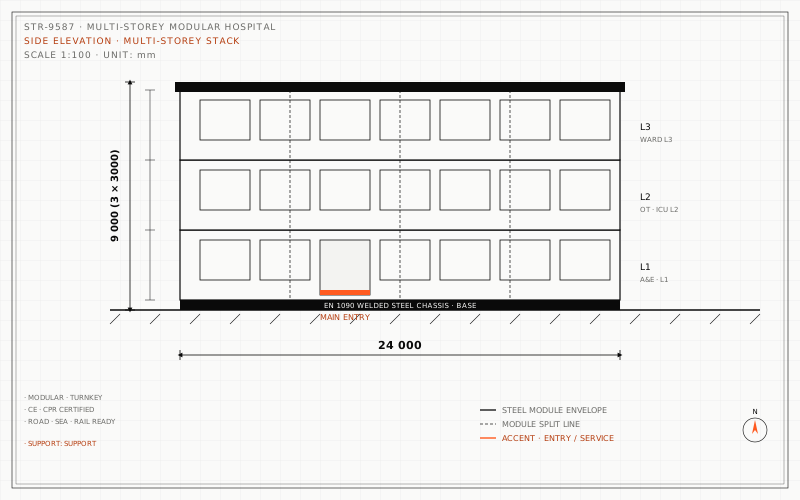
Engineered once, deployable many times.
A multi-storey modular hospital is a 3-6 storey healthcare facility assembled from volumetric prefabricated modules on a primary structural steel frame. This construction approach is the standard solution for mid-size urban hospitals where site footprint is limited, permanent construction is required, and the project timeline must compress the conventional 30-48 month hospital construction schedule into 12-18 months. structmod multi-storey modular hospitals deliver on all three constraints without compromising clinical performance, lifecycle durability, or compliance with ministry-of-health standards.
The typical layout places high-dependency clinical functions — emergency, surgery, ICU, imaging, sterile services — on the ground and first floors for fastest access and heaviest services demand. Ward floors occupy storeys 2-5 with wings radiating from a central service core housing lifts, stairs, MEP risers, and staff circulation. A rooftop plant deck carries HVAC, water tanks, solar, medical gas reticulation and helicopter landing pad where specified. The primary structural steel frame is erected site-first, modules infill the frame over 8-16 weeks, and finishes plus commissioning complete the final 4-6 months.
structmod delivers multi-storey modular hospitals to national health ministries, university teaching hospitals, private healthcare chains and international development partners. Completed projects include a 6-storey / 340-module / 120-bed regional referral hospital in northern Iraq, a 4-storey / 80-bed maternity and paediatric hospital in East Africa, and a 5-storey / 200-bed expansion wing integrated into an existing tertiary hospital campus. Each project is engineered to destination country building codes, Eurocode 8 seismic, fire compartmentation per EN 13501, and medical electrical per IEC 60364-7-710.
Secuencia de despliegue típica
- Mes 1 — preparación del emplazamiento, obras de cimentación, zanjas de servicios
- Meses 2–3 — erección de la estructura de acero principal (EN 1090)
- Meses 3–5 — cierre de envolvente, cubierta, muro cortina
- Meses 5–7 — preinstalación MEP, gas médico, alimentación de emergencia
- Meses 7–10 — equipamiento interior, instalación de equipos
- Meses 10–12 — puesta en marcha, FAT/SAT, formación de usuarios
- Mes 12 — entrega clínica con dossier completo de O&M
Spec sheet — STR-2992
| Longitud total | 15.2 m · 49.9 ft |
|---|---|
| Anchura (transporte) | 2,99 m |
| Anchura (desplegado) | 2,99 m |
| Altura (transporte) | 3.10 m |
| Superficie (desplegado) | 45.4 m² |
| Peso en seco | 13.2 t |
| Chasis | Acero laminado en caliente EN 10025 S355JR · EN 1090 |
| Calidad de soldadura | EN ISO 3834-2 · coordinador de soldadura certificado (IWE) |
| Envolvente | Panel sándwich, núcleo PIR 80 mm · λ ≈ 0,023 W/(m·K) |
| Resistencia al fuego | EI-30 · ensayado según EN 13501-2 |
| Suelo | Contrachapado marino sobre EPDM · clasificación antideslizante R-10 |
| Instalación eléctrica | 400 V / 50 Hz · trifásico · conforme IEC 60364 |
| Climatización | VRF multi-split · HEPA H13 (médica) |
| Rango de operación | −25 °C a +50 °C ambiente |
| Clasificación de viento | Diseñado para viento básico de 140 km/h (EN 1991-1-4) |
| Diseño sísmico | Según EN 1998-1 (Eurocódigo 8) · clase de ductilidad DCM |
| Transporte | Huella ISO 668 · apto para placa CSC (variantes contenedor) |
| Tiempo de montaje | 4 horas · equipo de 2 personas |
Full drawings, calculation notes, DoP, O&M manual and FAT report included with every unit. Specs indicative — configurable to project requirements.