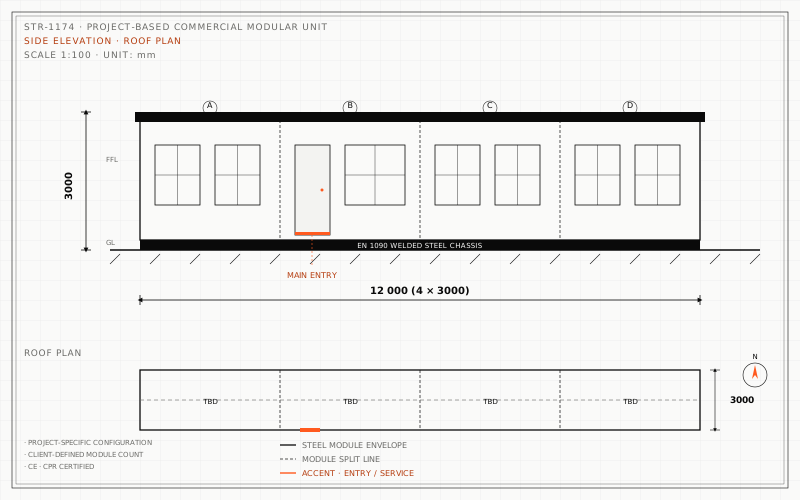
Engineered once, deployable many times.
A project-based commercial modular unit is a fully custom modular building engineered to a specific client brief — site constraints, architectural vision, commercial programme, fit-out standard — rather than drawn from a standard catalogue. structmod design-build engineering handles every stage from initial concept sketches through detail engineering, factory production, logistics, site assembly, MEP commissioning and handover, taking commercial accountability for the complete project outcome rather than a discrete component.
Typical project-based briefs include corporate headquarters buildings on constrained urban sites, flagship retail stores with distinctive architectural identity, boutique hospitality units (20-60 room hotels, branded resorts), mixed-use buildings combining ground-floor retail with upper-floor offices or apartments, and specialised commercial buildings (broadcasting studios, training centres, showrooms) with unique functional requirements. Each project begins with a design workshop where the structmod engineering team, your architect, and your commercial team work through requirements, constraints, site conditions and target programme to produce a module schedule and technical proposal.
Design-build delivery means structmod takes single-point responsibility for the complete project — no separation between architect, engineer, manufacturer, and contractor. This eliminates the interface risk that drives overruns on conventional commercial construction and enables the full benefits of modular: predictable schedule, fixed-price delivery, and factory-quality finishes. Typical project-based commercial modular unit delivers in 8-14 months from contract to operational handover, with factory production running in parallel with site works. Every project includes EN 1090 structural documentation, Eurocode 8 seismic analysis, destination-country fire compliance, and CE-marked components throughout.
Secuencia de despliegue típica
- Mes 1 — preparación del emplazamiento, obras de cimentación, zanjas de servicios
- Meses 2–3 — erección de la estructura de acero principal (EN 1090)
- Meses 3–5 — cierre de envolvente, cubierta, muro cortina
- Meses 5–7 — preinstalación MEP, gas médico, alimentación de emergencia
- Meses 7–10 — equipamiento interior, instalación de equipos
- Meses 10–12 — puesta en marcha, FAT/SAT, formación de usuarios
- Mes 12 — entrega clínica con dossier completo de O&M
Spec sheet — STR-3706
| Longitud total | 14.6 m · 47.9 ft |
|---|---|
| Anchura (transporte) | 2,99 m |
| Anchura (desplegado) | 2,99 m |
| Altura (transporte) | 3.10 m |
| Superficie (desplegado) | 43.7 m² |
| Peso en seco | 16.6 t |
| Chasis | Acero laminado en caliente EN 10025 S355JR · EN 1090 |
| Calidad de soldadura | EN ISO 3834-2 · coordinador de soldadura certificado (IWE) |
| Envolvente | Panel sándwich, núcleo PIR 80 mm · λ ≈ 0,023 W/(m·K) |
| Resistencia al fuego | EI-30 · ensayado según EN 13501-2 |
| Suelo | Contrachapado marino sobre EPDM · clasificación antideslizante R-10 |
| Instalación eléctrica | 400 V / 50 Hz · trifásico · conforme IEC 60364 |
| Climatización | VRF multi-split · HEPA H13 (médica) |
| Rango de operación | −25 °C a +50 °C ambiente |
| Clasificación de viento | Diseñado para viento básico de 140 km/h (EN 1991-1-4) |
| Diseño sísmico | Según EN 1998-1 (Eurocódigo 8) · clase de ductilidad DCM |
| Transporte | Huella ISO 668 · apto para placa CSC (variantes contenedor) |
| Tiempo de montaje | 3 horas · equipo de 2 personas |
Full drawings, calculation notes, DoP, O&M manual and FAT report included with every unit. Specs indicative — configurable to project requirements.