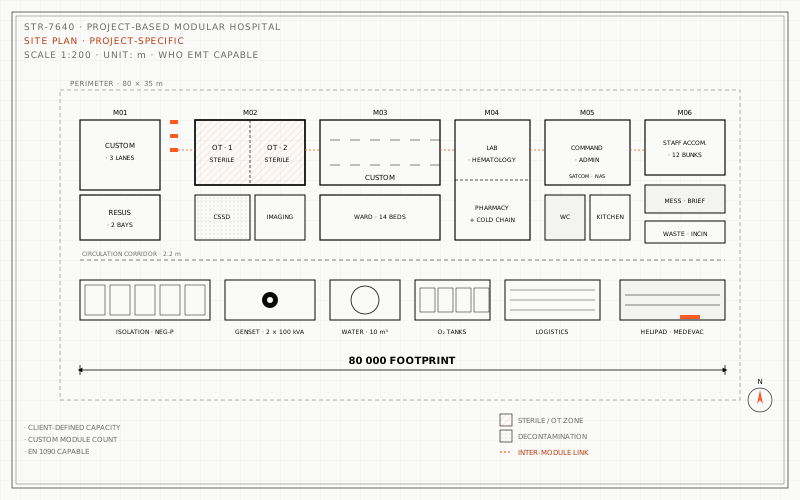
Engineered once, deployable many times.
A project-based modular hospital is a custom-engineered healthcare facility built to the specific clinical brief of the procuring authority — ministry of health, university teaching hospital, private healthcare operator, or international development partner. structmod design-build delivery begins with the functional programme (departmental schedule, bed mix, case mix, outpatient throughput, diagnostic capability) and ends with a commissioned, clinically-certified hospital that matches the brief exactly — not a standard catalogue product adapted to the site.
The design process starts with a clinical workshop where structmod medical planners, your clinical team, the host-country ministry of health representative, and any retained consultants (infection control, medical equipment, biomedical engineering) work through the functional programme floor by floor, room by room, until every clinical adjacency, utility requirement, equipment footprint and compliance standard is documented. This becomes the design brief that drives architecture, structural, MEP, and fit-out engineering through to the full tender package. Every decision is traceable to a clinical or compliance requirement, which protects the project from scope creep and de-risks approval processes.
structmod delivers project-based modular hospitals across healthcare niches: primary care and outpatient-focused hospitals (typically 20-80 beds), district general hospitals with comprehensive secondary care (80-200 beds), tertiary referral hospitals with specialty services (200-500 beds), specialty hospitals (cardiac, maternity, paediatric, oncology) and expansion wings integrated into existing hospital campuses. Every project is engineered to destination-country building codes, Eurocode 8 seismic, IEC 60364-7-710 medical electrical, ministry-of-health departmental standards, and applicable infection control guidelines (CDC, ECDC, HBN UK, or national equivalent). Lead time is 8-18 months from contract signature depending on project scale and regulatory complexity.
Secuencia de despliegue típica
- Mes 1 — preparación del emplazamiento, obras de cimentación, zanjas de servicios
- Meses 2–3 — erección de la estructura de acero principal (EN 1090)
- Meses 3–5 — cierre de envolvente, cubierta, muro cortina
- Meses 5–7 — preinstalación MEP, gas médico, alimentación de emergencia
- Meses 7–10 — equipamiento interior, instalación de equipos
- Meses 10–12 — puesta en marcha, FAT/SAT, formación de usuarios
- Mes 12 — entrega clínica con dossier completo de O&M
Spec sheet — STR-3029
| Longitud total | 14.9 m · 48.9 ft |
|---|---|
| Anchura (transporte) | 2,99 m |
| Anchura (desplegado) | 2,99 m |
| Altura (transporte) | 3.20 m |
| Superficie (desplegado) | 44.6 m² |
| Peso en seco | 14.9 t |
| Chasis | Acero laminado en caliente EN 10025 S355JR · EN 1090 |
| Calidad de soldadura | EN ISO 3834-2 · coordinador de soldadura certificado (IWE) |
| Envolvente | Panel sándwich, núcleo PIR 80 mm · λ ≈ 0,023 W/(m·K) |
| Resistencia al fuego | EI-30 · ensayado según EN 13501-2 |
| Suelo | Contrachapado marino sobre EPDM · clasificación antideslizante R-10 |
| Instalación eléctrica | 120/240 V · 60 Hz (especificación EE.UU.) · conforme IEC 60364 |
| Climatización | Unidad compacta de cubierta · MERV-13 |
| Rango de operación | −25 °C a +50 °C ambiente |
| Clasificación de viento | Diseñado para viento básico de 150 km/h (EN 1991-1-4) |
| Diseño sísmico | Según EN 1998-1 (Eurocódigo 8) · clase de ductilidad DCM |
| Transporte | Huella ISO 668 · apto para placa CSC (variantes contenedor) |
| Tiempo de montaje | 4–16 semanas en obra |
Full drawings, calculation notes, DoP, O&M manual and FAT report included with every unit. Specs indicative — configurable to project requirements.