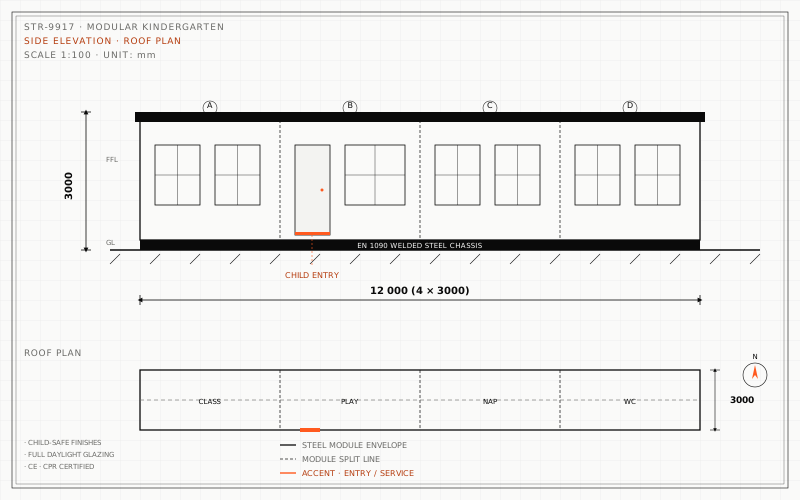
Engineered once, deployable many times.
A modular kindergarten is a permanent early-years education facility built from prefabricated modules with the age-appropriate classrooms, play spaces, washrooms, kitchen and outdoor learning interface that nurseries and preschools require. structmod modular kindergartens serve national early-years education programmes (a strategic priority in many countries where kindergarten coverage is being extended), private kindergarten chains opening new locations, employer-sponsored childcare for workforce communities, and humanitarian education programmes serving refugee or displaced young children. The 8-12 week turnkey delivery enables September openings, rapid programme rollout, and post-disaster education continuity.
Standard configurations include age-grouped classrooms (typically 40-60 m² for 15-25 children depending on age group — 0-2 years younger toddlers, 2-3 years older toddlers, 3-5 years preschool), indoor play hall for active play in poor weather, age-appropriate washrooms with low-height fixtures, sleep/quiet area for younger children's nap times, kitchen sized for child meals (full meal preparation or warming-up depending on programme), reception and parent meet-and-greet area, staff room and administrative office, secure outdoor play area interface (the outdoor play equipment itself is supplied separately), and supporting infrastructure. Safety features include low window sills with appropriate restrictors, soft-edge furniture, electrical outlets at adult height with covers, and secure entrance/exit control.
structmod modular kindergartens serve education ministries extending early-years coverage in growing populations and underserved areas, employer-sponsored childcare programmes (a growing sector as employers compete for workforce), refugee education programmes through UNHCR and education NGOs, and post-disaster reconstruction restoring early-years infrastructure. Compliance includes destination-country building code, fire safety and life safety per appropriate national standard, child safety regulations specific to early-years education, kitchen food safety per HACCP/ISO 22000, and accessibility for children with disabilities. Lead time is 8-12 weeks from contract signature for stock configurations, 12-14 weeks for customised configurations.
Typical deployment sequence
- Day 1 — site foundation verified, screw jacks or strip footings in place
- Day 2–3 — modules lifted into position by mobile crane
- Day 3–4 — inter-module connections and envelope sealing
- Day 4–5 — MEP connections, wet testing
- Day 5–6 — interior finish, fixtures and equipment install
- Day 7 — commissioning, FAT report, user training and handover
Spec sheet — STR-2079
| Overall length | 15.9 m · 52.2 ft |
|---|---|
| Width (transport) | 2.99 m |
| Width (deployed) | 2.99 m |
| Height (transport) | 3.00 m |
| Floor area (deployed) | 47.5 m² |
| Dry weight | 9.9 t |
| Chassis | EN 10025 S355JR hot-rolled steel · EN 1090 EXC-2 |
| Welding quality | EN ISO 3834-3 |
| Envelope | Sandwich panel, PIR core 80 mm · λ ≈ 0.023 W/(m·K) |
| Fire resistance | EI-30 · tested to EN 13501-2 |
| Floor | Marine plywood on EPDM · R-10 slip rating |
| Electrical | 230 V / 50 Hz · TN-S · IEC 60364 compliant |
| HVAC | Split inverter heat pump · MERV-8 |
| Operating range | −25 °C to +50 °C ambient |
| Wind rating | Designed for 130 km/h basic wind (EN 1991-1-4) |
| Seismic design | Per EN 1998-1 (Eurocode 8) · ductility class DCM |
| Transport | ISO 668 footprint · CSC plate eligible (container variants) |
| Setup time | 2–7 days on site |
Full drawings, calculation notes, DoP, O&M manual and FAT report included with every unit. Specs indicative — configurable to project requirements.