Engineered once, deployable many times.
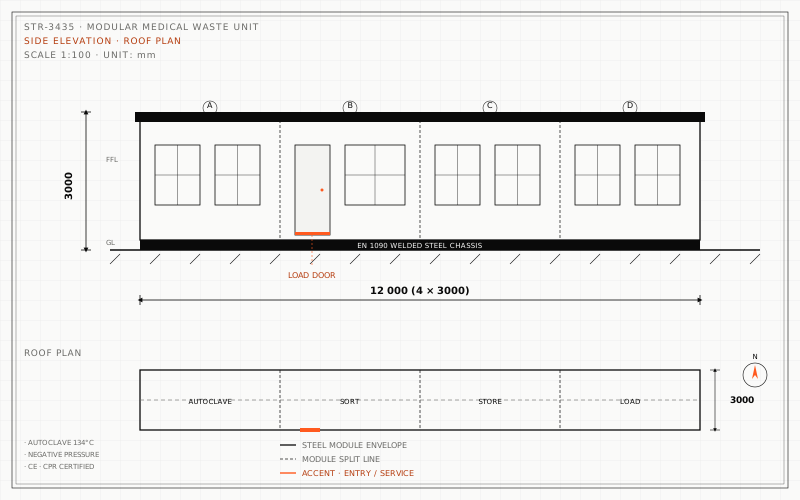
A modular medical waste unit treats clinical waste at the point of care — sterilising infectious material in an autoclave and reducing volume through shredding before final disposal. structmod modular medical waste units serve hospitals managing their own clinical waste stream rather than relying on external disposal contractors, field hospitals operating in remote locations without established waste infrastructure, and humanitarian programmes treating waste in disaster or conflict settings. The modular unit handles the standard clinical waste streams — sharps, infectious soft waste, anatomical waste, pharmaceutical waste — through a combined autoclaving and shredding process that renders waste safe and reduces disposal volume by 70-80%.
The treatment workflow is engineered around safety and operator protection: clinical waste arrives at the unit in colour-coded bags or sharps bins per the segregation protocol; loading into the autoclave chamber happens through a sealed loading bay protecting the operator from exposure; the autoclave cycle (typically 134°C for 18 minutes or equivalent dwell time) sterilises all infectious material to log-6 reduction of bacterial spore challenges per EN 285 or ISO 17665; treated waste transfers to the integrated shredder reducing it to fragments under 25 mm; the shredded sterile output goes to standard municipal waste stream rather than requiring specialist clinical waste disposal. Operator protection includes PPE workflow, eyewash, emergency shower, and cycle-failure alarms.
structmod modular medical waste units deliver to hospitals seeking to internalise clinical waste management for cost or sovereignty reasons, to military and humanitarian field hospitals where external waste contractor services don't exist, to specialty facilities (research labs, clinical trial sites, burns units) generating high-volume specialist waste streams, and to national health programmes building distributed waste treatment infrastructure. Lead time is 10-12 weeks from contract signature. Compliance includes EN 285 / ISO 17665 autoclave validation, WHO Safe Management of Wastes from Health-Care Activities guidance, and EU Waste Framework Directive (2008/98/EC) for European deployments.
Typical deployment sequence
- Day 1 — site foundation verified, screw jacks or strip footings in place
- Day 2–3 — modules lifted into position by mobile crane
- Day 3–4 — inter-module connections and envelope sealing
- Day 4–5 — MEP connections, wet testing
- Day 5–6 — interior finish, fixtures and equipment install
- Day 7 — commissioning, FAT report, user training and handover
Spec sheet — STR-2606
| Overall length | 12.6 m · 41.3 ft |
|---|---|
| Width (transport) | 2.99 m |
| Width (deployed) | 2.99 m |
| Height (transport) | 2.90 m |
| Floor area (deployed) | 37.7 m² |
| Dry weight | 14.6 t |
| Chassis | EN 10025 S355JR hot-rolled steel · EN 1090 EXC-2 |
| Welding quality | EN ISO 3834-3 |
| Envelope | Sandwich panel, PIR core 80 mm · λ ≈ 0.023 W/(m·K) |
| Fire resistance | EI-30 · tested to EN 13501-2 |
| Floor | Marine plywood on EPDM · R-10 slip rating |
| Electrical | 120/240 V · 60 Hz (US-spec) · IEC 60364 compliant |
| HVAC | Packaged rooftop · MERV-13 |
| Operating range | −25 °C to +50 °C ambient |
| Wind rating | Designed for 150 km/h basic wind (EN 1991-1-4) |
| Seismic design | Per EN 1998-1 (Eurocode 8) · ductility class DCM |
| Transport | ISO 668 footprint · CSC plate eligible (container variants) |
| Setup time | 3 hours · 2-person crew |
Full drawings, calculation notes, DoP, O&M manual and FAT report included with every unit. Specs indicative — configurable to project requirements.