Engineered once, deployable many times.
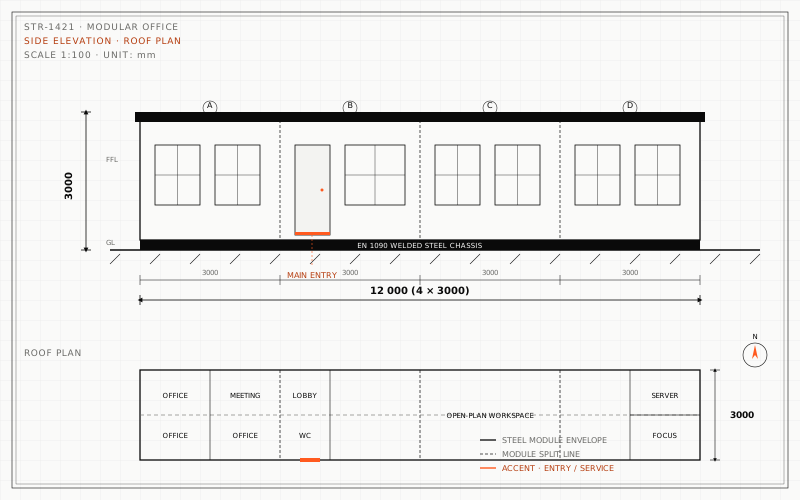
A modular office building is a permanent commercial workspace assembled from prefabricated modules with the office layouts, MEP services, IT infrastructure and finishes already installed in the factory. structmod modular office buildings serve corporate clients expanding workspace on constrained timelines, mining and oil & gas operators establishing administration buildings at remote sites, technology companies opening new development centres, government agencies extending office space without extended construction disruption, and developers building speculative or pre-leased commercial space.
Standard configurations include open-plan workspace zones (typically 8-12 m² per workstation including circulation), enclosed offices for managers and executives, meeting rooms in mixed sizes (4-person huddle through 12-person boardroom), focus rooms and phone booths for concentrated work, kitchen and breakout areas for staff respite, washrooms sized to occupancy, server room with appropriate cooling and security for IT infrastructure, reception and visitor management area, and supporting circulation. Multi-storey stackable configurations extend office capacity vertically — typical 2-4 storey configurations integrate lift, stair core and curtain-wall facade for full commercial-grade presentation.
structmod modular office buildings serve corporates growing across multiple locations who want consistent workspace quality, commercial real estate developers building speculative office space, public sector agencies extending office capacity for service delivery, and remote-site operators (mining, oil & gas, infrastructure projects) establishing administrative buildings. Lead time is 10-14 weeks from contract signature for single-storey stock configurations, 14-18 weeks for multi-storey stackable configurations. EN 1090 EXC-2 structural steel, EN 1998-1 + TBDY 2019 seismic compliance, IEC 60364-1 commercial electrical, and destination-country building code compliance support permanent commercial installation.
Typical deployment sequence
- Day 1 — site foundation verified, screw jacks or strip footings in place
- Day 2–3 — modules lifted into position by mobile crane
- Day 3–4 — inter-module connections and envelope sealing
- Day 4–5 — MEP connections, wet testing
- Day 5–6 — interior finish, fixtures and equipment install
- Day 7 — commissioning, FAT report, user training and handover
Spec sheet — STR-1421
| Overall length | 14.1 m · 46.3 ft |
|---|---|
| Width (transport) | 2.99 m |
| Width (deployed) | 2.99 m |
| Height (transport) | 3.20 m |
| Floor area (deployed) | 42.2 m² |
| Dry weight | 17.1 t |
| Chassis | EN 10025 S355JR hot-rolled steel · EN 1090 EXC-2 |
| Welding quality | EN ISO 3834-3 |
| Envelope | Sandwich panel, PIR core 80 mm · λ ≈ 0.023 W/(m·K) |
| Fire resistance | EI-30 · tested to EN 13501-2 |
| Floor | Marine plywood on EPDM · R-10 slip rating |
| Electrical | 120/240 V · 60 Hz (US-spec) · IEC 60364 compliant |
| HVAC | Packaged rooftop · MERV-13 |
| Operating range | −25 °C to +50 °C ambient |
| Wind rating | Designed for 150 km/h basic wind (EN 1991-1-4) |
| Seismic design | Per EN 1998-1 (Eurocode 8) · ductility class DCM |
| Transport | ISO 668 footprint · CSC plate eligible (container variants) |
| Setup time | 3 hours · 2-person crew |
Full drawings, calculation notes, DoP, O&M manual and FAT report included with every unit. Specs indicative — configurable to project requirements.