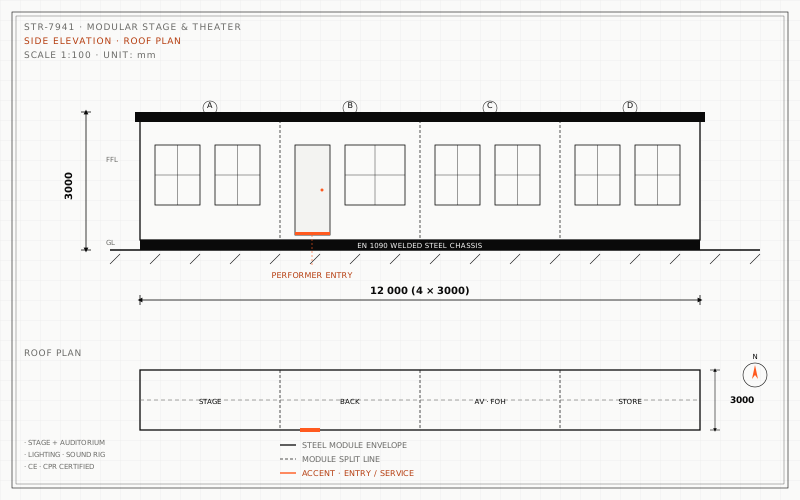
Engineered once, deployable many times.
A modular stage and theater is a permanent or relocatable performing arts venue assembled from prefabricated modules with the stage, backstage, audience seating, dressing rooms, box office and supporting venue infrastructure required for theatrical, musical or community performance. structmod modular stage and theater facilities serve community theatre programmes building local performing arts capability, schools establishing performing arts buildings, festival operators creating temporary venues at festival sites, and humanitarian arts programmes (refugee community arts, post-conflict cultural recovery) delivering performing arts venues as part of community development. The 14-18 week turnkey delivery enables programme launches around theatre season scheduling.
Standard configurations include the stage (typical 80-150 m² stage area for community-scale theatre, 200+ m² for larger venues), audience seating area (typical 100-500 seats arranged in raked seating for sightline quality), backstage area (set storage, scenery dock, wing space for off-stage performers), dressing rooms with mirrors, lighting and quick-change facilities, green room for performer rest between scenes, technical control room with lighting and sound mixing positions, box office and ticket sales area, audience concourse with washrooms and refreshment counter, and supporting back-of-house spaces. Theatre acoustics design supports both speech intelligibility (for theatrical performance) and musical performance (depending on programming priority); reverberation time typically 0.8-1.2 seconds for theatre, 1.4-1.8 seconds for music-priority venues.
structmod modular stage and theater facilities serve community arts programmes worldwide — local council building community arts capability, school districts establishing performing arts education infrastructure, religious or cultural community organisations building dedicated performance space, and arts festivals creating temporary venues for festival seasons. Lead time is 14-18 weeks from contract signature. Compliance includes destination-country building code, place-of-assembly fire safety standards (high-density occupancy with appropriate egress), accessibility per ADA equivalent for audience and performer access, and venue licensing per destination country requirements (entertainment licence, alcohol service if applicable).
Typical deployment sequence
- Day 1 — site foundation verified, screw jacks or strip footings in place
- Day 2–3 — modules lifted into position by mobile crane
- Day 3–4 — inter-module connections and envelope sealing
- Day 4–5 — MEP connections, wet testing
- Day 5–6 — interior finish, fixtures and equipment install
- Day 7 — commissioning, FAT report, user training and handover
Spec sheet — STR-2479
| Overall length | 15.9 m · 52.2 ft |
|---|---|
| Width (transport) | 2.99 m |
| Width (deployed) | 2.99 m |
| Height (transport) | 2.80 m |
| Floor area (deployed) | 47.5 m² |
| Dry weight | 13.9 t |
| Chassis | EN 10025 S355JR hot-rolled steel · EN 1090 EXC-2 |
| Welding quality | EN ISO 3834-3 |
| Envelope | Sandwich panel, PIR core 80 mm · λ ≈ 0.023 W/(m·K) |
| Fire resistance | EI-30 · tested to EN 13501-2 |
| Floor | Marine plywood on EPDM · R-10 slip rating |
| Electrical | 400 V / 50 Hz · 3-phase · IEC 60364 compliant |
| HVAC | VRF multi-split · HEPA H13 (medical) |
| Operating range | −25 °C to +50 °C ambient |
| Wind rating | Designed for 140 km/h basic wind (EN 1991-1-4) |
| Seismic design | Per EN 1998-1 (Eurocode 8) · ductility class DCM |
| Transport | ISO 668 footprint · CSC plate eligible (container variants) |
| Setup time | 2–7 days on site |
Full drawings, calculation notes, DoP, O&M manual and FAT report included with every unit. Specs indicative — configurable to project requirements.