Engineered once, deployable many times.
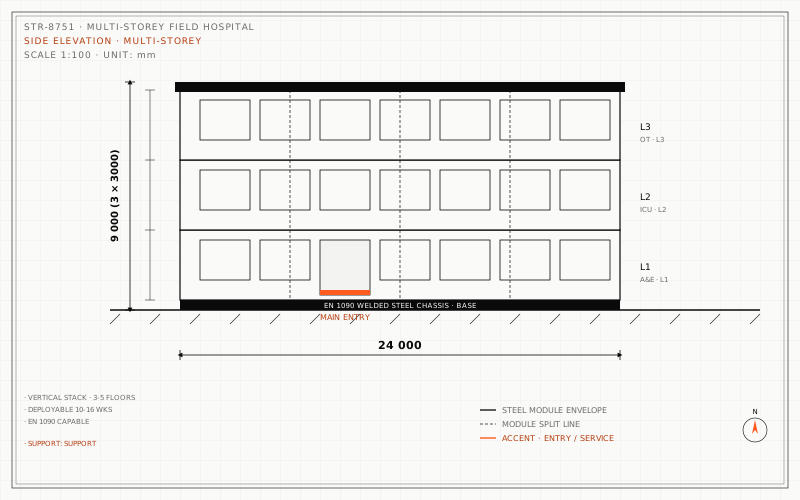
A multi-storey field hospital stacks inpatient wards vertically over a ground-floor clinical block, delivering significantly higher bed capacity per unit of site area than conventional single-storey field hospitals. structmod multi-storey field hospitals are engineered for scenarios where ground footprint is constrained — dense urban disaster zones, restricted military compounds, or island and coastal deployments — while retaining the rapid-build speed and self-sufficiency that define field hospital capability.
The typical configuration places emergency, surgical, ICU, imaging and laboratory on the ground floor for fastest patient access, with 40-80 inpatient beds distributed across the upper storeys served by lifts and stairs. Lightweight steel frame construction on an EN 1090 certified structure keeps the total deployed weight below threshold for helicopter airlift of individual modules. Full seismic design per Eurocode 8 ensures structural performance in earthquake response deployments, where ground-shake aftershocks are a real operational risk.
structmod multi-storey field hospitals support humanitarian missions, NATO expeditionary deployments, and civil disaster response programmes where capacity must scale without expanding horizontal footprint. Typical applications include urban earthquake response (where clearing sufficient ground area is impractical), military forward deployments in restricted terrain, and maritime disaster response on small island states. Lead time is 4-12 months from contract signature including seismic validation, module production, sea freight, on-site erection, and clinical commissioning.
Typical deployment sequence
- Month 1 — site preparation, foundation works, utilities trenching
- Month 2–3 — primary steel structure erection (EN 1090)
- Month 3–5 — envelope closure, roofing, curtain wall
- Month 5–7 — MEP rough-in, medical gas, emergency power
- Month 7–10 — interior fit-out, equipment installation
- Month 10–12 — commissioning, FAT/SAT, user training
- Month 12 — clinical handover with full O&M dossier
Spec sheet — STR-2752
| Overall length | 15.2 m · 49.9 ft |
|---|---|
| Width (transport) | 2.99 m |
| Width (deployed) | 2.99 m |
| Height (transport) | 3.10 m |
| Floor area (deployed) | 45.4 m² |
| Dry weight | 16.2 t |
| Chassis | EN 10025 S355JR hot-rolled steel · EN 1090 |
| Welding quality | EN ISO 3834-2 · certified RWC (IWE) |
| Envelope | Sandwich panel, PIR core 80 mm · λ ≈ 0.023 W/(m·K) |
| Fire resistance | EI-30 · tested to EN 13501-2 |
| Floor | Marine plywood on EPDM · R-10 slip rating |
| Electrical | 400 V / 50 Hz · 3-phase · IEC 60364 compliant |
| HVAC | VRF multi-split · HEPA H13 (medical) |
| Operating range | −25 °C to +50 °C ambient |
| Wind rating | Designed for 140 km/h basic wind (EN 1991-1-4) |
| Seismic design | Per EN 1998-1 (Eurocode 8) · ductility class DCM |
| Transport | ISO 668 footprint · CSC plate eligible (container variants) |
| Setup time | 4 hours · 2-person crew |
Full drawings, calculation notes, DoP, O&M manual and FAT report included with every unit. Specs indicative — configurable to project requirements.