Engineered once, deployable many times.
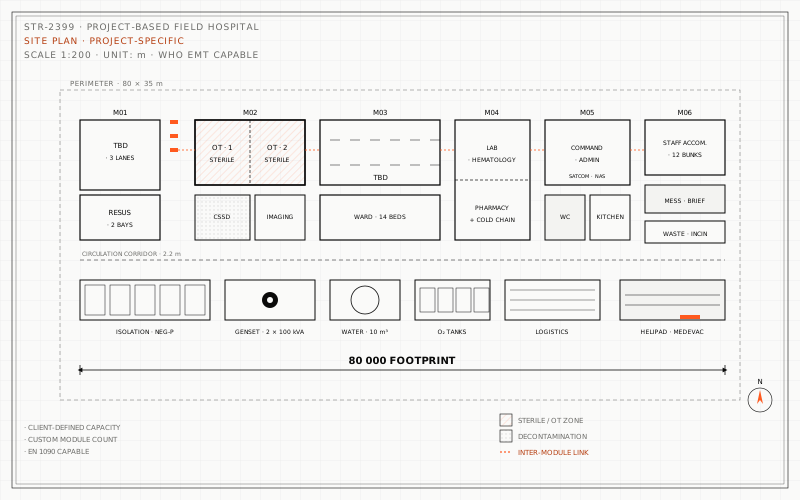
A project-based field hospital is a custom-engineered medical facility built to the specific requirements of your tender, RFP or ministry specification. structmod engineering begins with your functional brief — patient throughput, clinical capabilities, climate, logistics envelope, duration of deployment — and delivers a bespoke design that meets the exact performance standard required by the procuring authority, whether NATO, WHO, UN agency, national health ministry or private healthcare operator.
Every project-based field hospital is validated against its governing standard. NATO procurements reference STANAG 2560 and AMedP-9.1 with Medical Evaluation Team (MET) acceptance. WHO EMT procurements reference Emergency Medical Team Minimum Standards for Type 1 (outpatient), Type 2 (inpatient + surgery) or Type 3 (referral). National ministry procurements reference in-country building codes, electrical standards, medical device regulation and local seismic / climate design codes. structmod design-build workflow integrates all governing specifications into a single coordinated technical submission.
Typical project-based field hospital scopes include bespoke bed count (25-500 beds), specialty services beyond standard Role 2 (cardiac surgery, paediatrics, obstetrics, oncology, dialysis), extreme-environment variants (Arctic, desert, tropical), extended-endurance configurations (180+ day autonomy), and integration with host nation infrastructure. Design timeline is 4-8 weeks for concept-to-detail engineering, followed by 16-24 weeks for manufacture, factory acceptance, shipment and on-site commissioning.
Typical deployment sequence
- Hour 0–2 — trailer or container units arrive on site
- Hour 2–6 — positioning, leveling and inter-unit connection
- Hour 6–12 — envelope sealing, MEP hook-up, medical gas
- Hour 12–24 — equipment install, commissioning, FAT
- Hour 24–72 — user training, operational handover
Spec sheet — STR-2789
| Overall length | 14.9 m · 48.9 ft |
|---|---|
| Width (transport) | 2.99 m |
| Width (deployed) | 2.99 m |
| Height (transport) | 3.20 m |
| Floor area (deployed) | 44.6 m² |
| Dry weight | 17.9 t |
| Chassis | EN 10025 S355JR hot-rolled steel · EN 1090 |
| Welding quality | EN ISO 3834-2 · certified RWC (IWE) |
| Envelope | Sandwich panel, PIR core 80 mm · λ ≈ 0.023 W/(m·K) |
| Fire resistance | EI-30 · tested to EN 13501-2 |
| Floor | Marine plywood on EPDM · R-10 slip rating |
| Electrical | 120/240 V · 60 Hz (US-spec) · IEC 60364 compliant |
| HVAC | Packaged rooftop · MERV-13 |
| Operating range | −25 °C to +50 °C ambient |
| Wind rating | Designed for 150 km/h basic wind (EN 1991-1-4) |
| Seismic design | Per EN 1998-1 (Eurocode 8) · ductility class DCM |
| Transport | ISO 668 footprint · CSC plate eligible (container variants) |
| Setup time | 24–72 hours · 4–6-person crew |
Full drawings, calculation notes, DoP, O&M manual and FAT report included with every unit. Specs indicative — configurable to project requirements.