Engineered once, deployable many times.
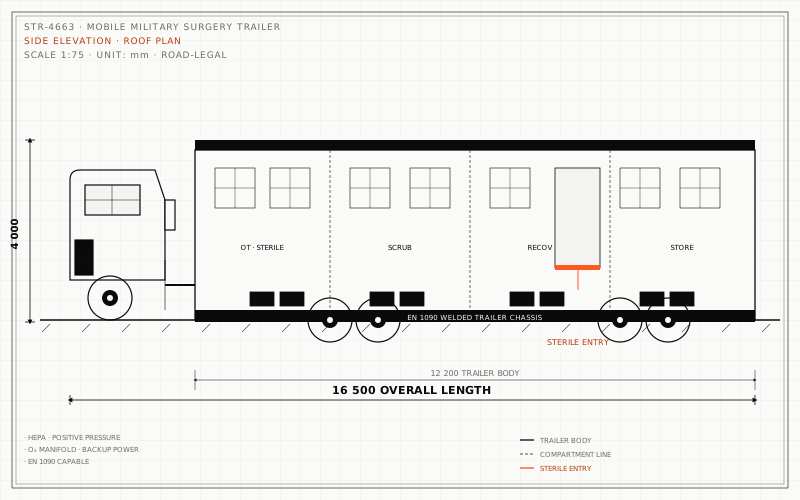
A mobile military surgery trailer is a road-deployable forward surgical facility engineered for damage-control surgery in expeditionary military operations. structmod mobile military surgery trailers deliver NATO Role 2 forward surgical capability — sized to stabilise battlefield casualties before evacuation to higher-echelon care, with the rugged engineering and operational mobility that forward surgical teams (FSTs) and shock trauma platoons require. The trailer-based configuration deploys with the supported formation and positions for damage-control surgery within the 'golden hour' that trauma outcomes depend on.
Standard configurations include the operating theatre (typical 20-25 m² with HEPA H13 ventilation approaching ISO 14644 class 7), anaesthesia workstation with gas scavenging, scrub sink bay at the theatre entrance, clean preparation zone, dirty instrument return, 2-4 bed recovery and patient holding ward, and supporting clinical spaces (medication preparation, sterile stock, biomedical engineering bench). Medical gas reticulation per ISO 9170 with cylinder-bank backup; medical electrical per IEC 60364-7-710 Group 2 with isolated power and UPS; optional ballistic envelope per STANAG 4569 Level III/IV for operations under small-arms threat.
structmod mobile military surgery trailers serve forward surgical teams operating ahead of Role 3 combat support hospitals, shock trauma platoons supporting maneuver units, expeditionary medical forces providing pre-hospital damage control surgery, and humanitarian-military operations where surgical capability must move with the operational picture. Lead time is 12-14 weeks from contract signature for stock configurations, 14-18 weeks for configurations with extended holding, ICU integration, or ballistic envelope. NATO STANAG 2560 medical evaluation criteria, AMedP-9.1 modular medical support principles, and STANAG 2345 MEDEVAC interface compatibility guide the design. Clinical commissioning includes microbiological air sampling and surgical workflow validation before first clinical use.
Tipik Konuşlanma Sırası
- Saat 0 — römork çekici araçla gelir, konumlandırılır ve takoz vurulur
- Saat 0–1 — dengeleme krikoları açılır, tesviye doğrulanır
- Saat 1–2 — hidrolik duvarlar veya genişleme panelleri açılır
- Saat 2–3 — altyapı bağlantıları (elektrik, su, atık su)
- Saat 3–4 — FAT protokolüne göre işlevsel test
- Saat 4 — kullanıcı eğitimiyle operasyonel teslimat
Spec sheet — STR-3182
| Toplam uzunluk | 14.2 m · 46.6 ft |
|---|---|
| Genişlik (nakliye) | 2,99 m |
| Genişlik (konuşlandırılmış) | 2,99 m |
| Yükseklik (nakliye) | 2,90 m |
| Zemin alanı (konuşlandırılmış) | 42.5 m² |
| Boş ağırlık | 14.2 t |
| Şasi | EN 10025 S355JR sıcak hadde çelik · EN 1090 EXC-2 |
| Kaynak kalitesi | EN ISO 3834-3 |
| Zarf | Sandviç panel, PIR çekirdek 80 mm · λ ≈ 0,023 W/(m·K) |
| Yangın direnci | EI-30 · EN 13501-2'ye göre test edilmiş |
| Zemin | EPDM üzerine denizcilik kontrplak · R-10 kayma sınıfı |
| Elektrik tesisatı | 120/240 V · 60 Hz (ABD spec) · IEC 60364 uyumlu |
| İklimlendirme | Çatı üstü paket cihaz · MERV-13 |
| Çalışma aralığı | −25 °C ile +50 °C ortam |
| Rüzgar sınıfı | 150 km/s temel rüzgar için tasarlandı (EN 1991-1-4) |
| Nakliye | ISO 668 ayak izi · CSC plakası uygun (konteyner varyantlar) |
| Kurulum süresi | 4 saat · 2 kişilik ekip |
Tam çizimler, hesap notları, DoP, İ&B kılavuzu ve FAT raporu her ünite ile dahildir. Özellikler gösterge niteliğindedir — proje gereksinimlerine göre yapılandırılabilir.