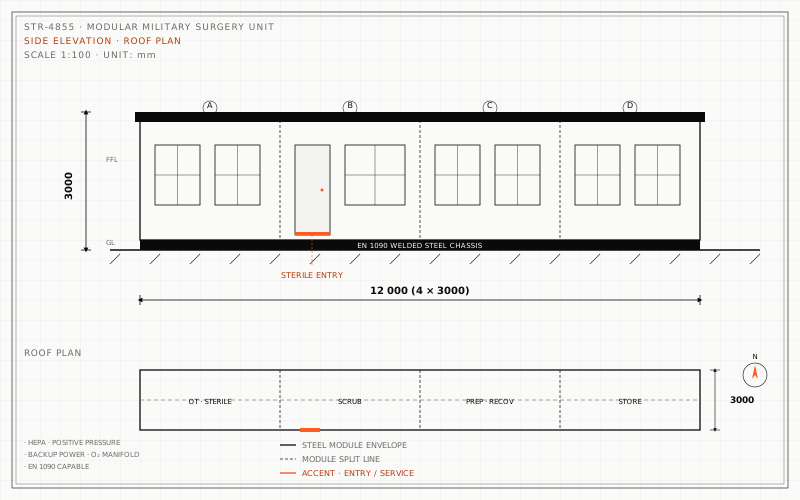
Engineered once, deployable many times.
A modular military surgery unit is a forward-deployed surgical facility built from prefabricated modules with the operating theatre, anaesthesia, scrub bay, recovery and patient holding capability required for damage-control surgery in expeditionary military operations. structmod modular military surgery units provide NATO Role 2 forward surgical capability — sized to stabilise battlefield casualties before evacuation to higher-echelon care, with the rugged engineering and infection-control performance that field surgery demands. The modular construction approach allows the surgical unit to deploy with the supported formation, then redeploy as the operational picture changes.
Standard configurations include the operating theatre (UK HBN 26-01 equivalent or ISO 14644 class 7 ultra-clean ventilation), anaesthesia workstation with gas scavenging, scrub sink bay at the theatre entrance, clean preparation zone, dirty instrument return, 4-6 bed recovery and patient holding ward, and supporting clinical spaces (medication preparation, sterile stock, biomedical engineering bench). Medical gas reticulation per ISO 9170 with cylinder-bank backup; medical electrical per IEC 60364-7-710 Group 2 with isolated power and UPS; environmental control per CBRN-protective configuration where threat assessment requires. Operating theatre environment is validated through microbiological commissioning before clinical use.
structmod modular military surgery units serve forward surgical teams (FST), shock trauma platoons, expeditionary medical units, and battalion aid stations operating beyond Role 1 capability. NATO STANAG 2560 medical evaluation criteria, AMedP-9.1 modular medical support principles, and STANAG 2345 MEDEVAC interface compatibility guide the design. Lead time is 12-14 weeks from contract signature for stock configurations, 14-18 weeks for configurations with extended holding, ICU integration or ballistic envelope. Clinical commissioning includes microbiological air sampling, equipment calibration and surgical workflow validation per the deploying service's clinical protocols.
Tipik Konuşlanma Sırası
- Gün 1 — saha temeli doğrulandı, vida krikoları veya şerit temel yerleştirildi
- Gün 2–3 — modüller mobil vinçle konumuna yerleştirildi
- Gün 3–4 — modüller arası bağlantılar ve zarf sızdırmazlığı
- Gün 4–5 — MEP bağlantıları, ıslak testler
- Gün 5–6 — iç kaplama, armatür ve ekipman montajı
- Gün 7 — devreye alma, FAT raporu, kullanıcı eğitimi ve teslimat
Spec sheet — STR-2999
| Toplam uzunluk | 15.9 m · 52.2 ft |
|---|---|
| Genişlik (nakliye) | 2,99 m |
| Genişlik (konuşlandırılmış) | 2,99 m |
| Yükseklik (nakliye) | 3.20 m |
| Zemin alanı (konuşlandırılmış) | 47.5 m² |
| Boş ağırlık | 11.9 t |
| Şasi | EN 10025 S355JR sıcak hadde çelik · EN 1090 EXC-2 |
| Kaynak kalitesi | EN ISO 3834-3 |
| Zarf | Sandviç panel, PIR çekirdek 80 mm · λ ≈ 0,023 W/(m·K) |
| Yangın direnci | EI-30 · EN 13501-2'ye göre test edilmiş |
| Zemin | EPDM üzerine denizcilik kontrplak · R-10 kayma sınıfı |
| Elektrik tesisatı | 120/240 V · 60 Hz (ABD spec) · IEC 60364 uyumlu |
| İklimlendirme | Çatı üstü paket cihaz · MERV-13 |
| Çalışma aralığı | −25 °C ile +50 °C ortam |
| Rüzgar sınıfı | 150 km/s temel rüzgar için tasarlandı (EN 1991-1-4) |
| Sismik tasarım | EN 1998-1 (Eurokod 8) uyarınca · sünek sınıf DCM |
| Nakliye | ISO 668 ayak izi · CSC plakası uygun (konteyner varyantlar) |
| Kurulum süresi | Sahada 2–7 gün |
Tam çizimler, hesap notları, DoP, İ&B kılavuzu ve FAT raporu her ünite ile dahildir. Özellikler gösterge niteliğindedir — proje gereksinimlerine göre yapılandırılabilir.