Engineered once, deployable many times.
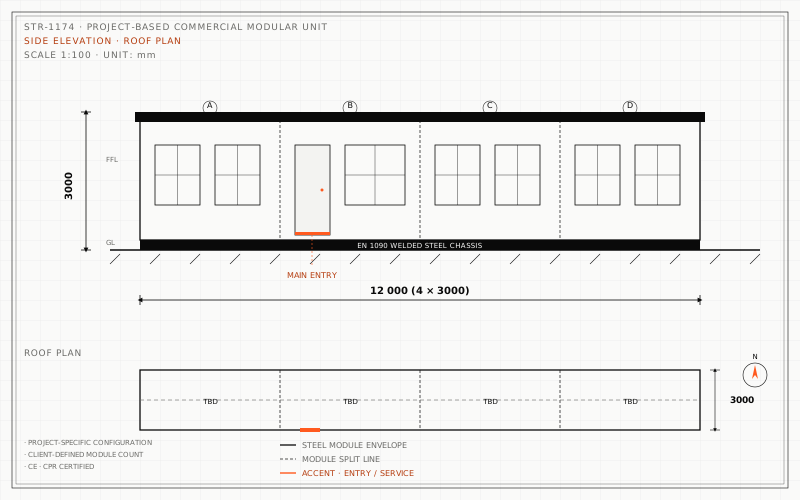
A project-based commercial modular unit is a fully custom modular building engineered to a specific client brief — site constraints, architectural vision, commercial programme, fit-out standard — rather than drawn from a standard catalogue. structmod design-build engineering handles every stage from initial concept sketches through detail engineering, factory production, logistics, site assembly, MEP commissioning and handover, taking commercial accountability for the complete project outcome rather than a discrete component.
Typical project-based briefs include corporate headquarters buildings on constrained urban sites, flagship retail stores with distinctive architectural identity, boutique hospitality units (20-60 room hotels, branded resorts), mixed-use buildings combining ground-floor retail with upper-floor offices or apartments, and specialised commercial buildings (broadcasting studios, training centres, showrooms) with unique functional requirements. Each project begins with a design workshop where the structmod engineering team, your architect, and your commercial team work through requirements, constraints, site conditions and target programme to produce a module schedule and technical proposal.
Design-build delivery means structmod takes single-point responsibility for the complete project — no separation between architect, engineer, manufacturer, and contractor. This eliminates the interface risk that drives overruns on conventional commercial construction and enables the full benefits of modular: predictable schedule, fixed-price delivery, and factory-quality finishes. Typical project-based commercial modular unit delivers in 8-14 months from contract to operational handover, with factory production running in parallel with site works. Every project includes EN 1090 structural documentation, Eurocode 8 seismic analysis, destination-country fire compliance, and CE-marked components throughout.
Typical deployment sequence
- Month 1 — site preparation, foundation works, utilities trenching
- Month 2–3 — primary steel structure erection (EN 1090)
- Month 3–5 — envelope closure, roofing, curtain wall
- Month 5–7 — MEP rough-in, medical gas, emergency power
- Month 7–10 — interior fit-out, equipment installation
- Month 10–12 — commissioning, FAT/SAT, user training
- Month 12 — clinical handover with full O&M dossier
Spec sheet — STR-3706
| Overall length | 14.6 m · 47.9 ft |
|---|---|
| Width (transport) | 2.99 m |
| Width (deployed) | 2.99 m |
| Height (transport) | 3.10 m |
| Floor area (deployed) | 43.7 m² |
| Dry weight | 16.6 t |
| Chassis | EN 10025 S355JR hot-rolled steel · EN 1090 |
| Welding quality | EN ISO 3834-2 · certified RWC (IWE) |
| Envelope | Sandwich panel, PIR core 80 mm · λ ≈ 0.023 W/(m·K) |
| Fire resistance | EI-30 · tested to EN 13501-2 |
| Floor | Marine plywood on EPDM · R-10 slip rating |
| Electrical | 400 V / 50 Hz · 3-phase · IEC 60364 compliant |
| HVAC | VRF multi-split · HEPA H13 (medical) |
| Operating range | −25 °C to +50 °C ambient |
| Wind rating | Designed for 140 km/h basic wind (EN 1991-1-4) |
| Seismic design | Per EN 1998-1 (Eurocode 8) · ductility class DCM |
| Transport | ISO 668 footprint · CSC plate eligible (container variants) |
| Setup time | 3 hours · 2-person crew |
Full drawings, calculation notes, DoP, O&M manual and FAT report included with every unit. Specs indicative — configurable to project requirements.