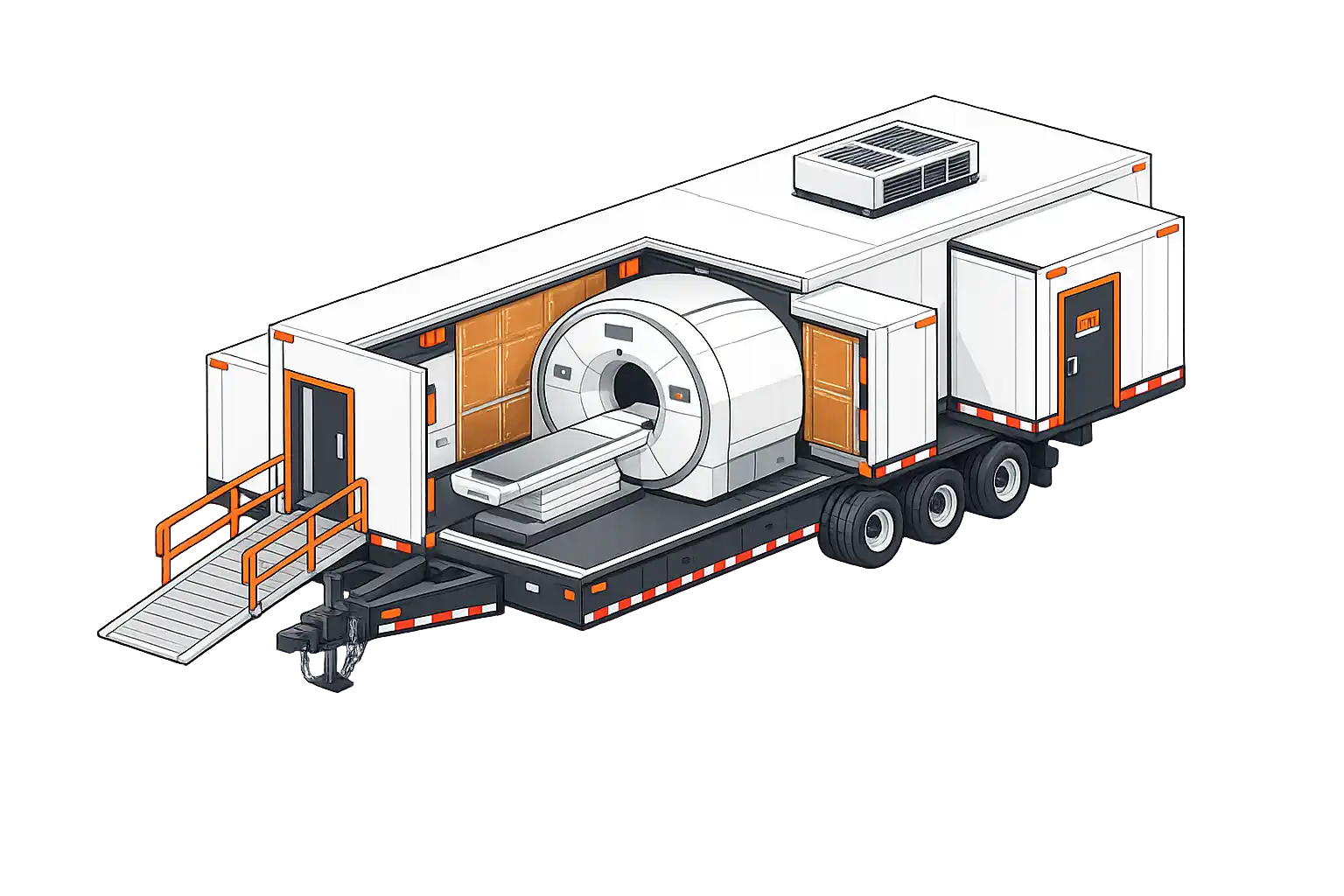
Engineered once, deployable many times.
An expandable imaging trailer combines diagnostic imaging capability with hydraulic pop-out walls that extend the operational footprint — providing the shielded imaging room, control console, patient preparation bay and recovery space that fixed-site imaging requires, on a road-deployable platform that drives between sites. structmod expandable imaging trailers serve healthcare imaging programmes where outreach combines high-end imaging modality with extended clinical workflow — diabetic retinopathy screening with imaging support, oncology screening programmes, hospital imaging during scanner replacement, and disaster response imaging surge.
Standard configurations integrate the imaging modality (CT, MRI, X-ray, or specialty imaging) at the trailer's centre with appropriate shielding (lead per NCRP Report 147 for CT/X-ray, RF cage per OEM specification for MRI), pop-out walls extending patient preparation, control console workspace and recovery bay laterally. The expanded operational floor area accommodates patient flow management that fixed-width imaging trailers cannot provide — proper pre-imaging consultation room, separate changing cubicles, accessible patient transfer for scanner positioning, and recovery space for post-contrast monitoring. Vibration management for the scanner combines with chassis stabilisation and acoustic isolation from external road traffic.
structmod expandable imaging trailers serve regional cancer screening programmes (where diagnostic-grade imaging plus extended patient workflow matter for screening quality), hospital imaging programmes during scanner replacement or department refurbishment, specialty imaging fleets covering rural populations, and disaster response imaging surge during major events. Lead time is 14-18 weeks from contract signature; OEM scanner integration adds 2-6 weeks. Compliance covers IEC 60601 medical electrical safety, NCRP Report 147 shielding, OEM scanner certification, and DOT/E-mark vehicle homologation.
Typical deployment sequence
- Hour 0 — trailer arrives on tow vehicle, positioned and chocked
- Hour 0–1 — stabilizer jacks deployed, leveling verified
- Hour 1–2 — hydraulic walls or slide-outs extended where fitted
- Hour 2–3 — utility connections (power, water, wastewater)
- Hour 3–4 — functional test per FAT protocol
- Hour 4 — operational handover with user training
Spec sheet — STR-2621
| Overall length | 14.1 m · 46.3 ft |
|---|---|
| Width (transport) | 2.55 m |
| Width (deployed) | 7.50 m |
| Height (transport) | 3.20 m |
| Floor area (deployed) | 105.8 m² |
| Dry weight | 11.1 t |
| Chassis | EN 10025 S355JR hot-rolled steel · EN 1090 EXC-2 |
| Welding quality | EN ISO 3834-3 |
| Envelope | Sandwich panel, PIR core 80 mm · λ ≈ 0.023 W/(m·K) |
| Fire resistance | EI-30 · tested to EN 13501-2 |
| Floor | Marine plywood on EPDM · R-10 slip rating |
| Electrical | 120/240 V · 60 Hz (US-spec) · IEC 60364 compliant |
| HVAC | Packaged rooftop · MERV-13 |
| Operating range | −25 °C to +50 °C ambient |
| Wind rating | Designed for 150 km/h basic wind (EN 1991-1-4) |
| Transport | ISO 668 footprint · CSC plate eligible (container variants) |
| Setup time | 3 hours · 2-person crew |
Full drawings, calculation notes, DoP, O&M manual and FAT report included with every unit. Specs indicative — configurable to project requirements.