Engineered once, deployable many times.
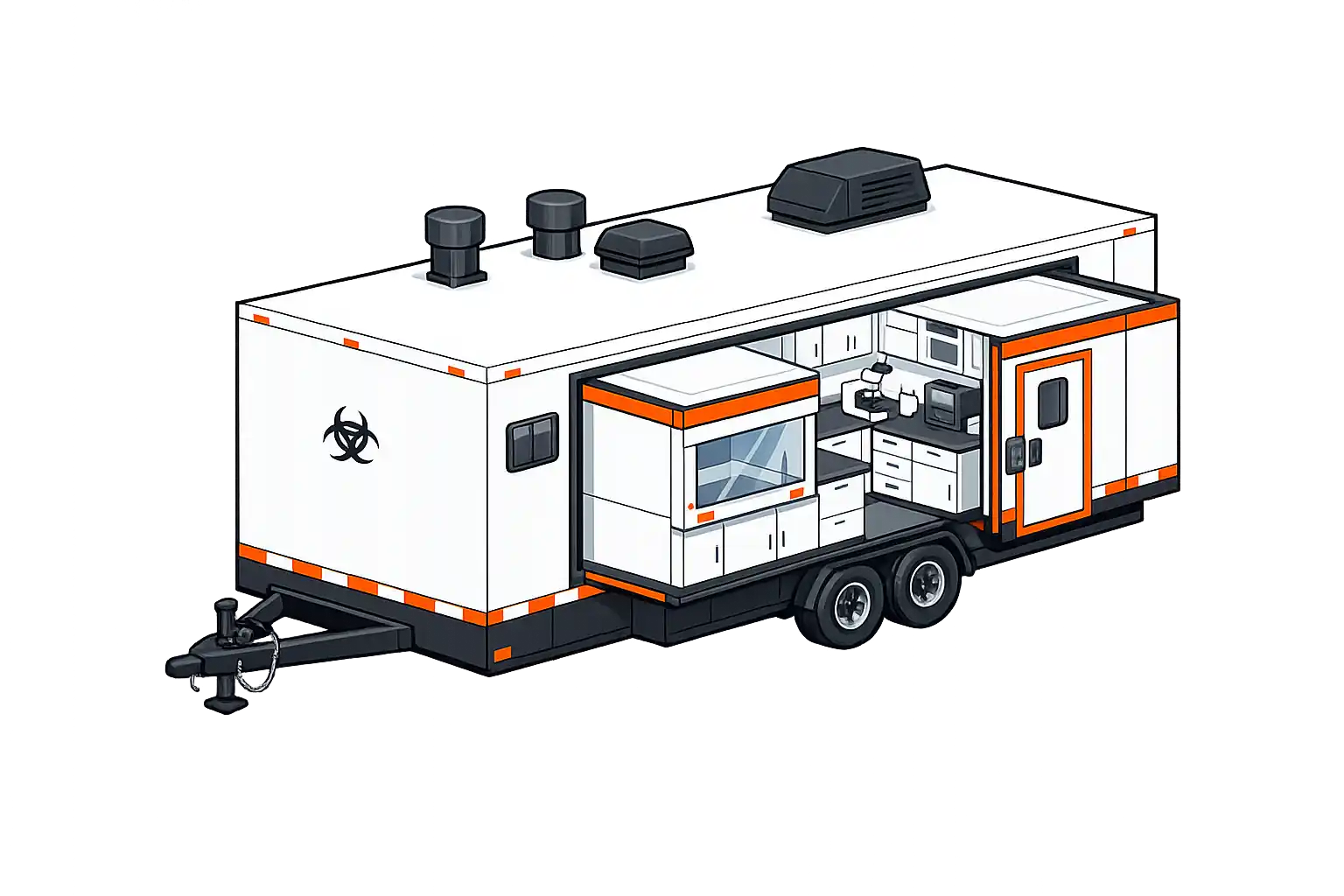
An expandable lab trailer is a road-deployable laboratory facility that opens to 7.5-8 m deployed width to accommodate full laboratory bench workspace, fume extraction infrastructure, biological safety cabinets and supporting laboratory equipment in a single trailer. structmod expandable lab trailers serve field research programmes (environmental sampling, ecological surveys, archaeological investigation), outbreak response (mobile diagnostic capability deploying to outbreak sites), industrial quality control at remote production sites, and clinical research programmes requiring on-site laboratory capability.
Standard configurations include modular laboratory benches with integrated services (gas, vacuum, water, electricity) along the trailer's length, fume cupboard (compliant with EN 14175) at one end, biological safety cabinet (Class II Type A2) for biological work, autoclave for sterilisation, refrigerated storage for samples and reagents, and supporting infrastructure (sample reception, hand wash, gowning area, dirty waste). BSL-2 configurations add anteroom for PPE workflow, HEPA-filtered exhaust, autoclave for waste sterilisation, and validated infection control workflow per BSL-2 requirements per WHO Laboratory Biosafety Manual.
structmod expandable lab trailers serve environmental investigation programmes (water quality testing at remote sites, soil contamination assessment), public health outbreak response (mobile diagnostic deployment to outbreak hot zones), academic and institutional research field campaigns, oil & gas operators requiring on-site quality control at exploration sites, and humanitarian deployment for clinical diagnostic capability in disaster zones. Lead time is 12-16 weeks from contract signature for stock configurations, 14-18 weeks for BSL-2 or specialty configurations. Compliance includes EN 14175 fume cupboards, ISO 15189 medical laboratory framework, WHO Laboratory Biosafety Manual reference.
Typical deployment sequence
- Hour 0 — trailer arrives on tow vehicle, positioned and chocked
- Hour 0–1 — stabilizer jacks deployed, leveling verified
- Hour 1–2 — hydraulic walls or slide-outs extended where fitted
- Hour 2–3 — utility connections (power, water, wastewater)
- Hour 3–4 — functional test per FAT protocol
- Hour 4 — operational handover with user training
Spec sheet — STR-2192
| Overall length | 15.2 m · 49.9 ft |
|---|---|
| Width (transport) | 2.55 m |
| Width (deployed) | 5.00 m |
| Height (transport) | 2.90 m |
| Floor area (deployed) | 76.0 m² |
| Dry weight | 14.2 t |
| Chassis | EN 10025 S355JR hot-rolled steel · EN 1090 EXC-2 |
| Welding quality | EN ISO 3834-3 |
| Envelope | Sandwich panel, PIR core 80 mm · λ ≈ 0.023 W/(m·K) |
| Fire resistance | EI-30 · tested to EN 13501-2 |
| Floor | Marine plywood on EPDM · R-10 slip rating |
| Electrical | 120/240 V · 60 Hz (US-spec) · IEC 60364 compliant |
| HVAC | Packaged rooftop · MERV-13 |
| Operating range | −25 °C to +50 °C ambient |
| Wind rating | Designed for 150 km/h basic wind (EN 1991-1-4) |
| Transport | ISO 668 footprint · CSC plate eligible (container variants) |
| Setup time | 4 hours · 2-person crew |
Full drawings, calculation notes, DoP, O&M manual and FAT report included with every unit. Specs indicative — configurable to project requirements.