Engineered once, deployable many times.
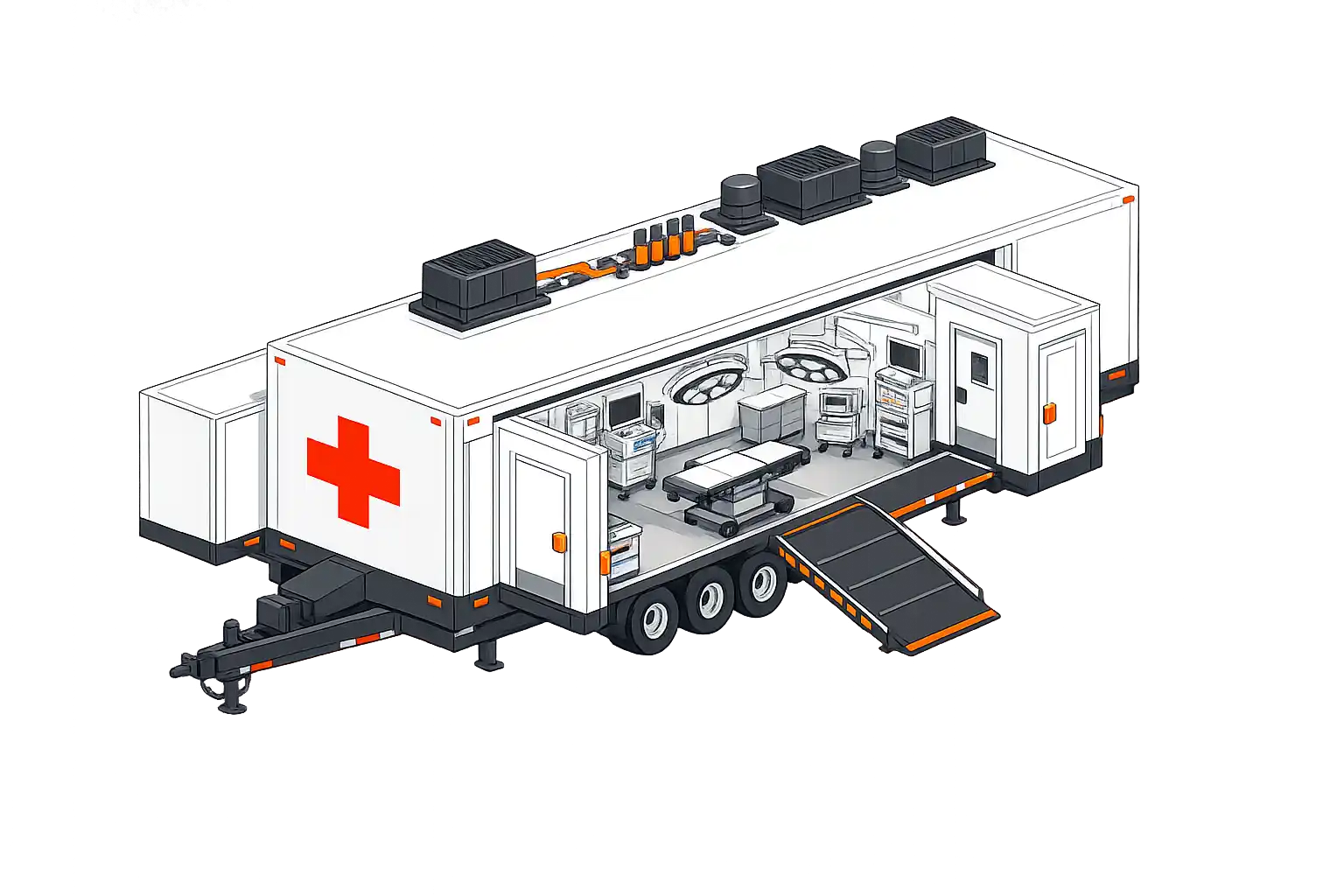
An expandable operation trailer is a road-deployable surgical theatre that combines the floor area of a fixed-site operating theatre with the transport efficiency of a road trailer — deploying to 7.5-8 m wide operational footprint to accommodate the operating theatre, anaesthesia workstation, scrub bay, sterile preparation and recovery bay required for sustained surgical operation. structmod expandable operation trailers serve surgical outreach programmes (cataract surgery, hernia repair, cleft palate programmes), hospital surgical capacity during operating theatre refurbishment, military forward surgical capability requiring sustained deployment, and humanitarian surgical missions.
Standard configurations include the operating theatre (Class B environment per UK HBN 26-01 equivalent — typical 25-30 m² sterile field with HEPA H13 laminar flow ventilation), anaesthesia workstation with gas scavenging, scrub sink bay at theatre entrance, clean preparation zone, dirty instrument return, 1-2 bed recovery bay with monitoring, and supporting clinical spaces (medication preparation, sterile stock). Medical gas reticulation per ISO 9170 with cylinder-bank backup; medical electrical per IEC 60364-7-710 Group 2 with isolated power; pressure cascades maintain cleanliness across the deployed clinical environment.
structmod expandable operation trailers serve surgical missions where sustained operation justifies deployment time — cataract surgery outreach delivering 15-30 surgeries per day across multiple weeks, surgical workforce camp medical support, military forward surgical capability with ICU integration, and humanitarian surgical response in protracted crisis situations. Lead time is 14-18 weeks from contract signature for stock configurations, 18-22 weeks for specialty surgical configurations. Compliance includes IEC 60364-7-710 Group 2 medical electrical, ISO 14644 class 7 ultra-clean operating environment, microbiological commissioning before clinical use.
Typical deployment sequence
- Hour 0 — trailer arrives on tow vehicle, positioned and chocked
- Hour 0–1 — stabilizer jacks deployed, leveling verified
- Hour 1–2 — hydraulic walls or slide-outs extended where fitted
- Hour 2–3 — utility connections (power, water, wastewater)
- Hour 3–4 — functional test per FAT protocol
- Hour 4 — operational handover with user training
Spec sheet — STR-2866
| Overall length | 14.6 m · 47.9 ft |
|---|---|
| Width (transport) | 2.55 m |
| Width (deployed) | 5.00 m |
| Height (transport) | 3.10 m |
| Floor area (deployed) | 73.0 m² |
| Dry weight | 13.6 t |
| Chassis | EN 10025 S355JR hot-rolled steel · EN 1090 EXC-2 |
| Welding quality | EN ISO 3834-3 |
| Envelope | Sandwich panel, PIR core 80 mm · λ ≈ 0.023 W/(m·K) |
| Fire resistance | EI-30 · tested to EN 13501-2 |
| Floor | Marine plywood on EPDM · R-10 slip rating |
| Electrical | 400 V / 50 Hz · 3-phase · IEC 60364 compliant |
| HVAC | VRF multi-split · HEPA H13 (medical) |
| Operating range | −25 °C to +50 °C ambient |
| Wind rating | Designed for 140 km/h basic wind (EN 1991-1-4) |
| Transport | ISO 668 footprint · CSC plate eligible (container variants) |
| Setup time | 3 hours · 2-person crew |
Full drawings, calculation notes, DoP, O&M manual and FAT report included with every unit. Specs indicative — configurable to project requirements.