Engineered once, deployable many times.
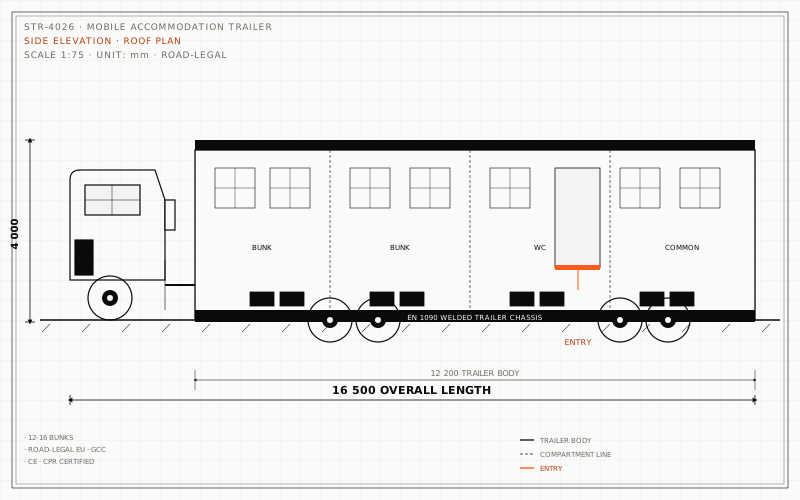
A mobile accommodation trailer is a road-deployable sleeping accommodation unit configured with bedrooms, en-suite bathrooms, and supporting infrastructure for sustained occupancy by workforce, military or humanitarian personnel. structmod mobile accommodation trailers serve mining and oil & gas operators establishing exploration camps quickly, defence forces accommodating personnel during exercises or deployments, construction project camps requiring rapid mobilisation, and humanitarian deployments housing relief workforces. The road-deployable configuration arrives at site ready to occupy — no on-site construction, no foundation works, just utility connection and orientation briefing.
Standard configurations include 2-4 bedroom variants per trailer, each with attached bathroom (shower, toilet, basin), built-in storage, work desk space, and individual HVAC for occupant comfort. Bedroom configurations follow the operating organisation's accommodation policy — single-occupancy rooms for managers and supervisors, twin-occupancy for skilled trades, four-bed shared rooms for trade workers or military personnel. Inter-trailer corridors link multiple accommodation trailers into camp-scale configurations, with shared communal facilities (dining, recreation, laundry) provided by adjacent specialty trailers. Each trailer connects to camp-level utilities (electrical mains, water supply, sewer or septic, communications) through standardised interface points.
structmod mobile accommodation trailers serve workforce camps where road-deployable sleeping accommodation matters — exploration mining camps following the geological campaign across multiple sites, oil & gas exploration teams rotating between drilling locations, construction project camps following the project's geographical phasing, defence forces deploying for time-limited exercises or operations, and humanitarian disaster response teams housing relief crews during the response window. Lead time is 8-10 weeks from contract signature for stock configurations. EN 1090 EXC-2 chassis, DOT/E-mark vehicle homologation, IEC 60364-1 commercial electrical, and accommodation building code compliance per destination country.
Typical deployment sequence
- Hour 0 — trailer arrives on tow vehicle, positioned and chocked
- Hour 0–1 — stabilizer jacks deployed, leveling verified
- Hour 1–2 — hydraulic walls or slide-outs extended where fitted
- Hour 2–3 — utility connections (power, water, wastewater)
- Hour 3–4 — functional test per FAT protocol
- Hour 4 — operational handover with user training
Spec sheet — STR-2851
| Overall length | 13.1 m · 43.0 ft |
|---|---|
| Width (transport) | 2.55 m |
| Width (deployed) | 7.50 m |
| Height (transport) | 2.80 m |
| Floor area (deployed) | 98.3 m² |
| Dry weight | 16.1 t |
| Chassis | EN 10025 S355JR hot-rolled steel · EN 1090 EXC-2 |
| Welding quality | EN ISO 3834-3 |
| Envelope | Sandwich panel, PIR core 80 mm · λ ≈ 0.023 W/(m·K) |
| Fire resistance | EI-30 · tested to EN 13501-2 |
| Floor | Marine plywood on EPDM · R-10 slip rating |
| Electrical | 400 V / 50 Hz · 3-phase · IEC 60364 compliant |
| HVAC | VRF multi-split · HEPA H13 (medical) |
| Operating range | −25 °C to +50 °C ambient |
| Wind rating | Designed for 140 km/h basic wind (EN 1991-1-4) |
| Transport | ISO 668 footprint · CSC plate eligible (container variants) |
| Setup time | 3 hours · 2-person crew |
Full drawings, calculation notes, DoP, O&M manual and FAT report included with every unit. Specs indicative — configurable to project requirements.