Engineered once, deployable many times.
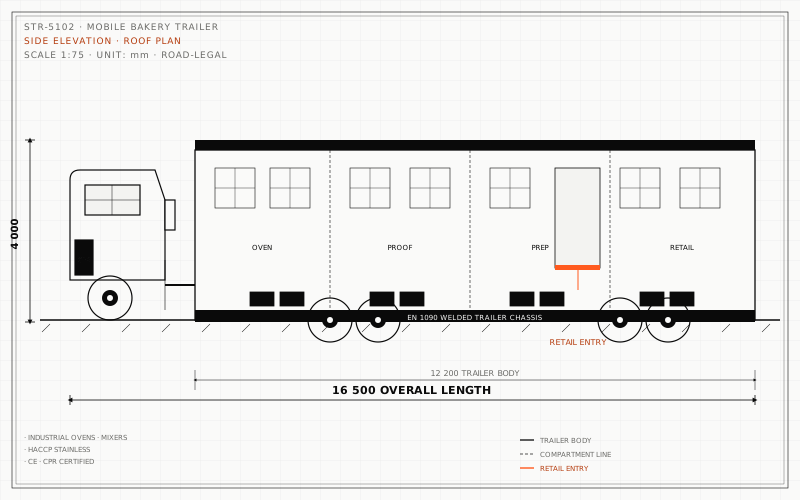
A mobile bakery trailer is a road-deployable bread and pastry production unit configured with industrial baking equipment — mixer, dough divider, proofing chamber, oven, cooling rack and packing infrastructure — in a single integrated trailer. structmod mobile bakery trailers serve military catering operations needing field bakery capability beyond garrison support, humanitarian feeding programmes producing fresh bread for refugee or displaced populations, mining and oil & gas camp catering producing daily fresh bread for resident workforces, and disaster response teams establishing food production capability where commercial bakery infrastructure is destroyed.
Standard configurations produce 500-1,500 loaves per shift depending on equipment specification and team size. Production workflow follows: ingredient receiving and storage zone (refrigerated for yeast and fats, dry for flour and sugar), industrial dough mixer (typical 50-150 kg dough capacity per cycle), dough divider and shaping equipment, proofing chamber with temperature and humidity control (typical 28-32°C, 75-85% relative humidity), oven (deck oven or rotary oven sized to throughput), cooling rack zone, packing line, and finished goods storage. Centralised mechanical bay houses gas supply, water heating, ventilation extract and refrigeration. Operator workspace and supporting facilities (washroom, cleaning equipment store) round out the trailer fit-out.
structmod mobile bakery trailers serve catering programmes where bread production must follow the operational programme — military theatre catering producing fresh bread for deployed troops, humanitarian feeding programmes (UN World Food Programme bakery operations in protracted refugee situations), mining campaign catering producing fresh bread daily for camp residents, and event catering producing artisan bread at festivals and large public events. Lead time is 10-12 weeks from contract signature. Compliance covers ISO 22000 food safety, NFPA 96 ventilation, IEC 60364-1 commercial electrical.
Typical deployment sequence
- Hour 0 — trailer arrives on tow vehicle, positioned and chocked
- Hour 0–1 — stabilizer jacks deployed, leveling verified
- Hour 1–2 — hydraulic walls or slide-outs extended where fitted
- Hour 2–3 — utility connections (power, water, wastewater)
- Hour 3–4 — functional test per FAT protocol
- Hour 4 — operational handover with user training
Spec sheet — STR-2115
| Overall length | 15.5 m · 50.9 ft |
|---|---|
| Width (transport) | 2.55 m |
| Width (deployed) | 7.50 m |
| Height (transport) | 3.00 m |
| Floor area (deployed) | 116.3 m² |
| Dry weight | 9.5 t |
| Chassis | EN 10025 S355JR hot-rolled steel · EN 1090 EXC-2 |
| Welding quality | EN ISO 3834-3 |
| Envelope | Sandwich panel, PIR core 80 mm · λ ≈ 0.023 W/(m·K) |
| Fire resistance | EI-30 · tested to EN 13501-2 |
| Floor | Marine plywood on EPDM · R-10 slip rating |
| Electrical | 230 V / 50 Hz · TN-S · IEC 60364 compliant |
| HVAC | Split inverter heat pump · MERV-8 |
| Operating range | −25 °C to +50 °C ambient |
| Wind rating | Designed for 130 km/h basic wind (EN 1991-1-4) |
| Transport | ISO 668 footprint · CSC plate eligible (container variants) |
| Setup time | 2 hours · 2-person crew |
Full drawings, calculation notes, DoP, O&M manual and FAT report included with every unit. Specs indicative — configurable to project requirements.