Engineered once, deployable many times.
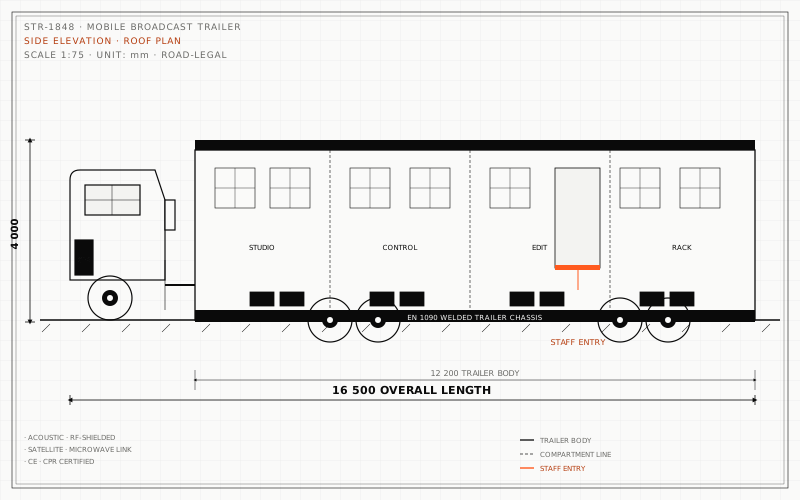
A mobile broadcast trailer (also known as an outside broadcast or OB van) is a road-deployable broadcast production facility for live event coverage — sports broadcasts, news events, concerts, political summits, and entertainment productions. structmod mobile broadcast trailers integrate the production control room, technical infrastructure (cameras, audio, video switching, graphics), satellite or fibre uplink for transmission to the broadcast network, and operator workspace into a single road-deployable unit. The trailer drives between event venues and sets up for broadcast within hours of arrival.
Standard configurations include the production control room with director's position, vision mixing, audio mixing, graphics workstation, and engineering monitoring; equipment racks housing broadcast servers, video switching matrix, audio infrastructure, encoders, and uplink electronics; satellite uplink dish (deployable mast or fixed roof-mount) or fibre/IP transmission infrastructure for broadcast network connection; cable management for outside connections to cameras, audio sources, and venue infrastructure; operator workspace with seating for production team during broadcasts. Acoustic isolation prevents external venue noise from affecting production audio; air conditioning maintains equipment temperature during sustained operation; redundant power systems (mains plus generator backup) prevent transmission interruption.
structmod mobile broadcast trailers serve sports broadcasters covering football, basketball, motorsport and other live sports across multiple venues per week; news broadcasters covering political events, breaking news, and major announcements; entertainment broadcasters covering concerts, festivals, and award shows; corporate broadcasters covering major announcements and stakeholder events. The trailer-based configuration enables broadcasters to maintain consistent production quality across different venues without relying on venue infrastructure. Lead time is 14-18 weeks from contract signature for stock configurations, 16-20 weeks for specialty configurations including 4K UHD or specialty audio infrastructure. EN 1090 EXC-2 chassis, IEC 60364-1 commercial electrical with broadcast-grade earthing, EMI/EMC compliance for sensitive electronics.
Typical deployment sequence
- Hour 0 — trailer arrives on tow vehicle, positioned and chocked
- Hour 0–1 — stabilizer jacks deployed, leveling verified
- Hour 1–2 — hydraulic walls or slide-outs extended where fitted
- Hour 2–3 — utility connections (power, water, wastewater)
- Hour 3–4 — functional test per FAT protocol
- Hour 4 — operational handover with user training
Spec sheet — STR-2424
| Overall length | 14.4 m · 47.2 ft |
|---|---|
| Width (transport) | 2.55 m |
| Width (deployed) | 5.00 m |
| Height (transport) | 2.70 m |
| Floor area (deployed) | 72.0 m² |
| Dry weight | 12.4 t |
| Chassis | EN 10025 S355JR hot-rolled steel · EN 1090 EXC-2 |
| Welding quality | EN ISO 3834-3 |
| Envelope | Sandwich panel, PIR core 80 mm · λ ≈ 0.023 W/(m·K) |
| Fire resistance | EI-30 · tested to EN 13501-2 |
| Floor | Marine plywood on EPDM · R-10 slip rating |
| Electrical | 230 V / 50 Hz · TN-S · IEC 60364 compliant |
| HVAC | Split inverter heat pump · MERV-8 |
| Operating range | −25 °C to +50 °C ambient |
| Wind rating | Designed for 130 km/h basic wind (EN 1991-1-4) |
| Transport | ISO 668 footprint · CSC plate eligible (container variants) |
| Setup time | 2–4 hours · 2-person crew |
Full drawings, calculation notes, DoP, O&M manual and FAT report included with every unit. Specs indicative — configurable to project requirements.