Engineered once, deployable many times.
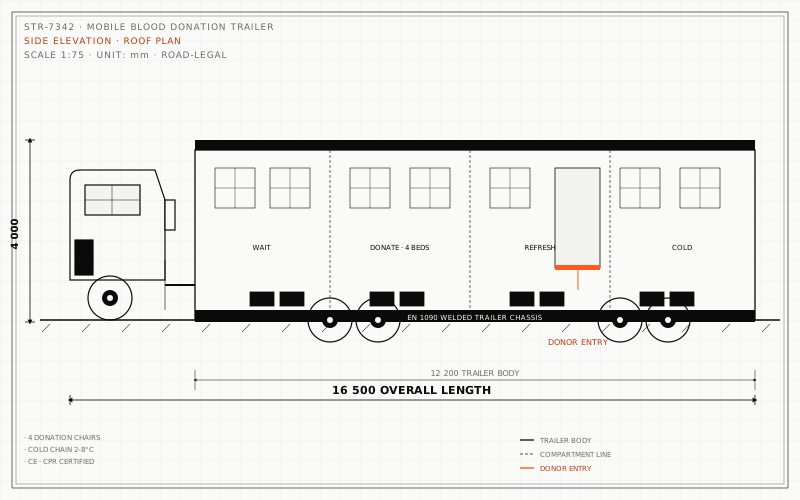
A mobile blood donation trailer is a road-deployable phlebotomy and blood collection unit that enables blood services to run drives at any site — corporate offices, university campuses, community centres, schools, factories, shopping centres — expanding donor reach far beyond the fixed blood bank network. structmod mobile blood donation trailers accommodate 4 donor chairs in parallel phlebotomy workflow, with donor screening at the trailer entrance, refreshment and recovery area at exit, and onboard refrigerated storage for collected units through the cold chain.
The donor journey through the trailer follows standard blood service workflow: arrival and registration at a reception desk with secure data entry; donor screening in a private consultation bay with haemoglobin testing and questionnaire review; phlebotomy at one of four donor chairs with single-use collection sets; post-donation refreshment and recovery bay with refreshments, seated rest and staff observation; departure. Each donor chair has dedicated phlebotomy lighting, waste bin (sharps, clinical, general separated), and donor comfort elements (armrest adjustment, fan, call button). Collected units transfer to onboard refrigerator (4±2°C for whole blood) or freezer (for plasma or cryoprecipitate) maintained through the cold chain until transport to the blood processing centre.
structmod mobile blood donation trailers serve national blood services, regional blood banks, Red Cross/Red Crescent operations, hospital blood collection programmes, and corporate blood drives. Lead time is 8-10 weeks from contract signature. EN 1090 EXC-2 chassis construction, DOT/E-mark road homologation, and compliance with destination-country blood service regulations (e.g., UK SaBTO, EU Blood Directive 2002/98/EC, FDA 21 CFR 640) ensure regulatory readiness for clinical blood collection.
Typical deployment sequence
- Hour 0 — trailer arrives on tow vehicle, positioned and chocked
- Hour 0–1 — stabilizer jacks deployed, leveling verified
- Hour 1–2 — hydraulic walls or slide-outs extended where fitted
- Hour 2–3 — utility connections (power, water, wastewater)
- Hour 3–4 — functional test per FAT protocol
- Hour 4 — operational handover with user training
Spec sheet — STR-3403
| Overall length | 12.3 m · 40.4 ft |
|---|---|
| Width (transport) | 2.99 m |
| Width (deployed) | 2.99 m |
| Height (transport) | 2.80 m |
| Floor area (deployed) | 36.8 m² |
| Dry weight | 10.3 t |
| Chassis | EN 10025 S355JR hot-rolled steel · EN 1090 EXC-2 |
| Welding quality | EN ISO 3834-3 |
| Envelope | Sandwich panel, PIR core 80 mm · λ ≈ 0.023 W/(m·K) |
| Fire resistance | EI-30 · tested to EN 13501-2 |
| Floor | Marine plywood on EPDM · R-10 slip rating |
| Electrical | 400 V / 50 Hz · 3-phase · IEC 60364 compliant |
| HVAC | VRF multi-split · HEPA H13 (medical) |
| Operating range | −25 °C to +50 °C ambient |
| Wind rating | Designed for 140 km/h basic wind (EN 1991-1-4) |
| Transport | ISO 668 footprint · CSC plate eligible (container variants) |
| Setup time | 5 hours · 2-person crew |
Full drawings, calculation notes, DoP, O&M manual and FAT report included with every unit. Specs indicative — configurable to project requirements.