Engineered once, deployable many times.
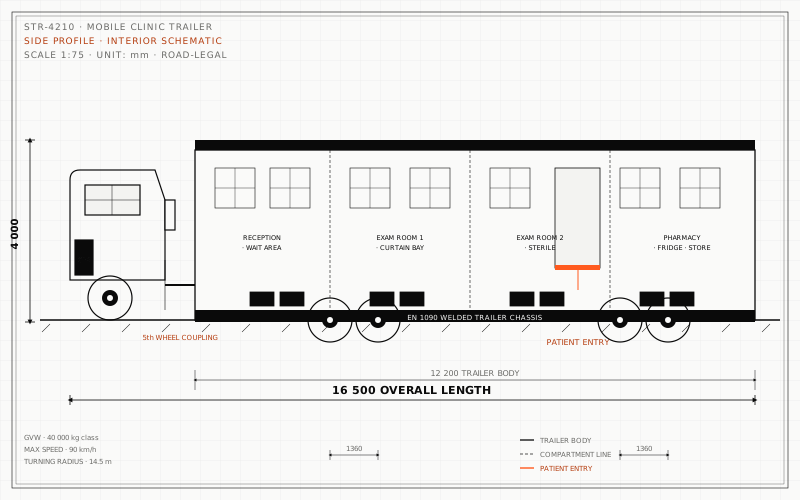
A mobile clinic trailer is a road-legal semi-trailer configured as a primary-care medical facility — examination rooms, triage, consultation spaces and on-board laboratory in a single integrated unit. structmod mobile clinic trailers deliver primary healthcare to communities where fixed infrastructure is absent, inadequate or inaccessible: rural villages, urban underserved populations, remote mining and oil & gas camps, refugee settlements, and communities isolated by natural disaster or conflict. A single towing vehicle deploys the trailer to site in 2-4 hours and operational throughput begins within the first shift.
Standard configuration includes a triage bay at the trailer entrance, 2-3 examination rooms with appropriate clinical adjacencies, a consultation office for longer patient conversations, a point-of-care laboratory with centrifuge, haematology analyser and rapid diagnostic kits, and a pharmacy dispensary with controlled-drug storage. Medical-grade electrical follows IEC 60364-7-710 with isolated power for Group 1 medical locations. HVAC delivers appropriate air changes for clinical use with HEPA filtration. Water, waste, medical gas and power connect to either external utilities or onboard autonomous systems for off-grid deployment.
structmod mobile clinic trailers support national health ministries running outreach programmes, NGOs delivering primary care in humanitarian missions, insurance carriers running corporate wellness clinics, oil & gas operators servicing workforce medical support, and private healthcare chains extending service to underserved areas. Lead time is 6-10 weeks from contract signature. EN 1090 EXC-2 chassis construction, DOT/E-mark vehicle homologation for road legality, and IEC 60364-7-710 medical electrical ensure regulatory compliance in all target markets.
Typical deployment sequence
- Hour 0 — trailer arrives on tow vehicle, positioned and chocked
- Hour 0–1 — stabilizer jacks deployed, leveling verified
- Hour 1–2 — hydraulic walls or slide-outs extended where fitted
- Hour 2–3 — utility connections (power, water, wastewater)
- Hour 3–4 — functional test per FAT protocol
- Hour 4 — operational handover with user training
Spec sheet — STR-2103
| Overall length | 14.3 m · 46.9 ft |
|---|---|
| Width (transport) | 2.99 m |
| Width (deployed) | 2.99 m |
| Height (transport) | 3.00 m |
| Floor area (deployed) | 42.8 m² |
| Dry weight | 15.3 t |
| Chassis | EN 10025 S355JR hot-rolled steel · EN 1090 EXC-2 |
| Welding quality | EN ISO 3834-3 |
| Envelope | Sandwich panel, PIR core 80 mm · λ ≈ 0.023 W/(m·K) |
| Fire resistance | EI-30 · tested to EN 13501-2 |
| Floor | Marine plywood on EPDM · R-10 slip rating |
| Electrical | 230 V / 50 Hz · TN-S · IEC 60364 compliant |
| HVAC | Split inverter heat pump · MERV-8 |
| Operating range | −25 °C to +50 °C ambient |
| Wind rating | Designed for 130 km/h basic wind (EN 1991-1-4) |
| Transport | ISO 668 footprint · CSC plate eligible (container variants) |
| Setup time | 5 hours · 2-person crew |
Full drawings, calculation notes, DoP, O&M manual and FAT report included with every unit. Specs indicative — configurable to project requirements.