Engineered once, deployable many times.
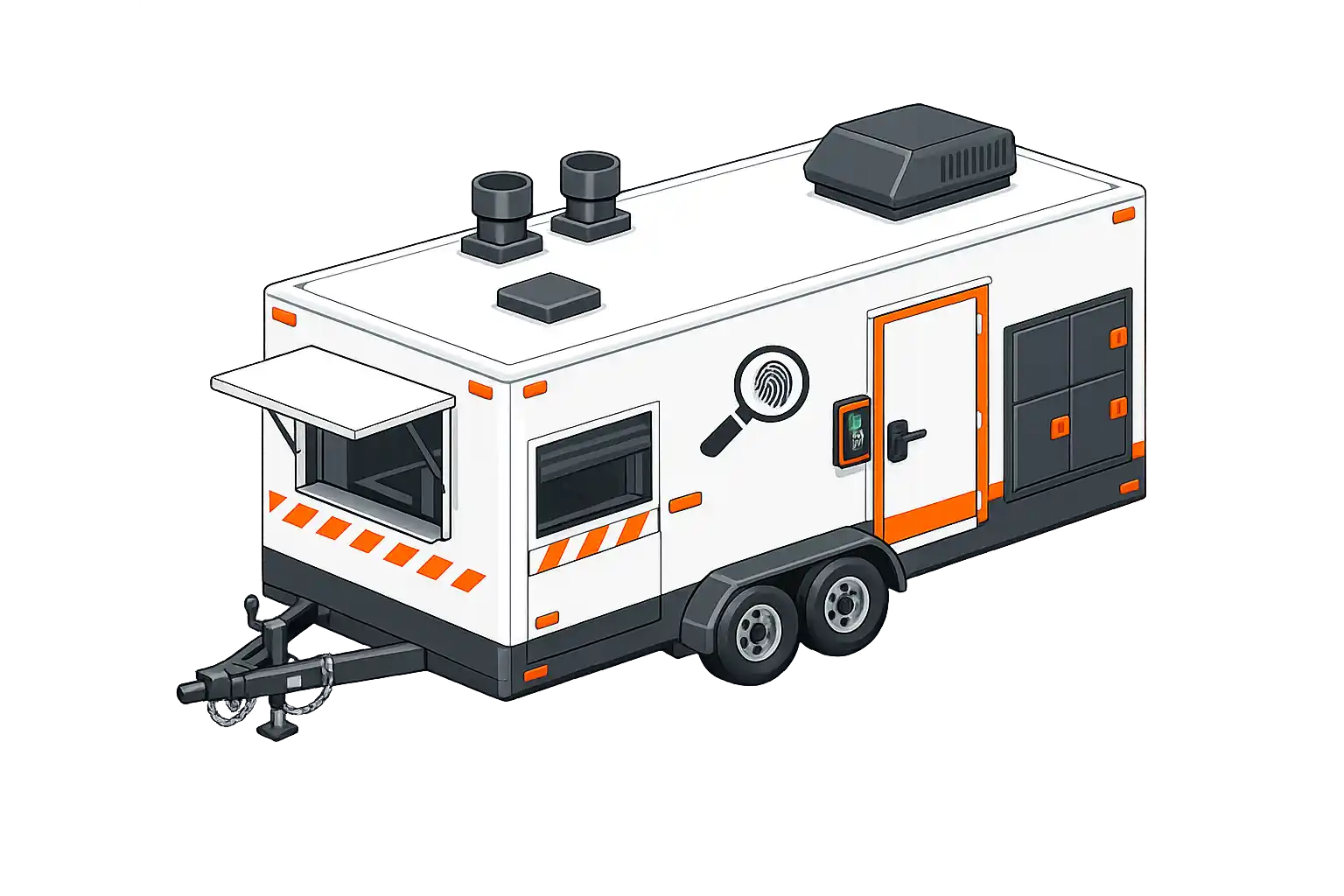
A mobile forensic lab is a road-deployable criminal investigation laboratory configured with DNA analysis, toxicology chemistry, evidence processing and chain-of-custody infrastructure for on-site or near-site forensic investigation. structmod mobile forensic lab trailers serve national police forensic services conducting field forensic operations, military forensic units supporting post-conflict investigation and mass grave analysis, counter-terrorism units processing evidence from incident sites, and specialty forensic operations (drug enforcement laboratory support, wildlife crime investigation) requiring rapid field deployment.
Standard configurations include DNA analysis bay (with pre-PCR and post-PCR contamination zones physically separated), toxicology chemistry bay (GC-MS or LC-MS instrumentation for drug analysis), evidence reception and chain-of-custody workspace (secure evidence storage, bar-coded evidence tracking, documentation), trace evidence examination (microscopy, spectroscopy for fibres, hair, glass, paint analysis), latent fingerprint development (cyanoacrylate fuming chamber, powder workstations, ALS examination), and supporting infrastructure (operator changing and PPE workflow, laboratory waste management, climate control sized to equipment heat load). Chain-of-custody is paramount — electronic evidence tracking with tamper-evident audit logging supports court-admissible forensic work.
structmod mobile forensic lab trailers serve forensic operations where field deployment matters — national police forensic services running field forensic support at major crime scenes, international criminal tribunals and war crimes investigation deploying to post-conflict zones for mass grave analysis, military forensic units supporting expeditionary operations, and specialty forensic programmes (counter-narcotics mobile testing, wildlife crime enforcement) requiring rapid field deployment. Lead time is 12-14 weeks from contract signature for stock configurations, 14-18 weeks for specialty configurations. Compliance includes ISO 17025 laboratory competence framework support, ENFSI guidelines (European Network of Forensic Science Institutes), and destination-country forensic accreditation framework.
Typical deployment sequence
- Hour 0 — trailer arrives on tow vehicle, positioned and chocked
- Hour 0–1 — stabilizer jacks deployed, leveling verified
- Hour 1–2 — hydraulic walls or slide-outs extended where fitted
- Hour 2–3 — utility connections (power, water, wastewater)
- Hour 3–4 — functional test per FAT protocol
- Hour 4 — operational handover with user training
Spec sheet — STR-2762
| Overall length | 12.2 m · 40.0 ft |
|---|---|
| Width (transport) | 2.99 m |
| Width (deployed) | 2.99 m |
| Height (transport) | 2.90 m |
| Floor area (deployed) | 36.5 m² |
| Dry weight | 17.2 t |
| Chassis | EN 10025 S355JR hot-rolled steel · EN 1090 EXC-2 |
| Welding quality | EN ISO 3834-3 |
| Envelope | Sandwich panel, PIR core 80 mm · λ ≈ 0.023 W/(m·K) |
| Fire resistance | EI-30 · tested to EN 13501-2 |
| Floor | Marine plywood on EPDM · R-10 slip rating |
| Electrical | 120/240 V · 60 Hz (US-spec) · IEC 60364 compliant |
| HVAC | Packaged rooftop · MERV-13 |
| Operating range | −25 °C to +50 °C ambient |
| Wind rating | Designed for 150 km/h basic wind (EN 1991-1-4) |
| Transport | ISO 668 footprint · CSC plate eligible (container variants) |
| Setup time | 4 hours · 2-person crew |
Full drawings, calculation notes, DoP, O&M manual and FAT report included with every unit. Specs indicative — configurable to project requirements.