Engineered once, deployable many times.
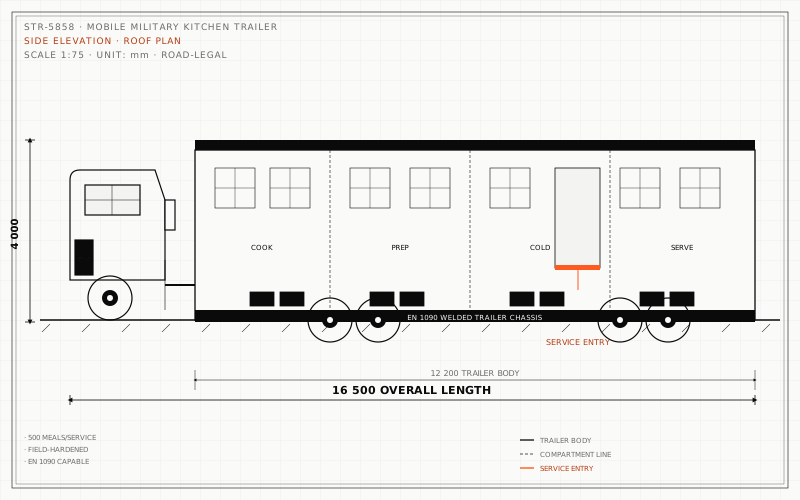
A mobile military kitchen trailer is a road-deployable battalion-scale catering facility for deployed military forces — producing hot rations for 1,000-2,000 personnel per service cycle in a trailer that moves with the formation. structmod mobile military kitchen trailers serve military catering doctrine where the kitchen deploys with the supported formation (battalion task force, brigade combat team, expeditionary force) rather than operating from fixed garrison facilities. The trailer-based configuration delivers field catering capability within hours of arrival at a new operating location, supporting the operational tempo that modern military operations demand.
Standard configurations include the cooking line (combi ovens, ranges, tilting kettles for soup and stew, bratt pans, fryers — sized to battalion ration count), cold storage (walk-in chiller for multi-day fresh stock, freezer for frozen ration components), dry storage with ration accountability infrastructure, preparation zones (vegetable prep, meat prep, baking — separated for HACCP compliance), plating and serving workflow, dishwashing with dirty-return and clean-storage separation, and supporting infrastructure (operator workspace, centralised gas supply, water heating, ventilation extract, refrigeration plant). Equipment is military-spec with rugged simplified maintenance and consumables sourced through standard military supply chains. Food safety workflow supports ISO 22000 principles with NFPA 96 ventilation for fire safety.
structmod mobile military kitchen trailers serve deployed forces requiring battalion-level field catering — peacekeeping operations (UN peacekeeping battalions in protracted deployments), training exercises at remote training areas, expeditionary deployments without host-nation catering support, and humanitarian support operations where military forces deploy to provide aid. Lead time is 10-12 weeks from contract signature for stock configurations, 12-14 weeks for specialty configurations (multi-dietary accommodation, specific national service catering doctrine). NATO STANAG 2560 medical evaluation principles, AMedP-9.1 modular support guidance, and destination-country military catering standards guide the design.
Typical deployment sequence
- Hour 0 — trailer arrives on tow vehicle, positioned and chocked
- Hour 0–1 — stabilizer jacks deployed, leveling verified
- Hour 1–2 — hydraulic walls or slide-outs extended where fitted
- Hour 2–3 — utility connections (power, water, wastewater)
- Hour 3–4 — functional test per FAT protocol
- Hour 4 — operational handover with user training
Spec sheet — STR-3139
| Overall length | 13.9 m · 45.6 ft |
|---|---|
| Width (transport) | 2.99 m |
| Width (deployed) | 2.99 m |
| Height (transport) | 2.80 m |
| Floor area (deployed) | 41.6 m² |
| Dry weight | 16.9 t |
| Chassis | EN 10025 S355JR hot-rolled steel · EN 1090 EXC-2 |
| Welding quality | EN ISO 3834-3 |
| Envelope | Sandwich panel, PIR core 80 mm · λ ≈ 0.023 W/(m·K) |
| Fire resistance | EI-30 · tested to EN 13501-2 |
| Floor | Marine plywood on EPDM · R-10 slip rating |
| Electrical | 400 V / 50 Hz · 3-phase · IEC 60364 compliant |
| HVAC | VRF multi-split · HEPA H13 (medical) |
| Operating range | −25 °C to +50 °C ambient |
| Wind rating | Designed for 140 km/h basic wind (EN 1991-1-4) |
| Transport | ISO 668 footprint · CSC plate eligible (container variants) |
| Setup time | 2–4 hours · 2-person crew |
Full drawings, calculation notes, DoP, O&M manual and FAT report included with every unit. Specs indicative — configurable to project requirements.