Engineered once, deployable many times.
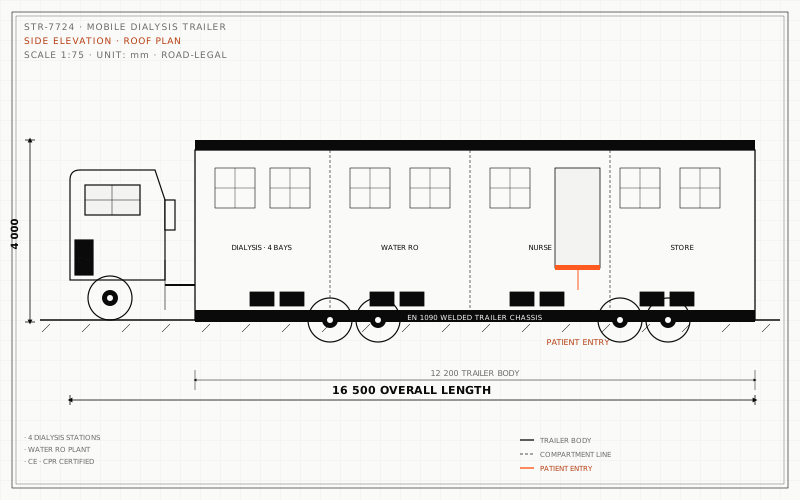
A mobile dialysis trailer brings haemodialysis capability to patient populations outside fixed renal unit catchments — rural areas with no local dialysis access, disaster response for patients with established renal failure, prison healthcare, workforce medical support in remote camps, and surge capacity during renal unit refurbishment. structmod mobile dialysis trailers accommodate 4-6 dialysis stations in parallel treatment workflow, with the water treatment and concentrate supply infrastructure that makes clinical dialysis possible — reverse osmosis plant, central bicarbonate supply, per-station acid concentrate, and dialysate distribution system.
Water treatment is the heart of a dialysis unit and the first engineering challenge on a mobile platform. structmod trailers integrate a full reverse osmosis water treatment plant dimensioned for the dialysis machine demand, with pre-filtration, softening, RO permeation, post-RO UV treatment, and delivery loop to each dialysis station. Water quality monitoring includes conductivity, chlorine, hardness, and microbiological surveillance per AAMI/ISO 23500 and EN 13959 standards. Central bicarbonate and acid concentrate supply feeds each station through a dedicated concentrate loop, eliminating the need for jug-at-machine concentrate handling and supporting reliable clinical dosing.
structmod mobile dialysis trailers serve national renal programmes running rural dialysis access, international development partners (WHO, UNHCR) supporting refugee populations with pre-existing renal failure, private renal care operators, and disaster response teams managing patients with chronic kidney disease in crisis settings. Lead time is 10-14 weeks from contract signature. Clinical commissioning includes water quality validation (AAMI/ISO 23500), machine-specific performance testing, and patient safety verification before first treatment.
Typical deployment sequence
- Hour 0 — trailer arrives on tow vehicle, positioned and chocked
- Hour 0–1 — stabilizer jacks deployed, leveling verified
- Hour 1–2 — hydraulic walls or slide-outs extended where fitted
- Hour 2–3 — utility connections (power, water, wastewater)
- Hour 3–4 — functional test per FAT protocol
- Hour 4 — operational handover with user training
Spec sheet — STR-2343
| Overall length | 14.3 m · 46.9 ft |
|---|---|
| Width (transport) | 2.99 m |
| Width (deployed) | 2.99 m |
| Height (transport) | 3.00 m |
| Floor area (deployed) | 42.8 m² |
| Dry weight | 12.3 t |
| Chassis | EN 10025 S355JR hot-rolled steel · EN 1090 EXC-2 |
| Welding quality | EN ISO 3834-3 |
| Envelope | Sandwich panel, PIR core 80 mm · λ ≈ 0.023 W/(m·K) |
| Fire resistance | EI-30 · tested to EN 13501-2 |
| Floor | Marine plywood on EPDM · R-10 slip rating |
| Electrical | 230 V / 50 Hz · TN-S · IEC 60364 compliant |
| HVAC | Split inverter heat pump · MERV-8 |
| Operating range | −25 °C to +50 °C ambient |
| Wind rating | Designed for 130 km/h basic wind (EN 1991-1-4) |
| Transport | ISO 668 footprint · CSC plate eligible (container variants) |
| Setup time | 5 hours · 2-person crew |
Full drawings, calculation notes, DoP, O&M manual and FAT report included with every unit. Specs indicative — configurable to project requirements.