Engineered once, deployable many times.
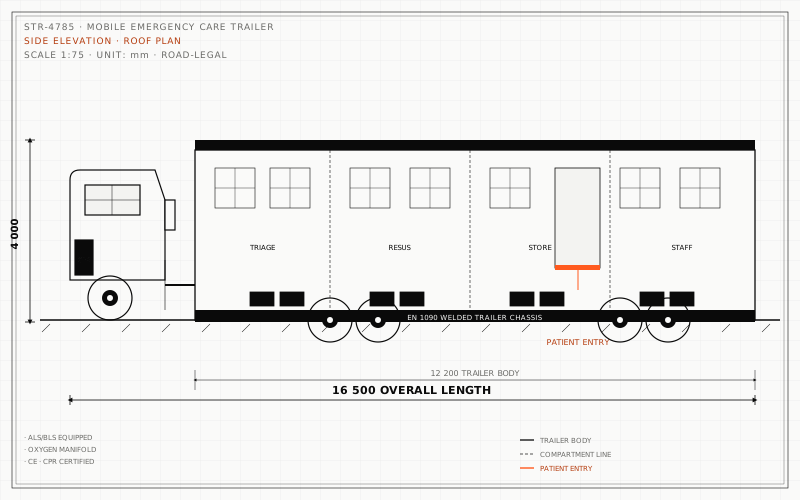
A mobile emergency care trailer is a road-deployable emergency department that delivers triage, resuscitation, and treatment capability for acute medical and trauma presentations. structmod mobile emergency care trailers support mass-casualty response, disaster relief, remote-event medical cover, hospital emergency department expansion during surge or refurbishment, and military forward emergency care. The unit configures around the emergency care workflow: triage at entry, resuscitation bay for life-threatening presentations, general treatment bays for stabilisation and definitive care, and observation for patients awaiting evacuation or admission.
The standard configuration provides a triage position at the trailer entrance (clinical screening, priority assignment, basic observations), a resuscitation bay equipped for cardiac arrest and major trauma (defibrillator, airway management, ventilator, full monitoring, medication trolley), 4-6 treatment bays (examination couches with monitoring, IV access, basic resuscitation equipment), and an observation/evacuation holding area. Medical gas, suction and IV infusion supplies reticulate through the trailer ceiling to each bay. Radiology support is typically through the co-located mobile x-ray trailer; point-of-care ultrasound (POCUS) is onboard for rapid bedside imaging.
structmod mobile emergency care trailers deploy with humanitarian response teams, national emergency services running event cover, hospitals augmenting ED capacity during flu season or mass-casualty drills, mining and oil & gas operators providing emergency response at remote sites, and military forward medical teams. Lead time is 10-12 weeks from contract signature. Clinical commissioning validates emergency workflow, life-safety systems, monitoring and alarm integration, infection control and PPE workflow — ready for acute clinical care on first deployment.
Typical deployment sequence
- Hour 0 — trailer arrives on tow vehicle, positioned and chocked
- Hour 0–1 — stabilizer jacks deployed, leveling verified
- Hour 1–2 — hydraulic walls or slide-outs extended where fitted
- Hour 2–3 — utility connections (power, water, wastewater)
- Hour 3–4 — functional test per FAT protocol
- Hour 4 — operational handover with user training
Spec sheet — STR-2892
| Overall length | 13.2 m · 43.3 ft |
|---|---|
| Width (transport) | 2.99 m |
| Width (deployed) | 2.99 m |
| Height (transport) | 2.70 m |
| Floor area (deployed) | 39.5 m² |
| Dry weight | 12.2 t |
| Chassis | EN 10025 S355JR hot-rolled steel · EN 1090 EXC-2 |
| Welding quality | EN ISO 3834-3 |
| Envelope | Sandwich panel, PIR core 80 mm · λ ≈ 0.023 W/(m·K) |
| Fire resistance | EI-30 · tested to EN 13501-2 |
| Floor | Marine plywood on EPDM · R-10 slip rating |
| Electrical | 230 V / 50 Hz · TN-S · IEC 60364 compliant |
| HVAC | Split inverter heat pump · MERV-8 |
| Operating range | −25 °C to +50 °C ambient |
| Wind rating | Designed for 130 km/h basic wind (EN 1991-1-4) |
| Transport | ISO 668 footprint · CSC plate eligible (container variants) |
| Setup time | 4 hours · 2-person crew |
Full drawings, calculation notes, DoP, O&M manual and FAT report included with every unit. Specs indicative — configurable to project requirements.