Engineered once, deployable many times.
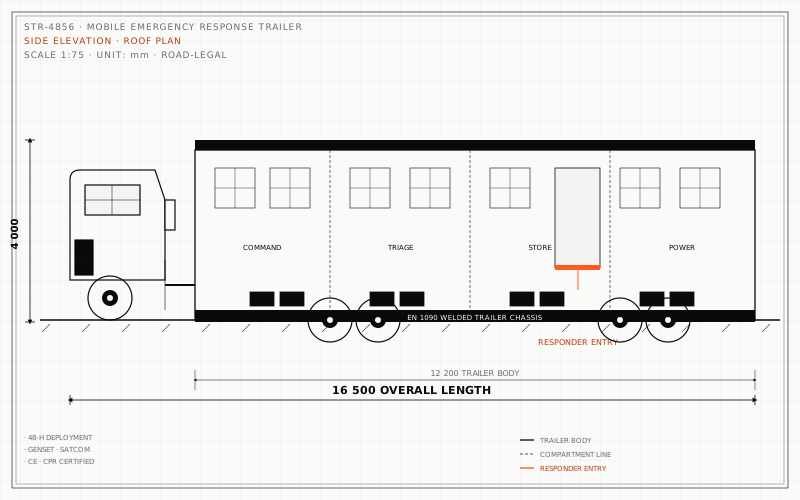
A mobile emergency response trailer is a road-deployable incident command facility for civil protection authorities, fire and rescue services, and disaster response agencies — providing the operations centre, planning workspace, communications infrastructure and logistics staging that incident management requires. structmod mobile emergency response trailers serve civil protection agencies (AFAD in Türkiye, BBK in Germany, equivalent agencies elsewhere), fire and rescue services standing up incident command at major events, and disaster response programmes pre-positioning capability across earthquake or flood-prone areas.
Standard configurations follow the Incident Command System (ICS) workflow: incident operations centre with displays for the common operational picture, planning section workspace with map walls and information management, logistics section with equipment staging and supply tracking, finance/admin section, public information liaison space, command office for the incident commander, communications room with multi-band radio operator positions, and rest area for sustained operations. Inter-trailer coupling supports multiple trailers combining into larger emergency operations centres for major incidents (mass-casualty events, regional disasters, national emergencies).
structmod mobile emergency response trailers deploy with civil protection forces responding to disaster sites (earthquakes, floods, wildfires, industrial accidents), pre-positioned at strategic locations for rapid deployment when disasters occur, and used by major events (large concerts, sporting events, political summits) requiring temporary incident command capability. The 2023 Kahramanmaraş earthquakes demonstrated the value of pre-positioned modular emergency response capability. Lead time is 8-10 weeks from contract signature for stock configurations. EN 1090 EXC-2 chassis, IEC 60364-1 commercial electrical, integration with national civil protection radio networks.
Typical deployment sequence
- Hour 0 — trailer arrives on tow vehicle, positioned and chocked
- Hour 0–1 — stabilizer jacks deployed, leveling verified
- Hour 1–2 — hydraulic walls or slide-outs extended where fitted
- Hour 2–3 — utility connections (power, water, wastewater)
- Hour 3–4 — functional test per FAT protocol
- Hour 4 — operational handover with user training
Spec sheet — STR-3360
| Overall length | 12.0 m · 39.4 ft |
|---|---|
| Width (transport) | 2.55 m |
| Width (deployed) | 5.00 m |
| Height (transport) | 2.70 m |
| Floor area (deployed) | 60.0 m² |
| Dry weight | 12.0 t |
| Chassis | EN 10025 S355JR hot-rolled steel · EN 1090 EXC-2 |
| Welding quality | EN ISO 3834-3 |
| Envelope | Sandwich panel, PIR core 80 mm · λ ≈ 0.023 W/(m·K) |
| Fire resistance | EI-30 · tested to EN 13501-2 |
| Floor | Marine plywood on EPDM · R-10 slip rating |
| Electrical | 230 V / 50 Hz · TN-S · IEC 60364 compliant |
| HVAC | Split inverter heat pump · MERV-8 |
| Operating range | −25 °C to +50 °C ambient |
| Wind rating | Designed for 130 km/h basic wind (EN 1991-1-4) |
| Transport | ISO 668 footprint · CSC plate eligible (container variants) |
| Setup time | 2 hours · 2-person crew |
Full drawings, calculation notes, DoP, O&M manual and FAT report included with every unit. Specs indicative — configurable to project requirements.