Engineered once, deployable many times.
A mobile kindergarten trailer is a road-deployable early-years education facility configured with age-appropriate learning spaces, washrooms and supporting infrastructure for 15-25 young children. structmod mobile kindergarten trailers serve early-years education programmes in underserved areas (where permanent kindergarten construction is not justified by population density), refugee and displaced population education programmes (serving children in protracted displacement), post-disaster education continuity programmes (restoring early-years services while permanent kindergartens are rebuilt), and temporary education programmes during permanent facility construction.
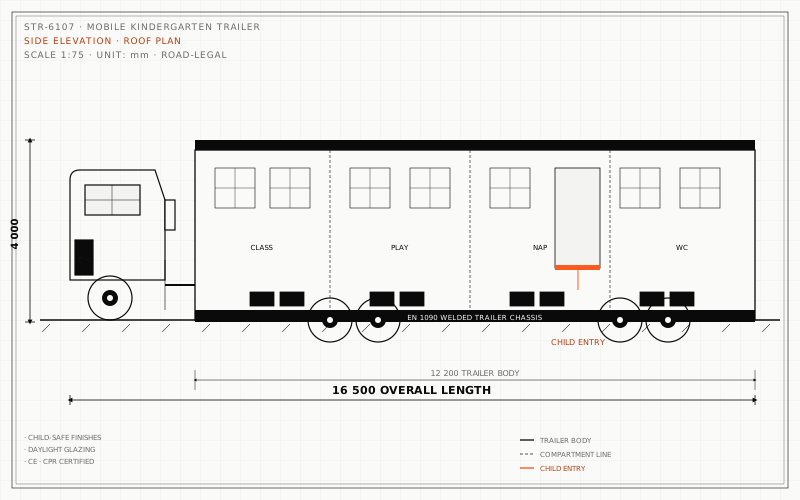
Standard configurations include a main learning and play area (typical 25-35 m² for 15-25 children), quiet sleep/nap zone for younger children's afternoon rest, age-appropriate washroom with low-height fixtures and child-safe features, teacher workstation and supplies storage, reception and parent meet-and-greet area, and supporting infrastructure (kitchenette for child meals or snacks, basic first aid, climate control). Safety features include low window restrictors, soft-edge furniture, electrical outlets at adult height with covers, secure entrance/exit control, and fenced play area interface where outdoor play is integrated. The mobile configuration enables education programmes to serve remote or dispersed populations that permanent construction cannot reach economically.
structmod mobile kindergarten trailers serve education programmes where road-deployable early-years capability matters — rural education programmes reaching dispersed populations, refugee education (UNHCR, UNICEF, education NGO programmes in protracted refugee situations), post-disaster education continuity programmes, and temporary education supporting permanent kindergarten construction. Lead time is 10-12 weeks from contract signature. EN 1090 EXC-2 chassis, IEC 60364-1 commercial electrical, destination-country accommodation for child-focused facility, fire safety per place-of-assembly standards.
Typical deployment sequence
- Hour 0 — trailer arrives on tow vehicle, positioned and chocked
- Hour 0–1 — stabilizer jacks deployed, leveling verified
- Hour 1–2 — hydraulic walls or slide-outs extended where fitted
- Hour 2–3 — utility connections (power, water, wastewater)
- Hour 3–4 — functional test per FAT protocol
- Hour 4 — operational handover with user training
Spec sheet — STR-2755
| Overall length | 15.5 m · 50.9 ft |
|---|---|
| Width (transport) | 2.55 m |
| Width (deployed) | 7.50 m |
| Height (transport) | 2.80 m |
| Floor area (deployed) | 116.3 m² |
| Dry weight | 10.5 t |
| Chassis | EN 10025 S355JR hot-rolled steel · EN 1090 EXC-2 |
| Welding quality | EN ISO 3834-3 |
| Envelope | Sandwich panel, PIR core 80 mm · λ ≈ 0.023 W/(m·K) |
| Fire resistance | EI-30 · tested to EN 13501-2 |
| Floor | Marine plywood on EPDM · R-10 slip rating |
| Electrical | 400 V / 50 Hz · 3-phase · IEC 60364 compliant |
| HVAC | VRF multi-split · HEPA H13 (medical) |
| Operating range | −25 °C to +50 °C ambient |
| Wind rating | Designed for 140 km/h basic wind (EN 1991-1-4) |
| Transport | ISO 668 footprint · CSC plate eligible (container variants) |
| Setup time | 2 hours · 2-person crew |
Full drawings, calculation notes, DoP, O&M manual and FAT report included with every unit. Specs indicative — configurable to project requirements.