Engineered once, deployable many times.
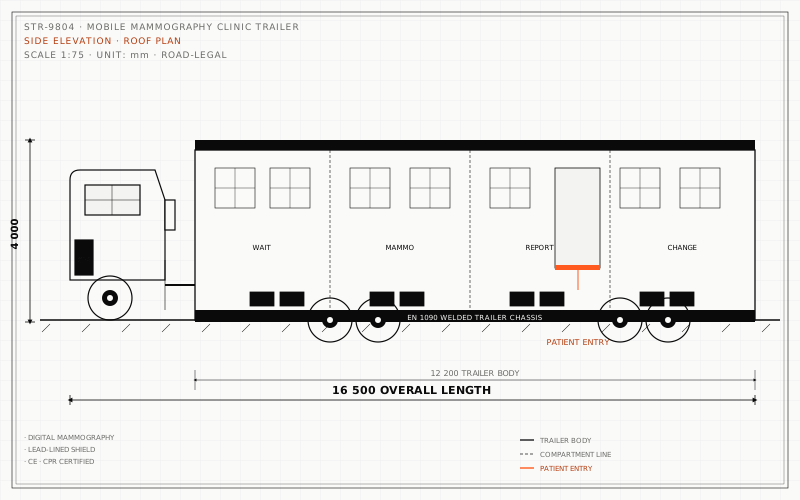
A mobile mammography trailer brings breast cancer screening to communities without easy access to fixed screening centres — rural populations, underserved urban populations, corporate workforce health programmes, and national screening programme coverage beyond the fixed centre network. structmod mobile mammography trailers integrate digital mammography (optional with tomosynthesis / 3D imaging), lead-shielded imaging room, technician console, patient waiting area and private changing cubicles into a road-legal semi-trailer that drives to site, sets up in 2-4 hours, and images 40-80 patients per clinical day.
The clinical workflow through the trailer follows screening programme protocols. Patients arrive at reception, complete any required documentation, wait in the seating area, enter the private changing cubicle for preparation, proceed to the imaging room for the mammography examination (typically 10-15 minutes with two-view bilateral imaging), and exit through the post-examination area. Digital image capture eliminates film handling; images transfer via secure network to the central screening reading centre for radiologist reporting. Tomosynthesis (digital breast tomosynthesis, DBT) adds 3D imaging capability recommended by many screening programmes for dense breast tissue — this is specified as an imaging-system upgrade at procurement.
structmod mobile mammography trailers serve national cancer screening programmes (the UK NHS Breast Screening Programme, Turkey Kanser Tarama Programı, similar programmes across Europe and the Gulf), regional cancer centres running outreach, corporate health programmes, and NGO-led awareness campaigns. Lead time is 10-14 weeks from contract signature. Lead shielding specification follows NCRP Report 147 for mammography workloads; mammography-specific radiation safety (IEC 60601-2-45) and EU Medical Exposures Directive compliance are validated at commissioning.
Typical deployment sequence
- Hour 0 — trailer arrives on tow vehicle, positioned and chocked
- Hour 0–1 — stabilizer jacks deployed, leveling verified
- Hour 1–2 — hydraulic walls or slide-outs extended where fitted
- Hour 2–3 — utility connections (power, water, wastewater)
- Hour 3–4 — functional test per FAT protocol
- Hour 4 — operational handover with user training
Spec sheet — STR-3334
| Overall length | 13.4 m · 44.0 ft |
|---|---|
| Width (transport) | 2.99 m |
| Width (deployed) | 2.99 m |
| Height (transport) | 3.10 m |
| Floor area (deployed) | 40.1 m² |
| Dry weight | 13.4 t |
| Chassis | EN 10025 S355JR hot-rolled steel · EN 1090 EXC-2 |
| Welding quality | EN ISO 3834-3 |
| Envelope | Sandwich panel, PIR core 80 mm · λ ≈ 0.023 W/(m·K) |
| Fire resistance | EI-30 · tested to EN 13501-2 |
| Floor | Marine plywood on EPDM · R-10 slip rating |
| Electrical | 400 V / 50 Hz · 3-phase · IEC 60364 compliant |
| HVAC | VRF multi-split · HEPA H13 (medical) |
| Operating range | −25 °C to +50 °C ambient |
| Wind rating | Designed for 140 km/h basic wind (EN 1991-1-4) |
| Transport | ISO 668 footprint · CSC plate eligible (container variants) |
| Setup time | 2–4 hours · 2-person crew |
Full drawings, calculation notes, DoP, O&M manual and FAT report included with every unit. Specs indicative — configurable to project requirements.