Engineered once, deployable many times.
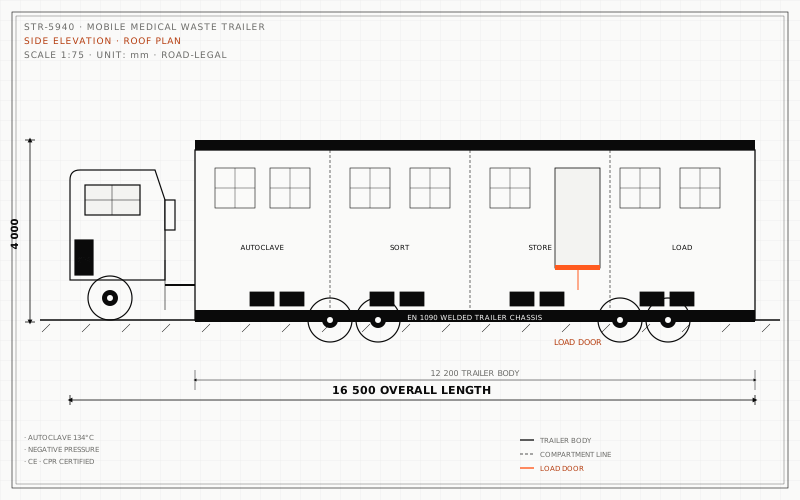
A mobile medical waste trailer is a road-deployable clinical waste treatment facility — autoclave for sterilisation of infectious waste, with closed-loop processing to prevent operator exposure during loading, treatment and discharge. structmod mobile medical waste trailers serve hospital networks managing waste streams across multiple sites without dedicated central treatment facility, military deployments where external waste contractor service is unavailable, humanitarian operations in disaster zones, and field hospital configurations where waste treatment must be self-contained.
Standard configurations include the autoclave (typical 200-500 kg capacity per cycle) integrated into the trailer with sealed loading bay protecting operators from infectious exposure, automated cycle control following EN 285 / ISO 17665 sterilisation parameters (typical 134°C for 18 minutes or equivalent dwell time), discharge bay for treated sterile waste suitable for municipal disposal stream, water and chemical supply for autoclave operation, supporting infrastructure (operator workstation, PPE storage, eyewash and emergency shower, cycle records storage), and onboard utilities (water tanks, generator) for autonomous operation where site utilities not available.
structmod mobile medical waste trailers serve hospital networks running internal waste treatment programmes (cost or sovereignty reasons for not using external contractors), military deployments standing up self-sufficient medical capability, humanitarian operations in disaster zones where waste infrastructure is destroyed, and specialty facilities (research, clinical trial sites, burns units) generating high-volume specialist waste streams. The trailer-based configuration supports rotating deployment between multiple sites within a hospital network, treating accumulated waste at each site before moving to the next. Lead time is 10-12 weeks from contract signature.
Typical deployment sequence
- Hour 0 — trailer arrives on tow vehicle, positioned and chocked
- Hour 0–1 — stabilizer jacks deployed, leveling verified
- Hour 1–2 — hydraulic walls or slide-outs extended where fitted
- Hour 2–3 — utility connections (power, water, wastewater)
- Hour 3–4 — functional test per FAT protocol
- Hour 4 — operational handover with user training
Spec sheet — STR-2789
| Overall length | 14.9 m · 48.9 ft |
|---|---|
| Width (transport) | 2.55 m |
| Width (deployed) | 7.50 m |
| Height (transport) | 3.20 m |
| Floor area (deployed) | 111.8 m² |
| Dry weight | 17.9 t |
| Chassis | EN 10025 S355JR hot-rolled steel · EN 1090 EXC-2 |
| Welding quality | EN ISO 3834-3 |
| Envelope | Sandwich panel, PIR core 80 mm · λ ≈ 0.023 W/(m·K) |
| Fire resistance | EI-30 · tested to EN 13501-2 |
| Floor | Marine plywood on EPDM · R-10 slip rating |
| Electrical | 120/240 V · 60 Hz (US-spec) · IEC 60364 compliant |
| HVAC | Packaged rooftop · MERV-13 |
| Operating range | −25 °C to +50 °C ambient |
| Wind rating | Designed for 150 km/h basic wind (EN 1991-1-4) |
| Transport | ISO 668 footprint · CSC plate eligible (container variants) |
| Setup time | 2–4 hours · 2-person crew |
Full drawings, calculation notes, DoP, O&M manual and FAT report included with every unit. Specs indicative — configurable to project requirements.