Engineered once, deployable many times.
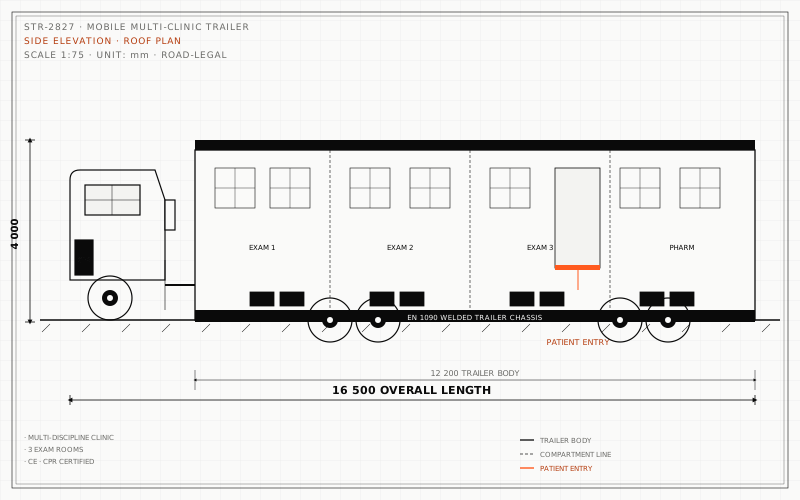
A mobile multi-clinic trailer combines multiple clinical specialties into a single integrated unit, allowing outreach programmes to deliver comprehensive healthcare on a single trailer rather than deploying multiple specialist trailers to each site. structmod mobile multi-clinic trailers are customised to the outreach programme's specialty mix — a typical configuration might combine general practice, paediatric, gynaecology and dental; another might combine primary care, ophthalmology, audiology and nutrition screening. The common design factor is that multiple clinical functions share the trailer envelope while each retaining appropriate privacy, infection control and clinical workflow.
The trailer interior divides into clinical zones connected by a central corridor. Each zone is configured for its specialty function — examination rooms sized and equipped for the clinical tasks, supporting equipment and consumables storage, and appropriate ergonomics. Shared infrastructure includes reception and waiting area at the trailer entrance, staff break and preparation area, sterilisation and cleaning support where applicable, and a patient progression flow that keeps clinical streams separated without duplicating every support function. MEP systems (HVAC, medical gas where needed, power, communications) serve all clinical zones from shared onboard or external supply.
structmod mobile multi-clinic trailers serve outreach programmes where the logistics of deploying multiple single-specialty trailers is impractical — rural communities with limited site space, island populations, humanitarian missions with tight logistics chains, and corporate or school health programmes where multiple services are delivered in a single site visit. Configuration is set at procurement based on the clinical programme; typical specialty combinations are 2-4 clinical functions per trailer. Lead time is 12-14 weeks from contract signature, extending slightly for extensively customised combinations due to MEP coordination and biomedical equipment integration.
Typical deployment sequence
- Hour 0 — trailer arrives on tow vehicle, positioned and chocked
- Hour 0–1 — stabilizer jacks deployed, leveling verified
- Hour 1–2 — hydraulic walls or slide-outs extended where fitted
- Hour 2–3 — utility connections (power, water, wastewater)
- Hour 3–4 — functional test per FAT protocol
- Hour 4 — operational handover with user training
Spec sheet — STR-2703
| Overall length | 14.3 m · 46.9 ft |
|---|---|
| Width (transport) | 2.99 m |
| Width (deployed) | 2.99 m |
| Height (transport) | 3.00 m |
| Floor area (deployed) | 42.8 m² |
| Dry weight | 12.3 t |
| Chassis | EN 10025 S355JR hot-rolled steel · EN 1090 EXC-2 |
| Welding quality | EN ISO 3834-3 |
| Envelope | Sandwich panel, PIR core 80 mm · λ ≈ 0.023 W/(m·K) |
| Fire resistance | EI-30 · tested to EN 13501-2 |
| Floor | Marine plywood on EPDM · R-10 slip rating |
| Electrical | 230 V / 50 Hz · TN-S · IEC 60364 compliant |
| HVAC | Split inverter heat pump · MERV-8 |
| Operating range | −25 °C to +50 °C ambient |
| Wind rating | Designed for 130 km/h basic wind (EN 1991-1-4) |
| Transport | ISO 668 footprint · CSC plate eligible (container variants) |
| Setup time | 5 hours · 2-person crew |
Full drawings, calculation notes, DoP, O&M manual and FAT report included with every unit. Specs indicative — configurable to project requirements.