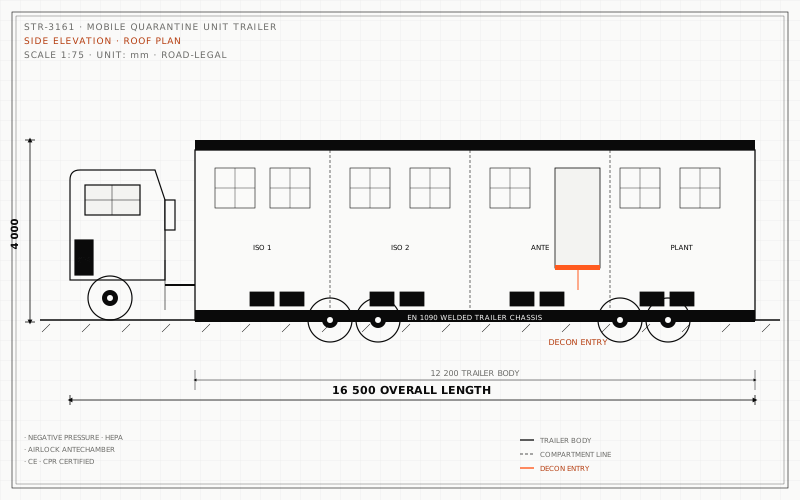
Engineered once, deployable many times.
A mobile quarantine trailer is a road-deployable isolation facility for infectious disease management — negative-pressure isolation room with anteroom airlock for PPE workflow and HEPA-filtered exhaust to prevent pathogen spread. structmod mobile quarantine trailers deploy to outbreak response sites within hours of activation, providing isolation capability before fixed quarantine infrastructure can be mobilised, supporting border health screening at international entry points, and providing surge isolation capacity for hospitals during epidemic peaks.
Standard configurations include 1-2 isolation patient bays (typically 8-12 m² each with single bed, en-suite bathroom, and patient monitoring), anteroom airlock buffering between corridor and isolation zone with PPE donning/doffing infrastructure, control vestibule for staff workflow management, and HEPA-filtered exhaust system (HEPA H13 filtration, discharge above the trailer roofline). Pressure differential is maintained at -10 Pa to -25 Pa relative to corridor, with pressure monitoring and audible/visual alarms for any deviation. Patient flow follows infection control workflow: corridor (clean) → anteroom (PPE donning) → isolation room → anteroom (PPE doffing) → corridor.
structmod mobile quarantine trailers serve outbreak response programmes where isolation capability must deploy within hours of activation, border health authorities running quarantine for symptomatic international travellers, hospital isolation surge during epidemic peaks (where existing fixed isolation runs out of capacity), and humanitarian outbreak response (Ebola, Marburg, novel respiratory viruses in fragile health systems). Lead time is 12-14 weeks from contract signature for stock configurations. Compliance includes WHO Infection Prevention and Control standards, ASHRAE 170 ventilation for healthcare facilities, CDC Isolation Precautions guidance.
Typical deployment sequence
- Hour 0 — trailer arrives on tow vehicle, positioned and chocked
- Hour 0–1 — stabilizer jacks deployed, leveling verified
- Hour 1–2 — hydraulic walls or slide-outs extended where fitted
- Hour 2–3 — utility connections (power, water, wastewater)
- Hour 3–4 — functional test per FAT protocol
- Hour 4 — operational handover with user training
Spec sheet — STR-3050
| Overall length | 13.0 m · 42.7 ft |
|---|---|
| Width (transport) | 2.99 m |
| Width (deployed) | 2.99 m |
| Height (transport) | 2.90 m |
| Floor area (deployed) | 38.9 m² |
| Dry weight | 17.0 t |
| Chassis | EN 10025 S355JR hot-rolled steel · EN 1090 EXC-2 |
| Welding quality | EN ISO 3834-3 |
| Envelope | Sandwich panel, PIR core 80 mm · λ ≈ 0.023 W/(m·K) |
| Fire resistance | EI-30 · tested to EN 13501-2 |
| Floor | Marine plywood on EPDM · R-10 slip rating |
| Electrical | 120/240 V · 60 Hz (US-spec) · IEC 60364 compliant |
| HVAC | Packaged rooftop · MERV-13 |
| Operating range | −25 °C to +50 °C ambient |
| Wind rating | Designed for 150 km/h basic wind (EN 1991-1-4) |
| Transport | ISO 668 footprint · CSC plate eligible (container variants) |
| Setup time | 2 hours · 2-person crew |
Full drawings, calculation notes, DoP, O&M manual and FAT report included with every unit. Specs indicative — configurable to project requirements.