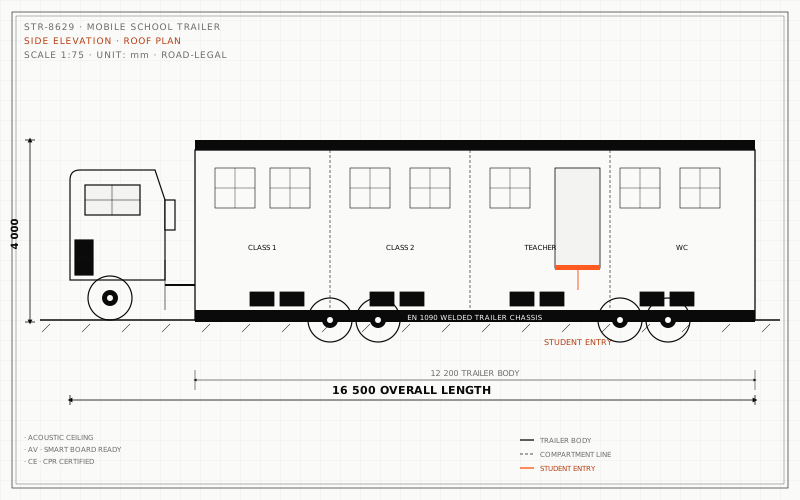
Engineered once, deployable many times.
A mobile school trailer is a road-deployable classroom configured for primary or secondary education — individual student desks, teacher workstation, interactive whiteboard, and supporting learning infrastructure for 15-25 students. structmod mobile school trailers serve education programmes expanding capacity on constrained timelines (new-term openings, post-disaster reconstruction), education programmes in underserved or growing areas (where permanent school construction is not yet justified but education needs immediate response), refugee education programmes (UNHCR, UNICEF, education NGO programmes), and school districts adding capacity to existing campuses during enrolment growth peaks.
Standard configurations include classroom space (typical 45-55 m² for 15-25 students), teacher workstation at front, interactive whiteboard or smartboard for digital content delivery, student desks arranged in rows or collaborative pods per teaching methodology, storage for student work and teaching materials, optional reading nook for quiet individual study, and supporting infrastructure (climate control, natural lighting with blinds, acoustic treatment for speech intelligibility). Safety features include appropriate fire exits sized for student egress, low-handle door hardware, illuminated escape routes, and ADA-equivalent accessibility. Technology infrastructure supports modern pedagogy — power at every desk position, network connectivity, audio-visual integration for multimedia teaching.
structmod mobile school trailers serve education programmes where road-deployable classroom capability matters — rural education extending to dispersed populations, refugee education in protracted displacement (Syrian refugees in Türkiye, Rohingya in Bangladesh, Ukrainian refugees across Europe), post-disaster education continuity restoring education while permanent schools are rebuilt, and temporary classroom capacity during school renovations or expansions. Lead time is 8-10 weeks from contract signature. EN 1090 EXC-2 chassis, IEC 60364-1 commercial electrical, fire safety per place-of-assembly standards, accessibility per ADA equivalent.
Typical deployment sequence
- Hour 0 — trailer arrives on tow vehicle, positioned and chocked
- Hour 0–1 — stabilizer jacks deployed, leveling verified
- Hour 1–2 — hydraulic walls or slide-outs extended where fitted
- Hour 2–3 — utility connections (power, water, wastewater)
- Hour 3–4 — functional test per FAT protocol
- Hour 4 — operational handover with user training
Spec sheet — STR-2125
| Overall length | 12.5 m · 41.0 ft |
|---|---|
| Width (transport) | 2.55 m |
| Width (deployed) | 7.50 m |
| Height (transport) | 2.80 m |
| Floor area (deployed) | 93.8 m² |
| Dry weight | 10.5 t |
| Chassis | EN 10025 S355JR hot-rolled steel · EN 1090 EXC-2 |
| Welding quality | EN ISO 3834-3 |
| Envelope | Sandwich panel, PIR core 80 mm · λ ≈ 0.023 W/(m·K) |
| Fire resistance | EI-30 · tested to EN 13501-2 |
| Floor | Marine plywood on EPDM · R-10 slip rating |
| Electrical | 400 V / 50 Hz · 3-phase · IEC 60364 compliant |
| HVAC | VRF multi-split · HEPA H13 (medical) |
| Operating range | −25 °C to +50 °C ambient |
| Wind rating | Designed for 140 km/h basic wind (EN 1991-1-4) |
| Transport | ISO 668 footprint · CSC plate eligible (container variants) |
| Setup time | 2 hours · 2-person crew |
Full drawings, calculation notes, DoP, O&M manual and FAT report included with every unit. Specs indicative — configurable to project requirements.