Engineered once, deployable many times.
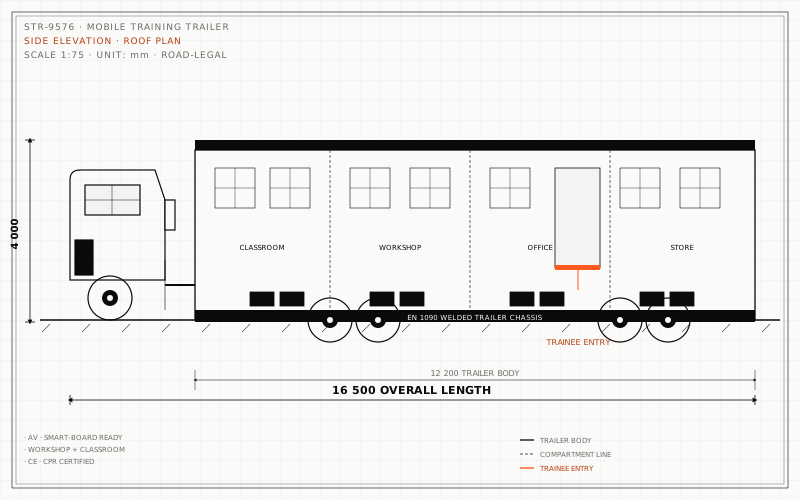
A mobile training trailer is a road-deployable training and certification facility configured for industrial, vocational, professional or military training programmes at the workplace or field site. structmod mobile training trailers serve industrial safety training programmes (mining, oil & gas, construction, manufacturing) delivering certification at worksites, military training units conducting specialty courses at operating bases, professional certification programmes (medical, technical, regulatory) reaching practitioners at their locations, and vocational training programmes extending trade education to remote areas.
Standard configurations include classroom/theory space (typical 30-45 m² for 15-25 trainees with teacher position, whiteboard or smartboard, student seating in theatre or classroom layout), simulator/practical space (configured for the specific training topic — equipment simulator, procedure practice area, specialty training apparatus), instructor's workspace with course materials and assessment infrastructure, printer and paperwork area for certification documentation, and supporting infrastructure (climate control, appropriate lighting for training activities, washroom, kitchenette for breaks). Specialty configurations include welding training booths, vehicle operator simulators, medical procedure practice rooms, mining safety simulators, and other topic-specific training infrastructure.
structmod mobile training trailers serve organisations where on-site training delivery matters — reducing the overhead of trainee travel to central training centres, maintaining workforce availability by training on-site, and ensuring training relevance by delivering it in the working environment. Common use cases: mining safety certification campaigns visiting multiple sites annually, manufacturing compliance training across multi-site industrial operators, military specialty training reaching deployed units, professional continuing education for medical, engineering or technical practitioners. Lead time is 10-12 weeks from contract signature. EN 1090 EXC-2 chassis, IEC 60364-1 commercial electrical, specialty equipment integration per training topic.
Typical deployment sequence
- Hour 0 — trailer arrives on tow vehicle, positioned and chocked
- Hour 0–1 — stabilizer jacks deployed, leveling verified
- Hour 1–2 — hydraulic walls or slide-outs extended where fitted
- Hour 2–3 — utility connections (power, water, wastewater)
- Hour 3–4 — functional test per FAT protocol
- Hour 4 — operational handover with user training
Spec sheet — STR-2337
| Overall length | 13.7 m · 44.9 ft |
|---|---|
| Width (transport) | 2.55 m |
| Width (deployed) | 7.50 m |
| Height (transport) | 3.00 m |
| Floor area (deployed) | 102.8 m² |
| Dry weight | 15.7 t |
| Chassis | EN 10025 S355JR hot-rolled steel · EN 1090 EXC-2 |
| Welding quality | EN ISO 3834-3 |
| Envelope | Sandwich panel, PIR core 80 mm · λ ≈ 0.023 W/(m·K) |
| Fire resistance | EI-30 · tested to EN 13501-2 |
| Floor | Marine plywood on EPDM · R-10 slip rating |
| Electrical | 230 V / 50 Hz · TN-S · IEC 60364 compliant |
| HVAC | Split inverter heat pump · MERV-8 |
| Operating range | −25 °C to +50 °C ambient |
| Wind rating | Designed for 130 km/h basic wind (EN 1991-1-4) |
| Transport | ISO 668 footprint · CSC plate eligible (container variants) |
| Setup time | 4 hours · 2-person crew |
Full drawings, calculation notes, DoP, O&M manual and FAT report included with every unit. Specs indicative — configurable to project requirements.