Engineered once, deployable many times.
A mobile vaccine transport trailer is a specialised refrigerated trailer engineered for cold-chain pharmaceutical transport — vaccines, biologics, blood products and temperature-sensitive medical supplies delivered intact from manufacturer or central depot to clinical administration points. structmod mobile vaccine transport trailers serve national immunisation programmes distributing vaccines across regional networks, humanitarian vaccine campaigns reaching remote populations (UNICEF, WHO, NGO partners), pharmaceutical company distribution networks supporting commercial product launches, and outbreak response distributing emergency vaccines.
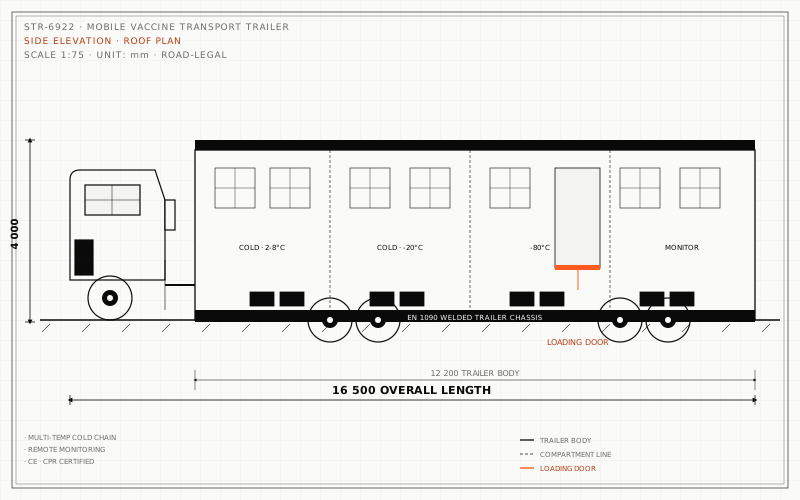
Standard configurations include the temperature-controlled cargo compartment with multiple temperature zones (typically +2°C to +8°C for standard vaccines, -20°C for some biologics, -70°C for specific products like COVID-19 mRNA vaccines), redundant refrigeration with primary and backup cooling units to prevent excursion if primary unit fails, continuous temperature data logging at multiple positions through the cargo compartment with audit-trail records per WHO PQS (Performance Quality Standards) requirements, supplementary backup (battery-powered cooling, dry ice or liquid nitrogen reservoirs depending on temperature requirements), and supporting infrastructure (operator workspace, vaccine receipt and dispatch documentation, security infrastructure for valuable pharmaceutical cargo).
structmod mobile vaccine transport trailers serve immunisation programmes globally — national EPI (Expanded Programme on Immunization) networks distributing routine childhood vaccines, COVID-19 mass vaccination campaigns requiring ultra-cold chain (-70°C) for mRNA vaccines, humanitarian campaigns delivering measles, polio and other vaccines to refugee or displaced populations, and pharmaceutical company commercial distribution. Lead time is 10-12 weeks from contract signature. Compliance includes WHO PQS for vaccine transport, EU GDP (Good Distribution Practice) Guidelines, IATA Time and Temperature Sensitive Label requirements for pharmaceutical transport.
Typical deployment sequence
- Hour 0 — trailer arrives on tow vehicle, positioned and chocked
- Hour 0–1 — stabilizer jacks deployed, leveling verified
- Hour 1–2 — hydraulic walls or slide-outs extended where fitted
- Hour 2–3 — utility connections (power, water, wastewater)
- Hour 3–4 — functional test per FAT protocol
- Hour 4 — operational handover with user training
Spec sheet — STR-3256
| Overall length | 13.6 m · 44.6 ft |
|---|---|
| Width (transport) | 2.99 m |
| Width (deployed) | 2.99 m |
| Height (transport) | 3.10 m |
| Floor area (deployed) | 40.7 m² |
| Dry weight | 16.6 t |
| Chassis | EN 10025 S355JR hot-rolled steel · EN 1090 EXC-2 |
| Welding quality | EN ISO 3834-3 |
| Envelope | Sandwich panel, PIR core 80 mm · λ ≈ 0.023 W/(m·K) |
| Fire resistance | EI-30 · tested to EN 13501-2 |
| Floor | Marine plywood on EPDM · R-10 slip rating |
| Electrical | 400 V / 50 Hz · 3-phase · IEC 60364 compliant |
| HVAC | VRF multi-split · HEPA H13 (medical) |
| Operating range | −25 °C to +50 °C ambient |
| Wind rating | Designed for 140 km/h basic wind (EN 1991-1-4) |
| Transport | ISO 668 footprint · CSC plate eligible (container variants) |
| Setup time | 3 hours · 2-person crew |
Full drawings, calculation notes, DoP, O&M manual and FAT report included with every unit. Specs indicative — configurable to project requirements.