Engineered once, deployable many times.
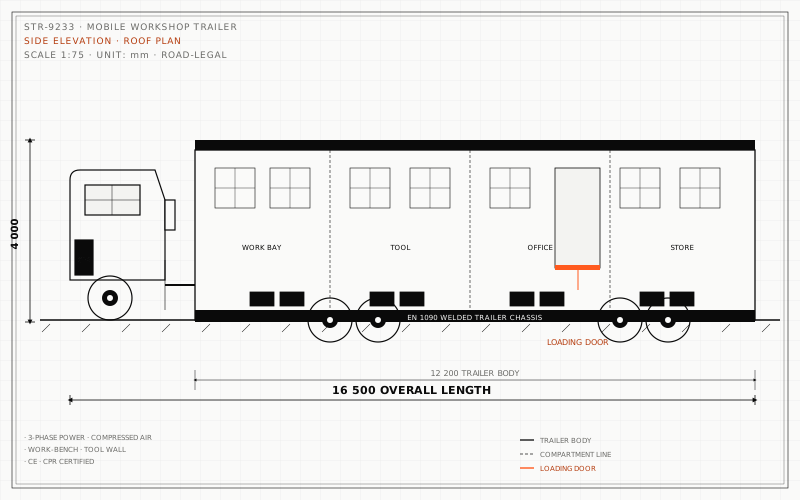
A mobile workshop trailer is a road-deployable industrial workshop configured for field equipment maintenance, fabrication, and repair at remote operating sites. structmod mobile workshop trailers serve mining and oil & gas operators establishing maintenance capability at remote exploration or production sites, military forces standing up vehicle and equipment workshops at deployed bases, infrastructure projects (utilities, road construction, renewable energy) requiring on-site workshop capability, and humanitarian deployments where fleet maintenance must be self-sufficient.
Standard configurations include workbenches with integrated vice positions (typical 3-6 m of bench length), mechanical workshop equipment (metal lathe, drill press, grinder, band saw — sized to maintenance scope), welding bay with TIG/MIG/stick capability and fume extraction per EN 12792, 3-phase electrical infrastructure (typical 32-63A per workshop bay), compressed air distribution to multiple service points, parts and tool storage with security infrastructure, and supporting facilities (operator washroom, small office for paperwork, climate control). Mechanical bay at one end of the trailer houses air compressor, welding power supplies, electrical distribution, and environmental control equipment.
structmod mobile workshop trailers serve sectors where road-deployable workshop capability supports the operational programme — mining site maintenance following the geological campaign across exploration locations, oil & gas maintenance at remote wellheads or pipeline operations, military vehicle workshops at deployed bases, infrastructure project fleet maintenance at multi-site projects, and humanitarian fleet maintenance during disaster response. Lead time is 10-12 weeks from contract signature for stock configurations. EN 1090 EXC-2 chassis, IEC 60364-1 commercial/industrial electrical with earth fault protection, fire safety per workshop fire-load classification, ventilation per industrial standards.
Typical deployment sequence
- Hour 0 — trailer arrives on tow vehicle, positioned and chocked
- Hour 0–1 — stabilizer jacks deployed, leveling verified
- Hour 1–2 — hydraulic walls or slide-outs extended where fitted
- Hour 2–3 — utility connections (power, water, wastewater)
- Hour 3–4 — functional test per FAT protocol
- Hour 4 — operational handover with user training
Spec sheet — STR-2370
| Overall length | 13.0 m · 42.7 ft |
|---|---|
| Width (transport) | 2.55 m |
| Width (deployed) | 5.00 m |
| Height (transport) | 2.70 m |
| Floor area (deployed) | 65.0 m² |
| Dry weight | 12.0 t |
| Chassis | EN 10025 S355JR hot-rolled steel · EN 1090 EXC-2 |
| Welding quality | EN ISO 3834-3 |
| Envelope | Sandwich panel, PIR core 80 mm · λ ≈ 0.023 W/(m·K) |
| Fire resistance | EI-30 · tested to EN 13501-2 |
| Floor | Marine plywood on EPDM · R-10 slip rating |
| Electrical | 230 V / 50 Hz · TN-S · IEC 60364 compliant |
| HVAC | Split inverter heat pump · MERV-8 |
| Operating range | −25 °C to +50 °C ambient |
| Wind rating | Designed for 130 km/h basic wind (EN 1991-1-4) |
| Transport | ISO 668 footprint · CSC plate eligible (container variants) |
| Setup time | 2 hours · 2-person crew |
Full drawings, calculation notes, DoP, O&M manual and FAT report included with every unit. Specs indicative — configurable to project requirements.