Engineered once, deployable many times.
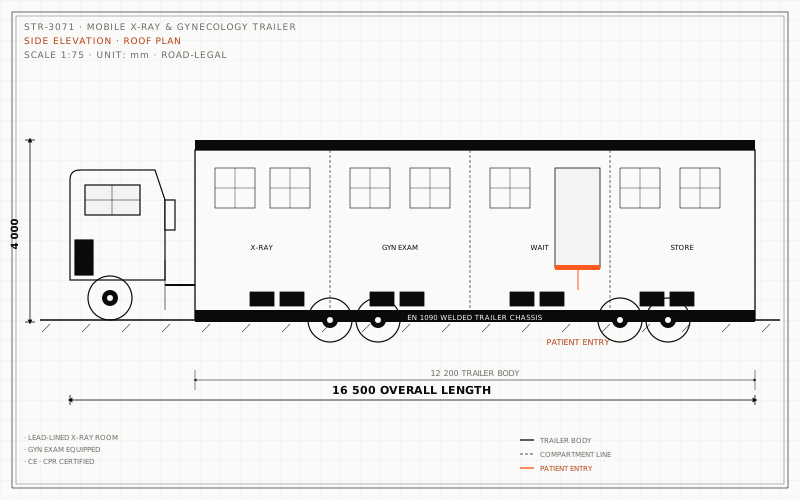
A mobile x-ray and gynaecology trailer combines two clinical functions often delivered together in outreach health programmes — general radiographic imaging and women's health examination including cervical screening and pelvic ultrasound. structmod mobile x-ray and gynaecology trailers integrate a lead-shielded digital radiography room, a gynaecology examination room with pelvic ultrasound, cervical screening workflow and supporting spaces into a single road-deployable unit — serving rural outreach programmes, refugee and displaced-population care, workforce health screening, and national programmes extending women's health coverage beyond fixed clinic networks.
The trailer workflow separates the two clinical functions with appropriate privacy and infection control. The x-ray side includes the imaging room (lead-shielded per NCRP Report 147), technician console with lead-protected viewing, and a small patient preparation bay. The gynaecology side includes the examination room with exam table, pelvic ultrasound, cervical screening setup with cytology or HPV-test sample handling, and private consultation space. Separate patient entrances and reception workflows reduce cross-traffic; shared staff facilities (break area, small office) occupy the trailer centre. Digital imaging and cytology sample logistics transfer to the central reporting and laboratory infrastructure via secure networks and cold-chain courier.
structmod mobile x-ray and gynaecology trailers support national women's health programmes (cervical screening targets, primary care access extension), NGO women's health projects (FGM-response, refugee women's health, post-conflict reproductive health), corporate health programmes in female-majority workforce sectors, and private healthcare operators extending outreach. Lead time is 12-14 weeks from contract signature. Clinical commissioning validates both imaging and gynaecology workflows through independent QC protocols — x-ray equipment constancy testing, ultrasound calibration, and gynaecology workflow rehearsal.
Typical deployment sequence
- Hour 0 — trailer arrives on tow vehicle, positioned and chocked
- Hour 0–1 — stabilizer jacks deployed, leveling verified
- Hour 1–2 — hydraulic walls or slide-outs extended where fitted
- Hour 2–3 — utility connections (power, water, wastewater)
- Hour 3–4 — functional test per FAT protocol
- Hour 4 — operational handover with user training
Spec sheet — STR-3459
| Overall length | 13.9 m · 45.6 ft |
|---|---|
| Width (transport) | 2.99 m |
| Width (deployed) | 2.99 m |
| Height (transport) | 3.00 m |
| Floor area (deployed) | 41.6 m² |
| Dry weight | 12.9 t |
| Chassis | EN 10025 S355JR hot-rolled steel · EN 1090 EXC-2 |
| Welding quality | EN ISO 3834-3 |
| Envelope | Sandwich panel, PIR core 80 mm · λ ≈ 0.023 W/(m·K) |
| Fire resistance | EI-30 · tested to EN 13501-2 |
| Floor | Marine plywood on EPDM · R-10 slip rating |
| Electrical | 230 V / 50 Hz · TN-S · IEC 60364 compliant |
| HVAC | Split inverter heat pump · MERV-8 |
| Operating range | −25 °C to +50 °C ambient |
| Wind rating | Designed for 130 km/h basic wind (EN 1991-1-4) |
| Transport | ISO 668 footprint · CSC plate eligible (container variants) |
| Setup time | 2–4 hours · 2-person crew |
Full drawings, calculation notes, DoP, O&M manual and FAT report included with every unit. Specs indicative — configurable to project requirements.