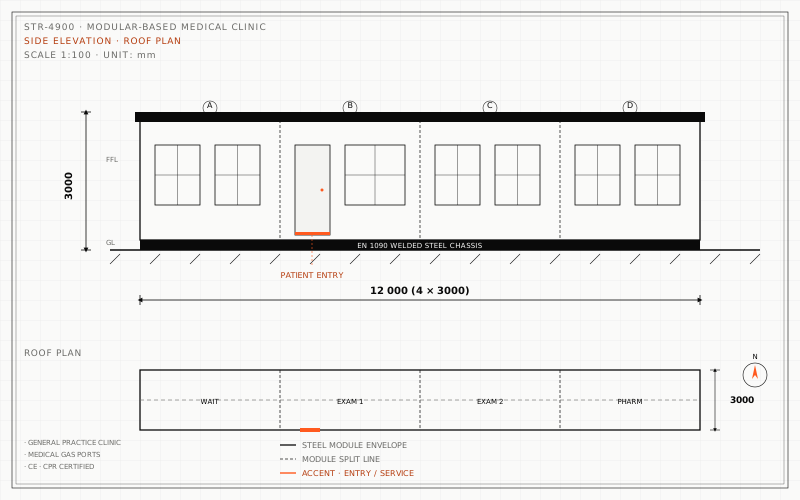
Engineered once, deployable many times.
A modular medical clinic is a permanent-installation healthcare building assembled from volumetric prefabricated modules — complete rooms with finishes, MEP services and clinical fittings already installed in the factory. structmod modular medical clinics deliver primary-care, specialist outpatient or community-clinic capability with the design life and clinical performance of a conventional building, but with the construction schedule of a manufactured product. Site foundation works and module production run in parallel; modules arrive plumbed, wired and finished; on-site assembly takes days; commissioning takes weeks; the clinic opens in a fraction of conventional construction time.
Standard configurations include 2-6 examination rooms, consultation offices, a treatment bay for procedures, a clinical room for nursing and dressings, a phlebotomy or sample collection point, a small clinical laboratory, a pharmacy dispensary, reception and waiting area, staff rooms and washrooms, and patient washrooms. The modular grid allows specialty extensions — adding a dental wing, a women's health wing, a paediatric wing, or a minor surgery suite — by adding additional modules to the same architectural language. Infection control, MEP zoning, finishes and accessibility all match the brief of a national health ministry community clinic standard.
structmod modular medical clinics serve health ministries building rapid-deployment community health infrastructure, NGOs establishing semi-permanent primary care presence in underserved areas, mining and oil & gas operators establishing site clinics for workforce healthcare, and private healthcare chains opening new outpatient centres. Lead time is 8-14 weeks from contract signature for stock configurations, 12-18 weeks for customised clinical programmes. EN 1090 EXC-2 structural steel, IEC 60364-7-710 medical electrical, and destination-country building code compliance ensure regulatory readiness for permanent installation.
Typical deployment sequence
- Day 1 — site foundation verified, screw jacks or strip footings in place
- Day 2–3 — modules lifted into position by mobile crane
- Day 3–4 — inter-module connections and envelope sealing
- Day 4–5 — MEP connections, wet testing
- Day 5–6 — interior finish, fixtures and equipment install
- Day 7 — commissioning, FAT report, user training and handover
Spec sheet — STR-2747
| Overall length | 14.7 m · 48.2 ft |
|---|---|
| Width (transport) | 2.99 m |
| Width (deployed) | 2.99 m |
| Height (transport) | 3.20 m |
| Floor area (deployed) | 44.0 m² |
| Dry weight | 11.7 t |
| Chassis | EN 10025 S355JR hot-rolled steel · EN 1090 EXC-2 |
| Welding quality | EN ISO 3834-3 |
| Envelope | Sandwich panel, PIR core 80 mm · λ ≈ 0.023 W/(m·K) |
| Fire resistance | EI-30 · tested to EN 13501-2 |
| Floor | Marine plywood on EPDM · R-10 slip rating |
| Electrical | 120/240 V · 60 Hz (US-spec) · IEC 60364 compliant |
| HVAC | Packaged rooftop · MERV-13 |
| Operating range | −25 °C to +50 °C ambient |
| Wind rating | Designed for 150 km/h basic wind (EN 1991-1-4) |
| Seismic design | Per EN 1998-1 (Eurocode 8) · ductility class DCM |
| Transport | ISO 668 footprint · CSC plate eligible (container variants) |
| Setup time | 4 hours · 2-person crew |
Full drawings, calculation notes, DoP, O&M manual and FAT report included with every unit. Specs indicative — configurable to project requirements.