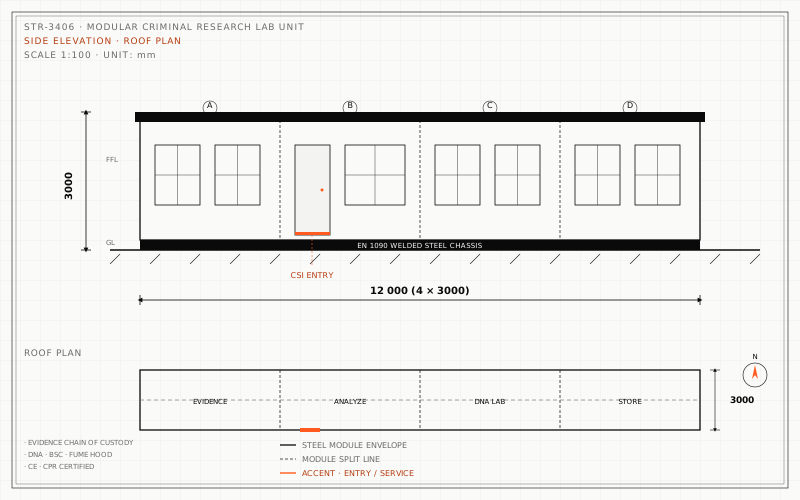
Engineered once, deployable many times.
A modular forensic laboratory is a permanent or semi-permanent crime laboratory built from prefabricated modules with the dedicated workspaces, infrastructure and infection control required for modern forensic science — DNA analysis, toxicology, ballistics, document examination, and evidence chain-of-custody management. structmod modular forensic laboratories serve national police forensic services, regional crime laboratories, military forensic units (mass-graves and conflict-zone investigation), and counter-terrorism evidence-processing facilities. The modular construction approach delivers a fully-fitted forensic capability in 12-16 weeks turnkey — critical when forensic backlogs compromise criminal justice system performance.
Standard configurations organise the laboratory around the forensic disciplines and chain-of-custody requirements: evidence reception with secure storage and accountability, DNA laboratory with PCR amplification and capillary electrophoresis (separated pre-PCR and post-PCR zones to prevent contamination), toxicology with GC-MS/LC-MS instrumentation, ballistics examination with comparison microscopy and recovery tank, documents examination with VSC (video spectral comparator) and ESDA, latent prints development with cyanoacrylate fuming chamber and powder workstations, and supporting spaces (administration, expert witness preparation, evidence release). Cleanroom-grade construction in DNA laboratories controls particle and biological contamination per ISO 14644 class 7 or 8 as required.
structmod modular forensic laboratories support national criminal justice modernisation programmes, post-conflict justice and accountability operations (war crimes investigation, mass grave exhumation), counter-narcotics enforcement (drug analysis throughput), and sexual violence prosecution (rape kit processing). Lead time is 12-16 weeks from contract signature for stock configurations, 16-24 weeks for configurations including specialty disciplines (digital forensics, forensic anthropology, forensic odontology). Compliance reference includes ISO 17025 (laboratory competence), ENFSI guidelines (European Network of Forensic Science Institutes), and destination-country forensic accreditation framework.
Typical deployment sequence
- Day 1 — site foundation verified, screw jacks or strip footings in place
- Day 2–3 — modules lifted into position by mobile crane
- Day 3–4 — inter-module connections and envelope sealing
- Day 4–5 — MEP connections, wet testing
- Day 5–6 — interior finish, fixtures and equipment install
- Day 7 — commissioning, FAT report, user training and handover
Spec sheet — STR-3379
| Overall length | 13.9 m · 45.6 ft |
|---|---|
| Width (transport) | 2.99 m |
| Width (deployed) | 2.99 m |
| Height (transport) | 2.80 m |
| Floor area (deployed) | 41.6 m² |
| Dry weight | 13.9 t |
| Chassis | EN 10025 S355JR hot-rolled steel · EN 1090 EXC-2 |
| Welding quality | EN ISO 3834-3 |
| Envelope | Sandwich panel, PIR core 80 mm · λ ≈ 0.023 W/(m·K) |
| Fire resistance | EI-30 · tested to EN 13501-2 |
| Floor | Marine plywood on EPDM · R-10 slip rating |
| Electrical | 400 V / 50 Hz · 3-phase · IEC 60364 compliant |
| HVAC | VRF multi-split · HEPA H13 (medical) |
| Operating range | −25 °C to +50 °C ambient |
| Wind rating | Designed for 140 km/h basic wind (EN 1991-1-4) |
| Seismic design | Per EN 1998-1 (Eurocode 8) · ductility class DCM |
| Transport | ISO 668 footprint · CSC plate eligible (container variants) |
| Setup time | 2–7 days on site |
Full drawings, calculation notes, DoP, O&M manual and FAT report included with every unit. Specs indicative — configurable to project requirements.