Engineered once, deployable many times.
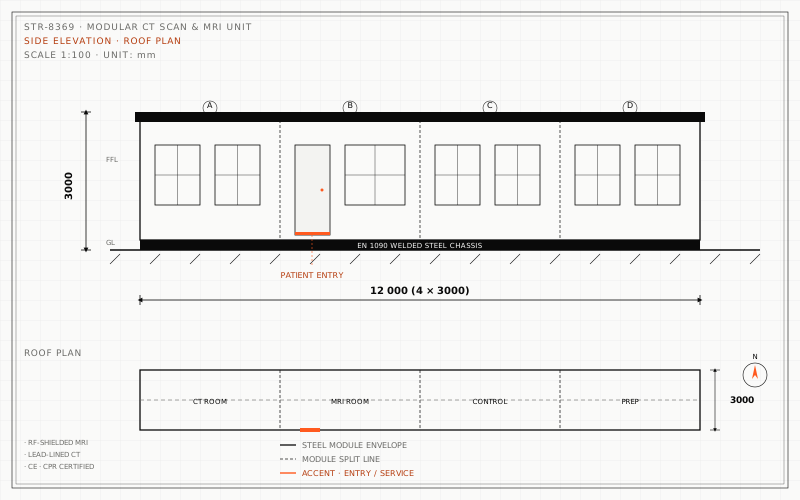
A modular CT scan and MRI unit is a permanent imaging wing assembled from prefabricated modules with the structural shielding, RF integrity and clinical workflow of a fixed-build imaging department. structmod modular CT scan and MRI units extend existing hospitals' imaging capacity, replace ageing imaging departments during refurbishment, or establish new imaging facilities at hospitals or stand-alone diagnostic centres. The modular construction shortens the timeline from 12-18 months for conventional imaging department build to 4-8 months turnkey — critical when the hospital's imaging service cannot be offline for an extended period.
The CT room module integrates lead-shielded walls, ceiling and floor per NCRP Report 147, vibration-isolated scanner foundation, dedicated chiller water supply, lead-protected control console viewing, and patient preparation workflow. The MRI suite module includes the full RF cage (copper or galvanised steel shielding bonded to dedicated earth, RF-sealed doors and viewing windows, waveguide penetrations for services), magnetic shielding, 5-gauss line management, and quench pipe to exterior. Reading rooms with PACS workstations, technician offices, patient changing cubicles and recovery space complete the wing. Each module is engineered to the specific OEM scanner specifications.
structmod modular CT scan and MRI units deliver to hospitals expanding imaging capacity, replacing legacy scanners, building dedicated imaging centres, or extending into new specialist imaging (cardiac CT, oncology PET-CT integration, advanced MRI). Lead time is 12-18 weeks from contract signature; OEM scanner integration adds 2-6 weeks depending on scanner complexity. Compliance includes NCRP Report 147 shielding survey post-installation, IEC 60601-1 medical electrical safety, IEC 60364-7-710 isolated-power Group 1 installation, and OEM scanner factory acceptance and clinical commissioning.
Typical deployment sequence
- Day 1 — site foundation verified, screw jacks or strip footings in place
- Day 2–3 — modules lifted into position by mobile crane
- Day 3–4 — inter-module connections and envelope sealing
- Day 4–5 — MEP connections, wet testing
- Day 5–6 — interior finish, fixtures and equipment install
- Day 7 — commissioning, FAT report, user training and handover
Spec sheet — STR-2700
| Overall length | 14.0 m · 45.9 ft |
|---|---|
| Width (transport) | 2.99 m |
| Width (deployed) | 2.99 m |
| Height (transport) | 2.70 m |
| Floor area (deployed) | 41.9 m² |
| Dry weight | 9.0 t |
| Chassis | EN 10025 S355JR hot-rolled steel · EN 1090 EXC-2 |
| Welding quality | EN ISO 3834-3 |
| Envelope | Sandwich panel, PIR core 80 mm · λ ≈ 0.023 W/(m·K) |
| Fire resistance | EI-30 · tested to EN 13501-2 |
| Floor | Marine plywood on EPDM · R-10 slip rating |
| Electrical | 230 V / 50 Hz · TN-S · IEC 60364 compliant |
| HVAC | Split inverter heat pump · MERV-8 |
| Operating range | −25 °C to +50 °C ambient |
| Wind rating | Designed for 130 km/h basic wind (EN 1991-1-4) |
| Seismic design | Per EN 1998-1 (Eurocode 8) · ductility class DCM |
| Transport | ISO 668 footprint · CSC plate eligible (container variants) |
| Setup time | 2 hours · 2-person crew |
Full drawings, calculation notes, DoP, O&M manual and FAT report included with every unit. Specs indicative — configurable to project requirements.