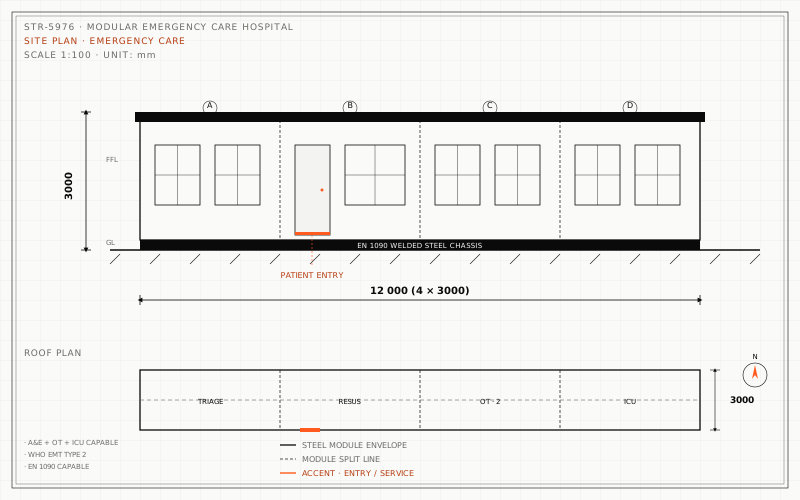
Engineered once, deployable many times.
A modular emergency care hospital is a permanent emergency department wing built from prefabricated modules organised around the standard ED workflow — triage at entry, resuscitation bays for life-threatening presentations, treatment bays for urgent and standard cases, and a short-stay observation area for patients awaiting admission, discharge or transfer. structmod modular emergency care hospitals serve hospitals expanding ED capacity to meet rising patient volumes, replacing aging ED infrastructure during refurbishment, or building new emergency capability at hospitals or stand-alone urgent care centres. The 12-18 week turnkey delivery compresses the conventional 12-24 month ED construction timeline.
Standard configurations include the ambulance entrance with trolley reception, triage cubicles for initial clinical screening, 2-3 resuscitation bays equipped for cardiac arrest, major trauma and airway emergencies (full monitoring, defibrillation, airway management, ventilation, surgical airway capability), 8-16 treatment bays for urgent and standard presentations (examination couches with monitoring, IV access, medication trolleys), a short-stay observation ward (4-12 beds) for patients awaiting decision, supporting clinical spaces (clean and dirty utility, drug room, plaster room, paediatric assessment, mental health assessment cubicle) and ED-specific clinical workflow (POCUS access, x-ray imaging integration, lab sample transport, emergency medication automation).
structmod modular emergency care hospitals deliver to hospitals across Europe, the Gulf and Africa where ED capacity expansion is a priority, to national health programmes building urgent care capability, and to humanitarian agencies establishing emergency referral capacity in extended deployments. Lead time is 14-18 weeks from contract signature for stock configurations, 18-24 weeks for customised configurations including specialty ED capabilities (paediatric ED, mental health crisis service, infectious disease isolation). Clinical commissioning validates emergency workflow, monitoring, life-safety systems and infection control before clinical opening.
Typical deployment sequence
- Day 1 — site foundation verified, screw jacks or strip footings in place
- Day 2–3 — modules lifted into position by mobile crane
- Day 3–4 — inter-module connections and envelope sealing
- Day 4–5 — MEP connections, wet testing
- Day 5–6 — interior finish, fixtures and equipment install
- Day 7 — commissioning, FAT report, user training and handover
Spec sheet — STR-3129
| Overall length | 12.9 m · 42.3 ft |
|---|---|
| Width (transport) | 2.99 m |
| Width (deployed) | 2.99 m |
| Height (transport) | 3.00 m |
| Floor area (deployed) | 38.6 m² |
| Dry weight | 15.9 t |
| Chassis | EN 10025 S355JR hot-rolled steel · EN 1090 EXC-2 |
| Welding quality | EN ISO 3834-3 |
| Envelope | Sandwich panel, PIR core 80 mm · λ ≈ 0.023 W/(m·K) |
| Fire resistance | EI-30 · tested to EN 13501-2 |
| Floor | Marine plywood on EPDM · R-10 slip rating |
| Electrical | 230 V / 50 Hz · TN-S · IEC 60364 compliant |
| HVAC | Split inverter heat pump · MERV-8 |
| Operating range | −25 °C to +50 °C ambient |
| Wind rating | Designed for 130 km/h basic wind (EN 1991-1-4) |
| Seismic design | Per EN 1998-1 (Eurocode 8) · ductility class DCM |
| Transport | ISO 668 footprint · CSC plate eligible (container variants) |
| Setup time | 2–7 days on site |
Full drawings, calculation notes, DoP, O&M manual and FAT report included with every unit. Specs indicative — configurable to project requirements.